


Ravi Kumar/X
Nov 24, 2025, 14:16
Ravi Kumar: Vitamin K Antagonists Remains the Gold Standard in APS
Ravi Kumar, Rheumatologist at Christian Medical College, shared on X:
“Major Trials of DOACs in Antiphospholipid Syndrome (APS)
- TRAPS Trial
(Rivaroxaban in High-Risk APS)
Population
- Triple-positive APS (LA + aCL + anti-β2GP1)
- High-risk group
- Prior arterial + venous thrombosis
Design
- Rivaroxaban 20 mg OD vs Warfarin INR 2–3
- RCT
- Open-label
Results
- 12% arterial events (mostly stroke) in rivaroxaban arm
- 0% events in warfarin arm
- Trial stopped early due to harm
Conclusion
Rivaroxaban FAILED in triple-positive APS – Not effective for arterial protection.
2. RAPS Trial
(Rivaroxaban in Venous-Only APS)
Population
- APS with previous venous thrombosis only
- Not restricted for triple-positivity
Design
- Rivaroxaban vs Warfarin
- RCT
- Primary endpoint = lab surrogate (Endogenous Thrombin Potential)
- Not powered for clinical events
Results
- Similar lab thrombin profiles between groups
- No clear increase in events – but too small & too short
- Could NOT establish non-inferiority for clinical thrombosis
Conclusion
A neutral trial -Does NOT prove DOAC safety in APS.
Not enough evidence to switch stable APS patients to rivaroxaban.
3. ASTRO-APS Trial
(Apixaban in APS)
Population
- APS with prior thrombosis
- Mixed-risk (venous + arterial)
- Included some triple-positive patients
Design
- Apixaban 5 mg BD vs Warfarin INR 2–3
- RCT
- Open-label
- Stopped early
Results
- Higher stroke rate in apixaban arm
- Multiple arterial events → Safety signal
- Warfarin group = fewer thrombosis
Conclusion
- Apixaban failed in APS.
- Clear evidence against DOAC use in arterial or high-risk APS.
Summary
- TRAPS → Rivaroxaban failed in triple-positive, arterial APS
- RAPS → Neutral lab-only trial, no clinical reassurance
- ASTRO → Apixaban caused more strokes, early termination
Final Message:
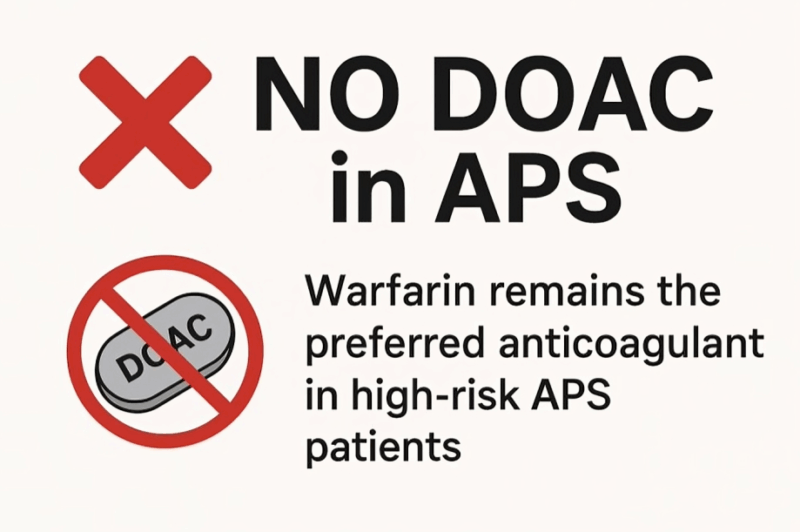
Vitamin K antagonists remains the gold standard in APS.
DOACs NOT recommended, especially in:
- Triple-positive APS
- Arterial thrombosis
- Recurrent events.”
Stay informed with Hemostasis Today.
-
Oct 19, 2026, 17:44Paul Riley: Moderating a Webinar on Anticoagulation Monitoring
-
Oct 19, 2026, 16:36Christopher Pittman: Blood Clot Prevention Cannot End at Hospital Discharge
-
Oct 19, 2026, 16:13Javier M. Floren: When Immune Cells Move With Their Environment
-
Oct 19, 2026, 16:04Hussnain Javaid: New EHA Guidelines for HbSC Disease Management
-
Oct 19, 2026, 15:50Deep Madkaiker: A New Academic Opportunity in Transfusion Medicine at ACTREC
-
Oct 19, 2026, 15:19Why Hematologists Should Care About Diminished Ovarian Reserve in SCD – ASH Education
-
Oct 19, 2026, 14:16Hyperfibrinolysis as an Underrecognized Cause of Bleeding
-
Oct 19, 2026, 13:36Shobhna Ladva: Aspen Pharma EME Raises Awareness of Blood Clot Risks During Hormonal Transitions
-
Oct 19, 2026, 13:11Giulia Furnari: Connecting With Global Hematology Experts at IACH 2026