


William Wallace: Vitamin C and Collagen Work as One Biological System
William Wallace, Co-Founder and Chief Scientific Officer at Supplement Success Solutions, shared a post on LinkedIn:
“Vitamin C and collagen are really part of the same machine.
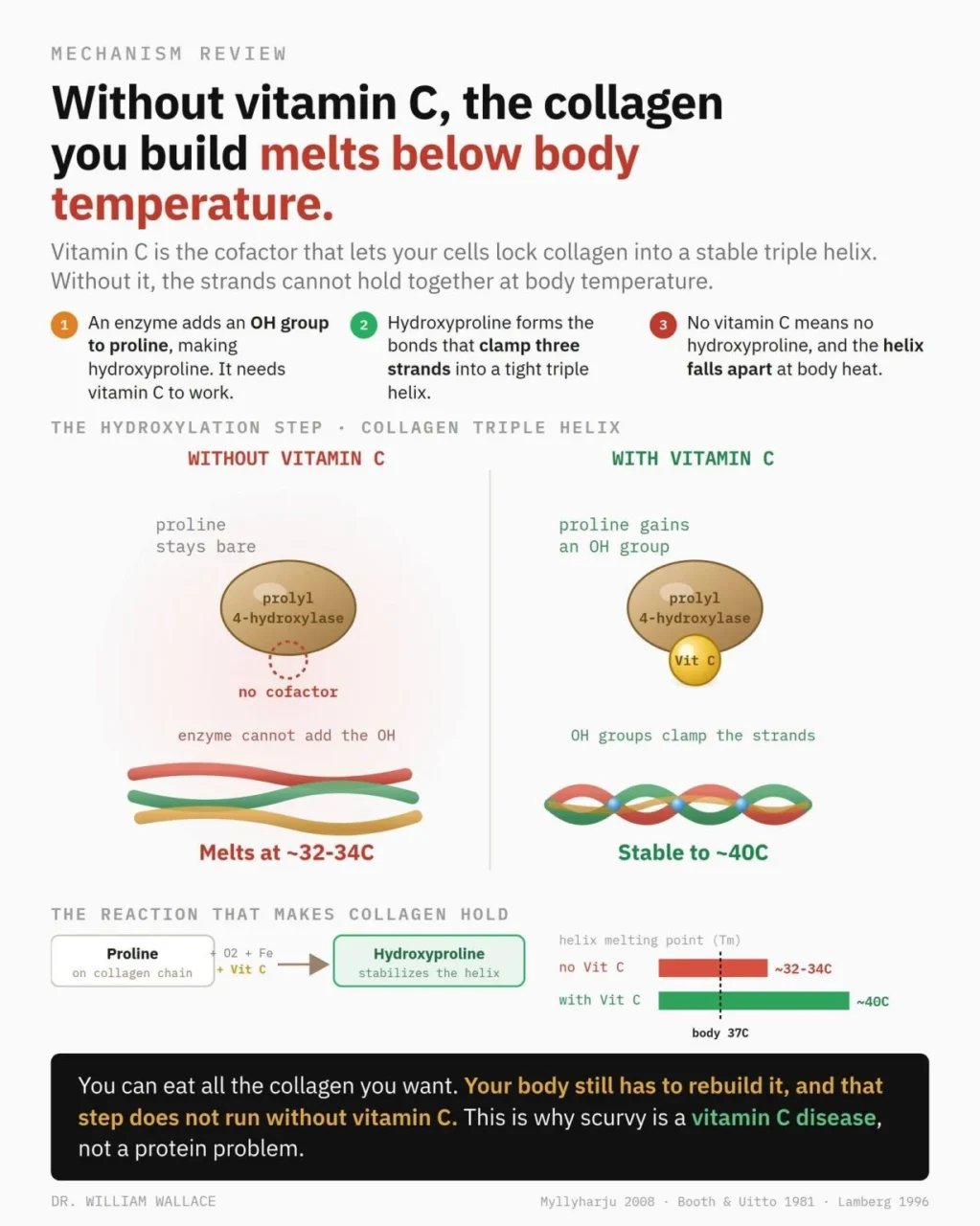
Collagen is built from three protein strands that wind into a tight triple helix. That helix is what gives collagen its strength. But the strands do not hold together on their own. They need a chemical modification first, and that modification is where vitamin C comes in.
An enzyme called proly 4-hydroxylase grabs proline residues on the collagen strands and adds an OH group, turning them into hydroxyproline.
Those hydroxyproline residues are what lock the three strands into a stable helix. The enzyme cannot run without its cofactors, and vitamin C is one of them. No vitamin C, no hydroxyproline.
Collagen that has not been properly hydroxylated does not hold its shape at body temperature. In a recombinant human collagen system, under-hydroxylated triple helices melted at around 32 to 34 degrees C. With vitamin C present and the enzyme working, the melting point rose to about 40 degrees C. Your body runs at 37.
So without enough vitamin C, the collagen you build comes apart at the temperature you live at.
This is the actual mechanism behind scurvy. It is not a protein deficiency. Sailors with scurvy were eating plenty of protein. They were not making stable collagen because they had no vitamin C, so wounds reopened, gums broke down, and old scars failed. The fix was not more meat. It was a lime.
So if you are taking collagen for skin, joints, or connective tissue, the vitamin C is not an optional add-on. It is the cofactor that makes the collagen step run at all. Eating collagen gives your body raw material. Vitamin C is what lets your body build with it.
The exact melting point numbers come from a lab expression system, not a measurement inside a living person. Under-hydroxylated collagen is unstable at body temperature, and that is textbook biochemistry.
- Myllyharju, Ann Med, 2008
- Booth and Uitto, Biochim Biophys Acta, 1981
- Lamberg et al., J Biol Chem, 1996.”
Stay updated with Hemostasis Today.
-
Jun 24, 2026, 16:32Arlindo Nascimento de Lemos Junior: Thrombus Echogenicity as a Predictor of Post-Thrombotic Syndrome Severity After DVT
-
Jun 24, 2026, 16:09Jimi Olaghere: The Future of Sickle Cell Disease Research Starts With Collaboration
-
Jun 24, 2026, 16:03Von Willebrand Disease as a Common Yet Under-Recognised Bleeding Disorder – EHC
-
Jun 24, 2026, 15:57Maia Meier: Women with Bleeding Disorders Reach the Summit of Mont Blanc
-
Jun 24, 2026, 15:40Annette Bowyer: The Emerging Role of Extravascular Factor VII in Haemostasis
-
Jun 24, 2026, 13:50Tijjani Balas: Why Early Detection of DVT Matters
-
Jun 24, 2026, 13:43Brandon Michael Henry: Interpreting Complement Activation After AAV Gene Therapy
-
Jun 24, 2026, 13:37Heba Youssef: Heparin-Induced Thrombocytopenia – The Prothrombotic Emergency You Cannot Miss
-
Jun 24, 2026, 13:32Jecko Thachil: Understanding the Clinical Spectrum of Vitamin B12