


Abdulla A. Damluji: Sex As An Effect Measure Modifier Between Frailty and Outcomes in AMI Patients
Abdulla A. Damluji, Director of the Cardiovascular Center on Aging at Cleveland Clinic, shared on LinkedIn about a recent article by Hasan Mohiaddin et al, published in Lancet Regional Health Europe:
”Great work led by Dr Muhammad Rashid on sex as an effect measure modifier between frailty and outcomes in AMI patients.
Frailty is common among older adults presenting with acute myocardial infarction and is consistently associated with adverse outcomes.
Women presenting with acute myocardial infarction carry a higher burden of frailty than men.
However, an important clinical question has remained unresolved.
Does the higher prevalence of frailty in women explain observed sex differences in outcomes, or does frailty carry a different prognostic meaning in men and women?
A large national population based study from England and Wales provides important clarity.
Investigators evaluated 931,133 adults admitted with acute myocardial infarction between 2005 and 2019.
Clinical registry data were associated with hospital admission records and national mortality data.
Frailty was assessed using a validated cumulative deficit index derived from secondary care administrative records and categorized as fit, mild frailty, moderate frailty, or severe frailty.
The primary outcome was all cause mortality at one year.
Prevalence and Baseline Profile
Women represented 34.1 percent of the cohort.
Severe frailty was more common in women than men, 16.7 percent versus 10.4 percent.
In contrast, men were more frequently categorized as fit, 33.7 percent versus 21.3 percent.
Within each frailty stratum, women were older than men. Among those with severe frailty, median age was 82 years in women and 78 years in men.
However, among patients with severe frailty, men carried a higher burden of cardiometabolic disease.
Diabetes was present in 57.0 percent of men versus 48.2 percent of women.
A Charlson comorbidity index greater than 3 was observed in 61.9 percent of men versus 47.9 percent of women.
Men with severe frailty also presented more often with cardiac arrest, 9.9 percent versus 7.2 percent, while women more frequently had preserved left ventricular systolic function.
These data suggest that frailty in men may cluster with a more advanced cardiovascular phenotype.
In Hospital Care
Treatment intensity declined as frailty increased in both sexes.
However, within each frailty category, men consistently received more invasive and pharmacologic therapies.
Among patients with severe frailty, men underwent invasive coronary angiography in 49.6 percent compared with 38.5 percent of women.
Percutaneous coronary intervention was performed in 36.9 percent of men versus 29.7 percent of women.
Composite quality of care scores were also higher in men with severe frailty than in women.
Thus, differences in outcomes cannot be attributed to less intensive treatment in men.
One Year Outcomes
Frailty was strongly associated with mortality in both sexes in a graded fashion.
In men, the adjusted hazard ratio for one year mortality increased from 1.72, 95 percent confidence interval 1.65 to 1.78, for mild frailty to 3.19, 95 percent confidence interval 3.04 to 3.34, for severe frailty, using fit patients as the reference.
In women, the adjusted hazard ratio increased from 1.50, 95 percent confidence interval 1.43 to 1.57, to 2.66, 95 percent confidence interval 2.51 to 2.82, across the same frailty spectrum.
Formal interaction testing showed that the association between severe frailty and one year mortality was 26 percent greater in men than in women, relative hazard ratio 1.26, 95 percent confidence interval 1.19 to 1.32, P interaction less than 0.001.
Absolute risk estimates further clarified this pattern.
Among fit patients, predicted one year mortality was slightly higher in women than men. With severe frailty, this relationship reversed.
Severely frail men had a 1.19 percent higher adjusted absolute risk of death at one year than severely frail women.
The stronger association in men extended to major adverse cardiovascular events and heart failure readmission.
Thirty Day Outcomes
Short term findings were directionally consistent. For thirty day all cause mortality, severe frailty was associated with an adjusted odds ratio of 2.09, 95 percent confidence interval 1.91 to 2.28, in men and 1.77, 95 percent confidence interval 1.56 to 2.01, in women.
The relative odds of death associated with severe frailty were 23 percent higher in men than in women, relative odds ratio 1.23, 95 percent confidence interval 1.15 to 1.31, P interaction less than 0.001.
Across Myocardial Infarction Subtypes
The sex specific association persisted across both ST segment elevation and non ST segment elevation presentations. For severe frailty, the relative hazard ratio for one year mortality was approximately 1.32 in both subgroups, confirming consistency of the effect.
Interpretation
This study identifies a clear sex frailty paradox in acute myocardial infarction. Severe frailty is more prevalent in women. Yet frailty carries a larger relative increase in short term and one year mortality in men, despite more intensive in hospital care.
Frailty in men may signal advanced cardiovascular disease and diminished physiologic reserve in the setting of acute ischemic injury.
In women, frailty may reflect broader multisystem vulnerability that is not solely driven by coronary disease severity.
These findings challenge a uniform approach to risk stratification.
Chronologic age alone is insufficient. Frailty assessment should be incorporated into routine evaluation, and interpretation of frailty may need to account for sex.
Key Points Helpful for Clinical Practice
- Severe frailty is more common in women presenting with acute myocardial infarction, but its prognostic impact is greater in men.
- In men, severe frailty is associated with more than a threefold increase in adjusted risk of one year mortality compared with fit men.
- The relative increase in mortality associated with severe frailty is 26 percent higher in men than in women.
- Men with severe frailty receive more intensive invasive and pharmacologic therapy than women, yet outcomes remain worse, suggesting underlying biological vulnerability.
- Routine frailty assessment should complement traditional risk models in acute myocardial infarction.
- Frailty in men may identify a particularly high risk cardiovascular phenotype that warrants close follow up and aggressive secondary prevention.
- Frailty in women highlights the need to close persistent treatment gaps while also addressing multisystem vulnerability and functional decline.
Integrating both sex and frailty into clinical decision making may improve precision in risk assessment and guide more individualized care pathways after acute myocardial infarction.”
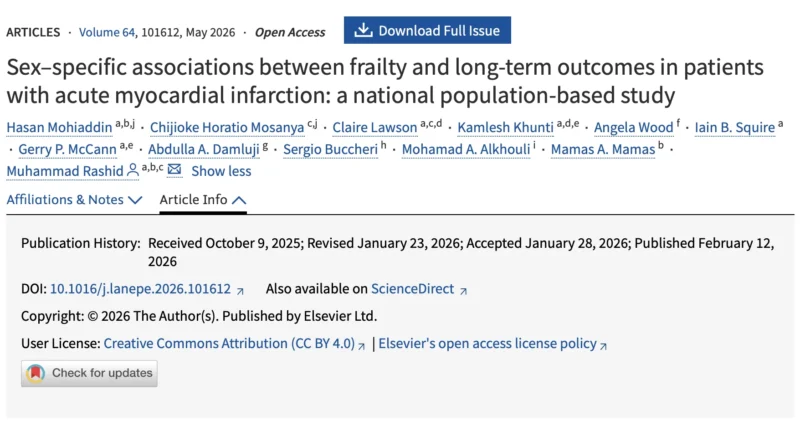
Title: Sex–specific associations between frailty and long-term outcomes in patients with acute myocardial infarction: a national population-based study
Authors: Hasan Mohiaddin, Chijioke Horatio Mosanya, Claire Lawson, Kamlesh Khunti, Angela Wood, Iain B. Squire, Gerry P. McCann, Abdulla A. Damluji, Sergio Buccheri, Mohamad A. Alkhouli, Mamas A. Mamas, Muhammad Rashid
Read the Full Article on Lancet Regional Health: Europe
Stay updated on all scientific advances with Hemostasis Today.
-
Oct 13, 2026, 02:01Nour Al-Mozain: Is It Really Anti-D? – Unraveling Auto-Anti-LW in the Transfusion Laboratory
-
Oct 13, 2026, 01:51Berenice Villegas: The Role of Morphologic Evaluation in Body Fluid Differential Analysis
-
Oct 13, 2026, 01:44Debadrita Ray: Evaluating vWF and VITRO Score for Detecting CSPH in cACLD Patients
-
Oct 13, 2026, 01:34Nagesh Ramesh: Donating Blood for International Plasma Awareness Week
-
Oct 12, 2026, 21:51Sam Botchey: Orthobiologics Are Advancing but the Evidence Must Keep Pace
-
Oct 12, 2026, 21:50Serum Vitamin D, Platelet Function, and Bleeding in Primary ITP – Platelets Journal
-
Oct 12, 2026, 21:30Nika Samadzadeh Tabrizi: Looking Forward to the PACeS Trial on Anticoagulation for POAF
-
Oct 12, 2026, 21:28Michael Megaly: Does Coronary Ectasia Affect Outcomes in Acute Coronary Syndromes?
-
Oct 12, 2026, 21:25Vitor Borin P. de Souza: Think Twice Before Anticoagulating an Isolated Subsegmental PE