


Ney Carter Borges: The APERITIF Trial Clarifies Rivaroxaban’s Role in LVT
Ney Carter Borges, Member Cardiologist of Global Physician Association at Cleveland Clinic Florida, shared on LinkedIn about a recent article by Etienne Puymirat et al in JAMA Cardiology:
”The APERITIF randomized clinical trial evaluated whether adding low-dose rivaroxaban (2.5 mg twice daily for 4 weeks) to dual antiplatelet therapy (DAPT) reduces left ventricular (LV) thrombus formation after anterior ST-segment elevation myocardial infarction (STEMI).
LV thrombus remains a clinically significant complication due to its association with systemic embolism, stroke, and mortality, particularly in large anterior infarctions.
Contemporary data suggest LV thrombus incidence may reach 15–25% in anterior MI when assessed with cardiac magnetic resonance (CMR), the gold-standard imaging modality .
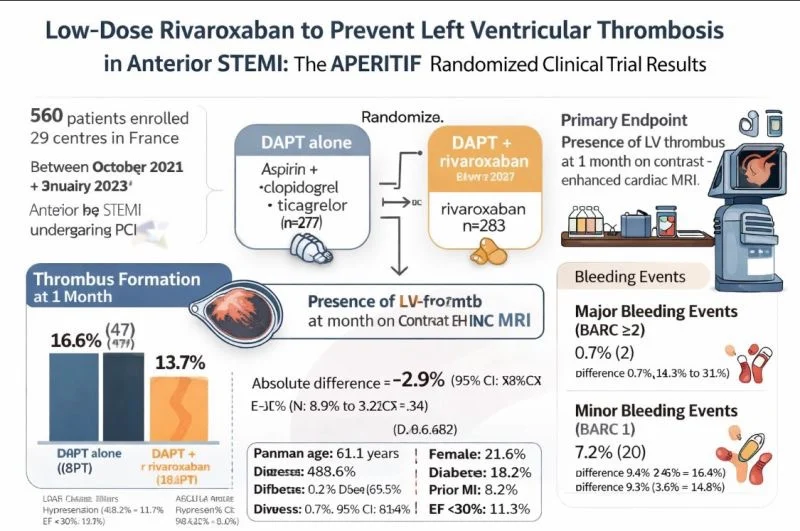
In this multicenter PROBE-design trial conducted across 29 French centers, 560 patients (mean age 61.1 ± 11.6 years; 21.6% women) were randomized to DAPT plus rivaroxaban (n=277) or DAPT alone (n=283).
The primary endpoint was LV thrombus detected by contrast-enhanced CMR at 1 month. LV thrombus occurred in 13.7% of patients receiving rivaroxaban versus 16.6% with DAPT alone (absolute difference −2.9%; 95% CI −8.9% to 3.2%; P=0.34), indicating no statistically significant reduction .
Major adverse cardiovascular events were low and comparable (0.7% vs 1.1%).
Major bleeding (BARC ≥2) was infrequent and similar between groups (1.5% vs 0.7%), but minor bleeding (BARC 1) was significantly higher with rivaroxaban (16.4% vs 7.2%; difference 9.3%; 95% CI 3.6%–14.8%) .
In conclusion, low-dose rivaroxaban added to DAPT did not significantly reduce LV thrombus formation at 1 month but increased minor bleeding.
Given lower-than-expected event rates, the study may have been underpowered; thus, modest benefit cannot be excluded.”
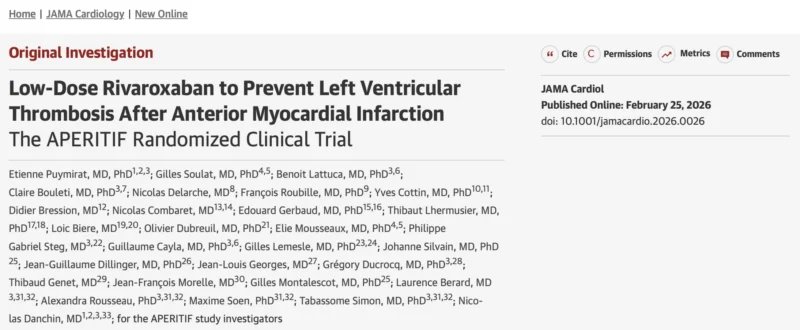
Title: Low-Dose Rivaroxaban to Prevent Left Ventricular Thrombosis After Anterior Myocardial Infarction: The APERITIF Randomized Clinical Trial
Authors: Etienne Puymirat, Gilles Soulat, Benoit Lattuca, Claire Bouleti, Nicolas Delarche, François Roubille, Yves Cottin, Didier Bression, Nicolas Combaret, Edouard Gerbaud, Thibaut Lhermusier, Loic Biere, Olivier Dubreuil, Elie Mousseaux, Philippe Gabriel Steg, Guillaume Cayla, Gilles Lemesle, Johanne Silvain, Jean-Guillaume Dillinger, Jean-Louis Georges, Grégory Ducrocq, Thibaud Genet, Jean-François Morelle, Gilles Montalescot, Laurence Berard, Alexandra Rousseau, Maxime Soen, Tabassome Simon, Nicolas Danchin for the APERITIF study investigators
Read the Full Article on JAMA Cardiology
Stay updated on all scientific advances with Hemostasis Today.
-
Oct 9, 2026, 16:23David Boone: Distinguishing Stroke Prevention from Rhythm Control in Atrial Fibrillation
-
Oct 9, 2026, 15:27Mohamed Hegazi: Geostatistical Modelling Maps Global β-Thalassaemia Carrier Prevalence
-
Oct 9, 2026, 15:15Maha Othman: Uncovering the Consensus on TXA in TBI – Call for Collaboration on a Landmark Umbrella Review
-
Oct 9, 2026, 15:07Daniel D. Han: How Inhalation Product Exposure Impairs Cardiac and Platelet Recovery After MI
-
Oct 9, 2026, 14:58William Toole: How Ultrasound-Guided PRP Therapy Relieves Joint and Tendon Pain
-
Oct 9, 2026, 14:50Shayan Mohammadmoradi: In Corpus Christi for the 20th Midwest Platelet Conference
-
Oct 9, 2026, 14:37Tariq Tramboo: High Platelet Concentrate for Osteoarthritis Knee – Recent Meta-Analyses
-
Oct 9, 2026, 14:26Yousma Khan: Hematology Series – Beyond RBCs, WBCs and Platelets
-
Oct 9, 2026, 14:13Jesus Ardila Novoa: Why the WHO’s Historic Essential Medicines List Decision Is Just the Beginning