


Afshin Moradi on TSH Level and Stroke Severity
Afshin Moradi, Student and Researcher at Tabriz University of Medical Sciences, shared on LinkedIn:
”I’m pleased to share our recently published study exploring the relationship between thyroid-stimulating hormone (TSH) levels and stroke severity.
Key highlights:
• Stroke severity showed a significant inverse correlation with TSH levels during hospital admission and at discharge.
• Higher TSH levels were associated with less severe stroke symptoms in the acute phase.
• No significant association was found between TSH levels and stroke severity before admission or three months after discharge.
• TSH levels were not related to age, gender, stroke subtype, or CT findings.
These findings suggest a potential role of thyroid function in stroke severity, highlighting the need for further large-scale studies.”
Read the full article here.
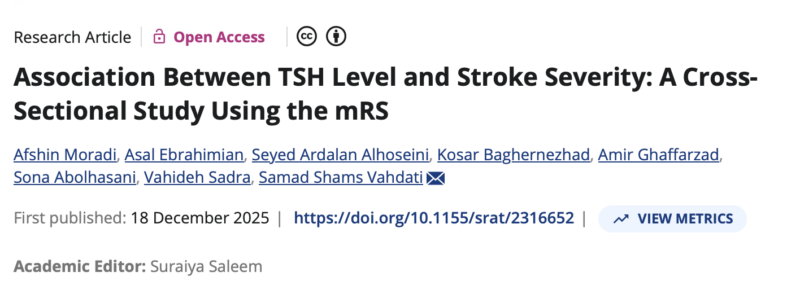
Article: Association Between TSH Level and Stroke Severity: A Cross-Sectional Study Using the mRS
Authors: Afshin Moradi, Asal Ebrahimian, Seyed Ardalan Alhoseini, Kosar Baghernezhad, Amir Ghaffarzad, Sona Abolhasani, Vahideh Sadra, Samad Shams Vahdati
Stay updated on all scientific advances with Hemostasis Today.
-
Oct 10, 2026, 09:48Ahmed Alotaibi: Can We “Remove” the ABO Problem from Group O Platelets?
-
Oct 10, 2026, 09:31Help Shape the New ASH Iron Deficiency Guidelines – American Society of Hematology
-
Oct 10, 2026, 09:05Wolfgang Miesbach: Moving from Bleed Control to Comprehensive Joint Health
-
Oct 10, 2026, 07:59Leila Caroline Souza Reis: Enoxaparin Dosing for VTE Prevention in Adults With Obesity
-
Oct 10, 2026, 07:41Adeeb Bazuhair: New Evidence for Catheter Directed Thrombolysis in Acute PE
-
Oct 10, 2026, 07:22Poppy Clarke: Turning Steps Into Support for Thrombosis Awareness
-
Oct 10, 2026, 07:12Hamzah Khan: The Role of Genuine Curiosity in Driving High-Impact Academic Research
-
Oct 10, 2026, 06:58Nita Radhakrishnan: Turning Evidence Into Action for Hemophilia Care in India
-
Oct 10, 2026, 06:48Nutan Kaushik: HemeNext 2.0 Brings Global Perspectives to Hematology