


IV Thrombolysis Does Not Improve Vision in Acute CRAO: Ahmed Koriesh on TenCRAOS Study
Ahmed Koriesh, Director Hospital Neurology Service at Cleveland Clinic Florida, shared on LinkedIn:
”TenCRAOS — IV Thrombolysis Does Not Improve Vision in Acute CRAO
IV thrombolysis for central retinal artery occlusion (CRAO) has always been a debated topic.
Evidence has been limited — CRAO is uncommon, patients present late, and trials have been small. For years, we’ve had more questions than answers.
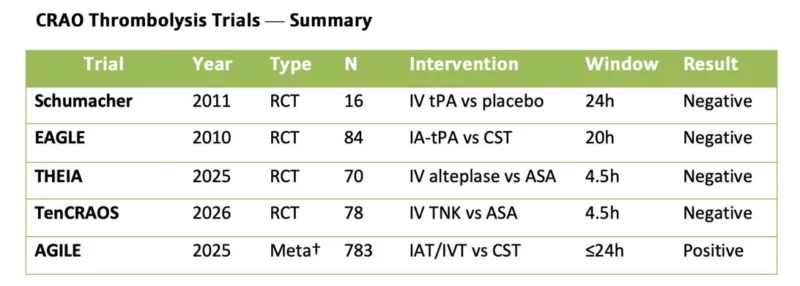
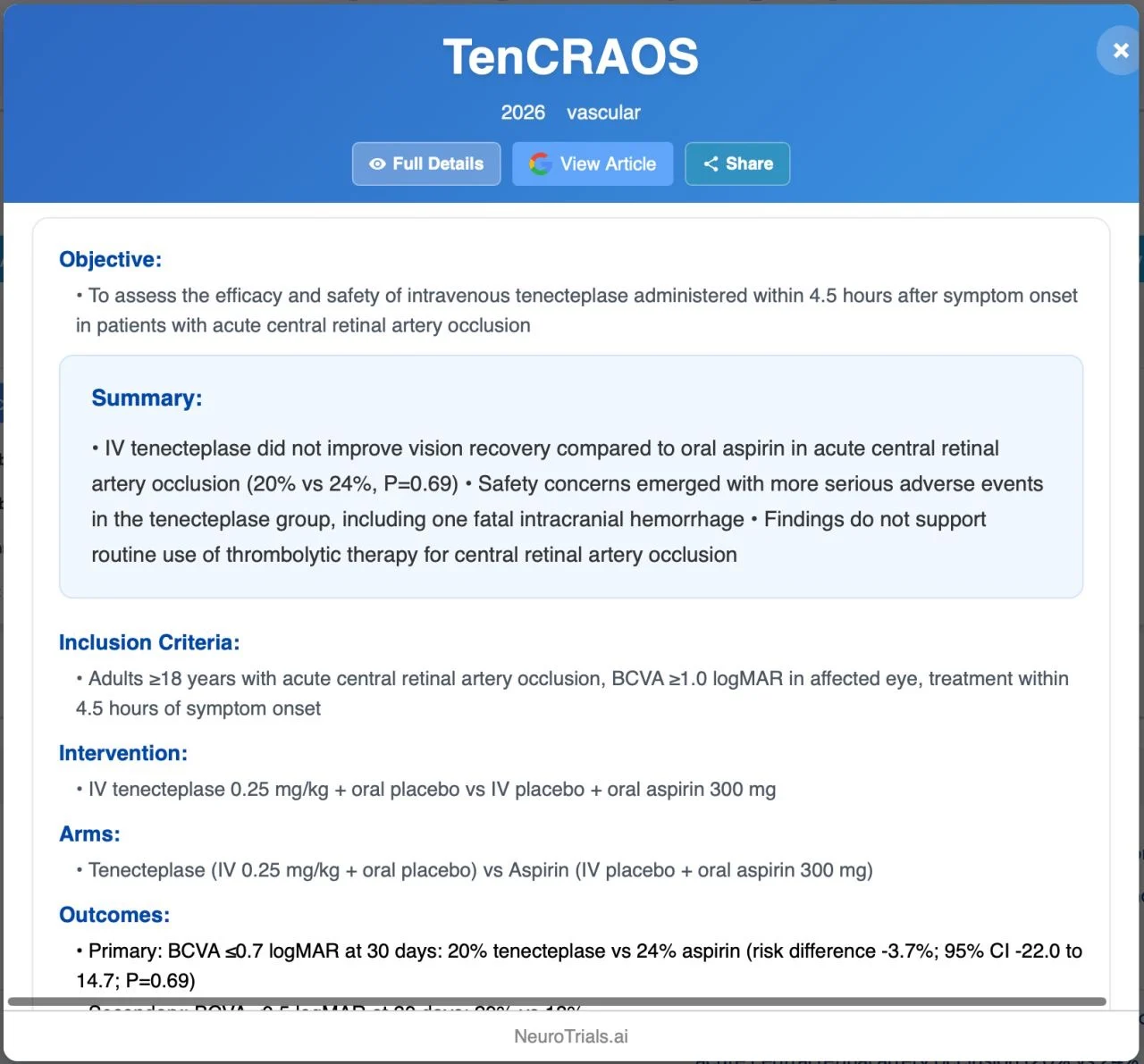
TenCRAOS (2026) randomized 78 patients with acute CRAO to IV tenecteplase (0.25 mg/kg) vs aspirin within 4.5 hours.
Key Findings:
Primary outcome: 20% TNK vs 24% aspirin (P = 0.69)
No visual benefit with IV thrombolysis
Safety signal: 1 fatal ICH; more SAEs with TNK (10 vs 4)
This is now the second negative RCT for IV thrombolysis in CRAO:
THEIA (2025): IV alteplase vs aspirin — no difference (66% vs 48%, P = 0.95)
What did guidelines say?
The AHA/ASA Scientific Statement (2021) on CRAO management stated that IV alteplase “may be considered” in carefully selected patients within 4.5 hours, with weak evidence (no RCT at that time) — this recommendation may need revisiting.
What about the AGILE meta-analysis?
The AGILE IPD meta-analysis (2025, N = 783) suggested early thrombolysis improves visual outcomes — but important caveats:
Pooled 35 studies, mostly single-arm observational studies — inherent selection bias
Subgroup of comparative studies was underpowered and could not reproduce the findings
Control group was heterogeneous (ocular massage, paracentesis, hemodilution, HBO, heparin) — not aspirin
However, AGILE did show potential benefit for intra-arterial thrombolysis (IAT) within 6 hours (OR 2.72 vs CST) — this still warrants RCT investigation.
Bottom Line:
IV thrombolysis for CRAO: RCT evidence is consistently negative — not recommended.
IA thrombolysis: Still under investigation.
AGILE suggests potential benefit within 6 hours, but RCT confirmation is needed.
So far, the evidence doesn’t support routine IV thrombolysis for acute CRAO.”
Stay updated on all scientific advances with Hemostasis Today.
-
Sep 16, 2026, 03:21Linda Shore-Lesserson: Dr. Nadia Hensley Delivers Visiting Lecture on Platelet Function Testing
-
Sep 16, 2026, 03:13Enrique Chacon-Cruz: Thrombocytopenia and ITP Risk After Vaccination
-
Sep 15, 2026, 23:35Katya McCarthy: From Lab Specialist to Patient – Facing Polycythemia and Venous Thrombosis
-
Sep 15, 2026, 23:19Narat Srivali: Chronic Preoperative Corticosteroid Use Associated with 51% Higher Postoperative VTE Risk
-
Sep 15, 2026, 23:13Grace M Thomas: Join 3rd edition of the Neutrophil Club of SFI Webinar Series on Thromboinflammation
-
Sep 15, 2026, 23:05Noha K Hashmi: Honoured to Present 2 Case-Based Posters at the 5th MENA Conference for Rare Diseases 2026
-
Sep 15, 2026, 22:56Susan Slingluff Hartmann: How NBDF and the BDRC Are Putting Lived Experience at the Heart of Studies
-
Sep 15, 2026, 22:50Shehab Mohamed: New GCC Consensus Recommendations for the Diagnosis and Management of HLH
-
Sep 15, 2026, 22:42100 Years of von Willebrand Disease: What Has a Century of Progress Taught Us? – EAHAD