

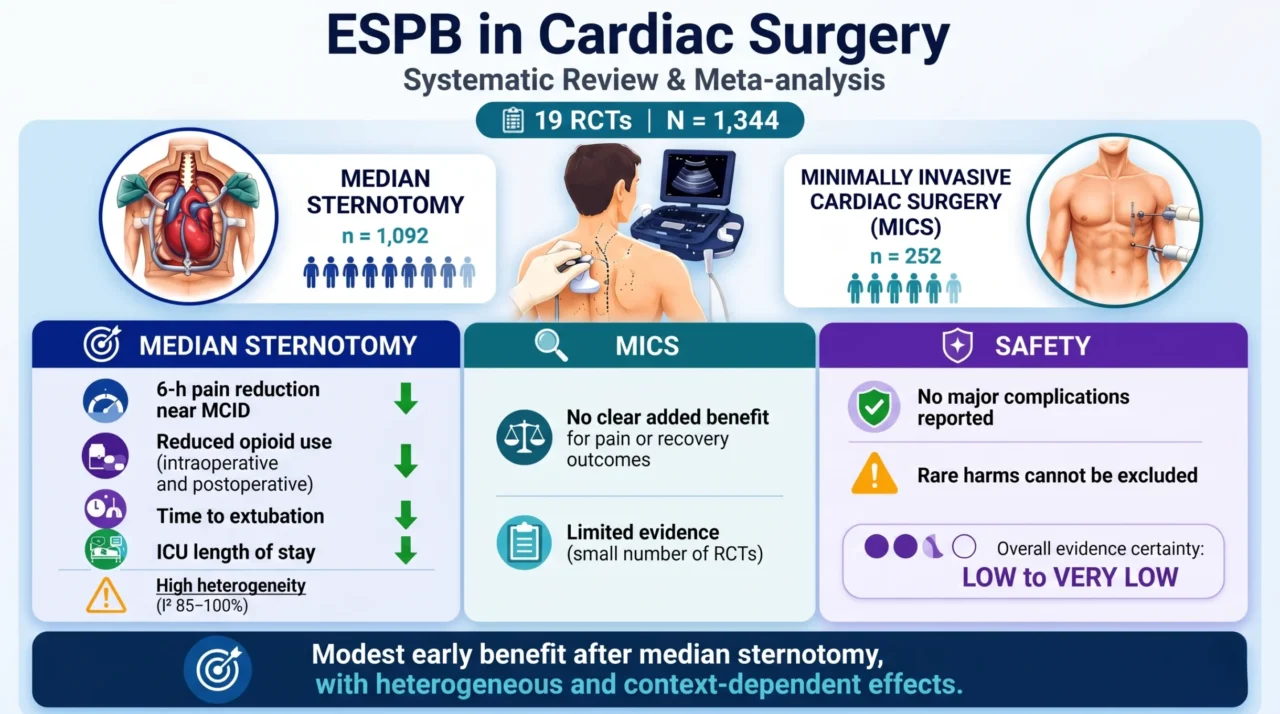
Diana Pérez Moreno: Analgesic Efficacy and Safety of Erector Spinae Plane Block After Sternotomy and MICS
Diana Pérez Moreno, Specialist in Pain Medicine, Palliative Care, and Interventional Pain Management at National Cancer Institute, shared a post on LinkedIn about a recent article she and her colleagues co-authored, published in Journal of Clinical Anesthesia, adding:
“To all our friends,
I would like to share our latest publication, which was published yesterday. It is a meta-analysis on the efficacy of the erector spinae plane (ESP) block in cardiac surgery, published in the Journal of Clinical Anesthesia.
In this article, our group has systematically evaluated and synthesized evidence supporting the use of the ESP block in cardiac surgery, drawing on multiple randomized controlled trials published over the last decade.
This October will mark the 10th anniversary of the ESP block since we first described the technique in Regional Anesthesia and Pain Medicine.
Today, that original publication has accumulated more than 3,000 citations and has generated over 2,000 publications indexed in PubMed alone.
Current medical evidence and guideline recommendations, including PROSPECT, now support the ESP block as a first-line analgesic technique for thoracic surgery (VATS) and laparoscopic cholecystectomy, and as an alternative option for thoracotomy and caesarean section.
Not to mention that it has become a first-line analgesic approach for rib fractures and spine surgery.
This publication, which took more than two years to complete, represents our team’s effort to clarify the true indications for the ESP block.
This work further supports the recommendations of several anesthesiology and cardiovascular surgery societies that now include the ESP block as an analgesic option in cardiac surgery, particularly when neuraxial techniques are contraindicated, such as in patients receiving anticoagulants.
This work was led by Diana Perez Moreno and Javier Andres Mora-Arteaga, experts in epidemiology and methodology from Bogotá, Colombia, and, of course, Maria Fernanda Contreras, a cardiovascular anesthesiologist who has performed hundreds of ESPBs in cardiac surgery in Colombia, providing outstanding clinical care to this patient population.
My deepest respect goes to Diana, the first author, whom I consider one of the leading figures in anesthesia and pain medicine research in Colombia. It has been a privilege to contribute to this important project.
Happy 10th anniversary to our ESP block.”
Title: Analgesic efficacy and safety of erector spinae plane block after sternotomy and minimally invasive cardiac surgery: A systematic review and Meta-analysis of randomized trials
Authors: Diana Perez-Moreno, Mauricio Forero, María Fernanda Contreras, Javier Andres Mora-Arteaga

Stay updated on all scientific advances with Hemostasis Today.
-
Sep 18, 2026, 01:35Matthew Hazell: From Platelet Refractoriness to Protecting Transplanted Organs
-
Sep 18, 2026, 01:23Apple Joy A. Valenzuela: Exploring How Neutrophil Develops from the Myeloblast to the Mature Segmented Neutrophil
-
Sep 18, 2026, 01:13Su Someh: Gaps and Variation in Global Plasma Donor Protection Policies
-
Sep 18, 2026, 01:03Joseph R. Shaw: Study Questions Blanket “No-Bridging” Strategy for Mechanical Heart Valves
-
Sep 17, 2026, 20:38Konstantinos Bistas: Reduced Circulating Tregs in Pediatric Chronic Neutropenia
-
Sep 17, 2026, 15:33Gopal Patidar: Honoured to Contribute to the ASFA 2026 Guidelines for Therapeutic Apheresis
-
Sep 17, 2026, 20:36Cosima C. Hoch: Developing a 3D Organotypic Co-Culture Model for Pleomorphic Adenoma
-
Sep 17, 2026, 20:19Riten Kumar: Boston Children’s Hospital Ranked No. 1 in Seven Pediatric Specialties
-
Sep 17, 2026, 20:17Katrina Snow: Whole Blood or Component Therapy – Which Would You Choose?