


Eugene Fan: FIBOM-AI – Predicting Marrow Fibrosis From Routine Blood Counts
Eugene Fan, Senior Consultant at Tan Tock Seng Hospital, shared a post on LinkedIn about a recent article he and his colleague co-authored, published in The Lancet Haematology:
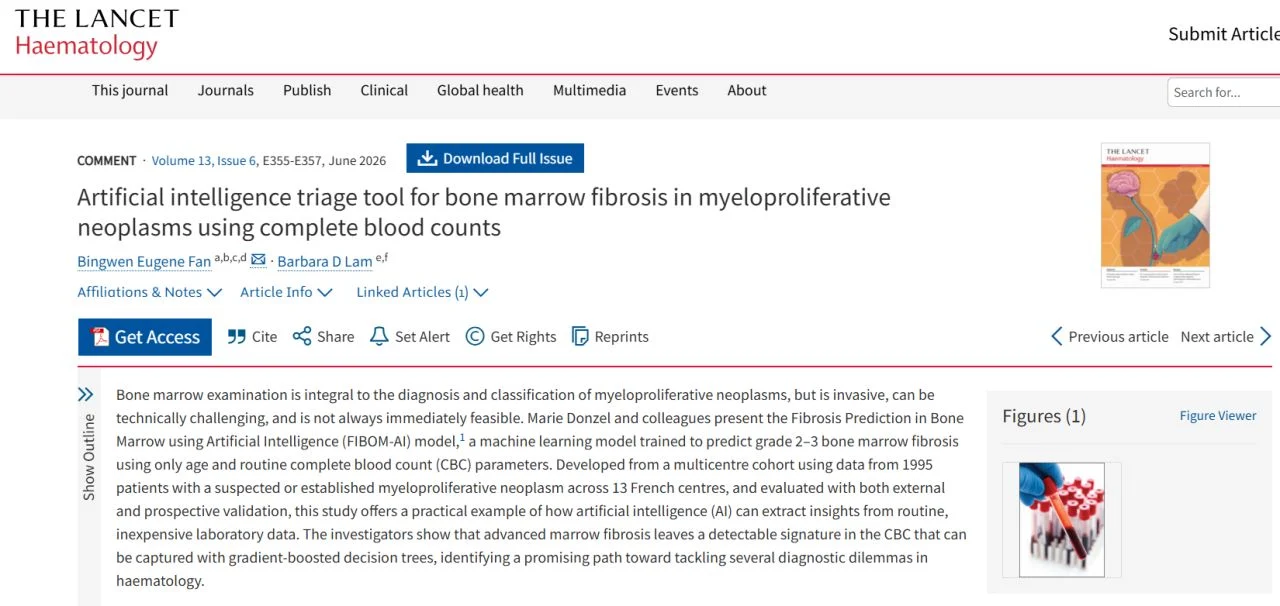
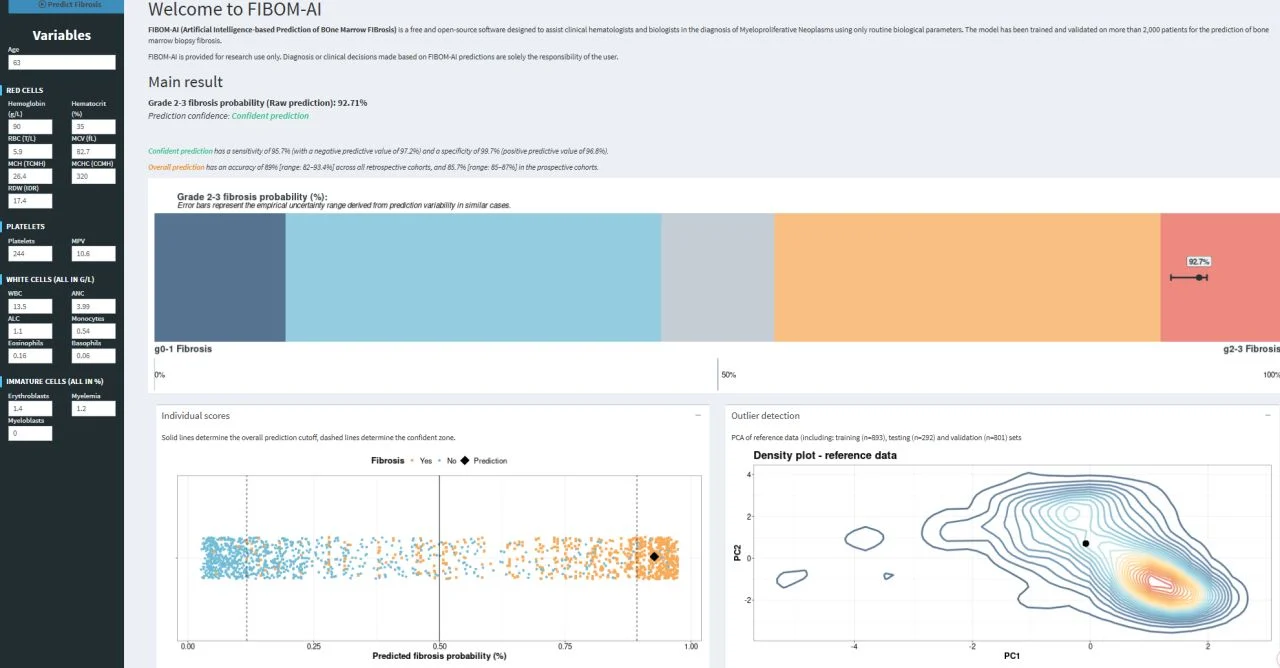
“I’m pleased to share our Comment in The Lancet Haematology, co-authored with Dr Barbara Lam, on the FIBOM-AI study published in the June 2026 issue – an artificial intelligence tool that predicts grade 2–3 bone marrow fibrosis in myeloproliferative neoplasms using age and routine complete blood count parameters.
The final model is available for clinicians to use as a free web-app and as an open source R package.
What I found particularly interesting is that the CBC, one of the most familiar and inexpensive tests in haematology, still has signals we are only beginning to understand.
FIBOM-AI suggests that advanced marrow fibrosis may leave a measurable footprint in routine blood count data, and that machine learning can help surface these patterns in clinically useful ways.
At the same time, we argue that strong model performance is not the same as clinical utility.
Bone marrow examination remains essential for MPN diagnosis, subtyping, prognostication, and recognition of prefibrotic disease.
AI tools like FIBOM-AI should therefore be viewed not as replacements for marrow assessment, but as potential aids to triage, timing, and longitudinal monitoring — especially when biopsy decisions are difficult because of frailty, accessibility, or patient preference.
The next step is not simply to build more accurate models, but to test how these tools change decisions in real clinical workflows.
In haematology, the most valuable AI may not be the most technically impressive one, but the one that helps haematologists make better, safer, and more timely decisions.”
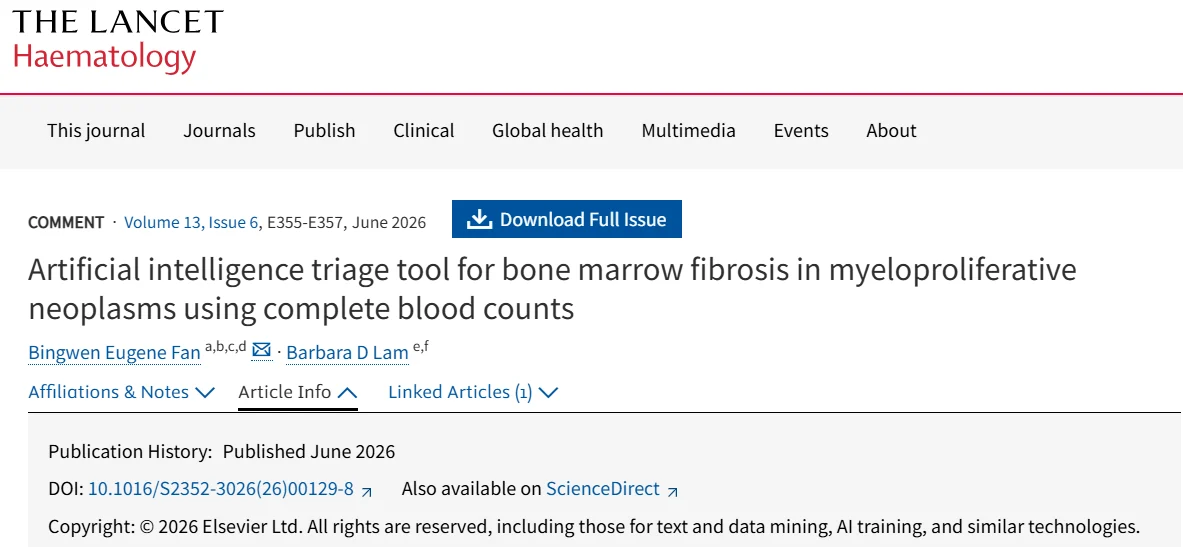
Title: Artificial intelligence triage tool for bone marrow fibrosis in myeloproliferative neoplasms using complete blood counts
Authors: Bingwen Eugene Fan, Barbara D Lam
Other posts featuring Eugene Fan on Hemostasis Today.
-
Sep 16, 2026, 16:06Katrina Louise Manalaysay: In Your 20s, You Might be Given the Opportunity to Donate Blood for the First Time
-
Sep 16, 2026, 15:45Matthew Hazell: A Brilliant Explanation of Phenotype vs Genotype Using a LEGO House
-
Sep 16, 2026, 15:23Ahmad Al-Ramahi: Presenting the Military Pharmacists Blood Training Course at the FIP World Congress
-
Sep 16, 2026, 15:21HIT Reimagined: Can 12-Lipoxygenase Inhibition Stop Immune Thrombosis?
-
Sep 16, 2026, 14:42Ruchi Punamia: Beyond the Blood Bank and The Clinical Impact of Apheresis
-
Sep 16, 2026, 14:06Kalyan Roy: Celebrating Apheresis, Advancing Care, Saving Lives
-
Sep 16, 2026, 13:38Andrew Zapfel: Advancing Sickle Cell Disease Care and Research
-
Sep 16, 2026, 13:30Thirunavukkarasu Angappan: Why Plasma-Derived Factor VIII Still Matters for Inhibitor Patients
-
Sep 16, 2026, 13:22Matthew Hazell: New BSH Guidance for Fetal, Neonatal and Paediatric Transfusion