


Anticoagulation Reversal in 2026: Are We Winning the Bleeding Battle? – Francisco Chacón-Lozsán
Francisco Chacón-Lozsán, Fellow at World Extreme Medicine, Member of European Society of Intensive Care Medicine (ESICM) and American College of Cardiology, shared a post on LinkedIn, about a recent article, by Bianca Rocca and Hugo ten Cate, published in The New England Journal of Medicine (NEJM), adding:
”Anticoagulation Reversal in 2026: Are We Winning the Bleeding Battle?
Anticoagulant-associated bleeding remains one of the most challenging emergencies in modern medicine.
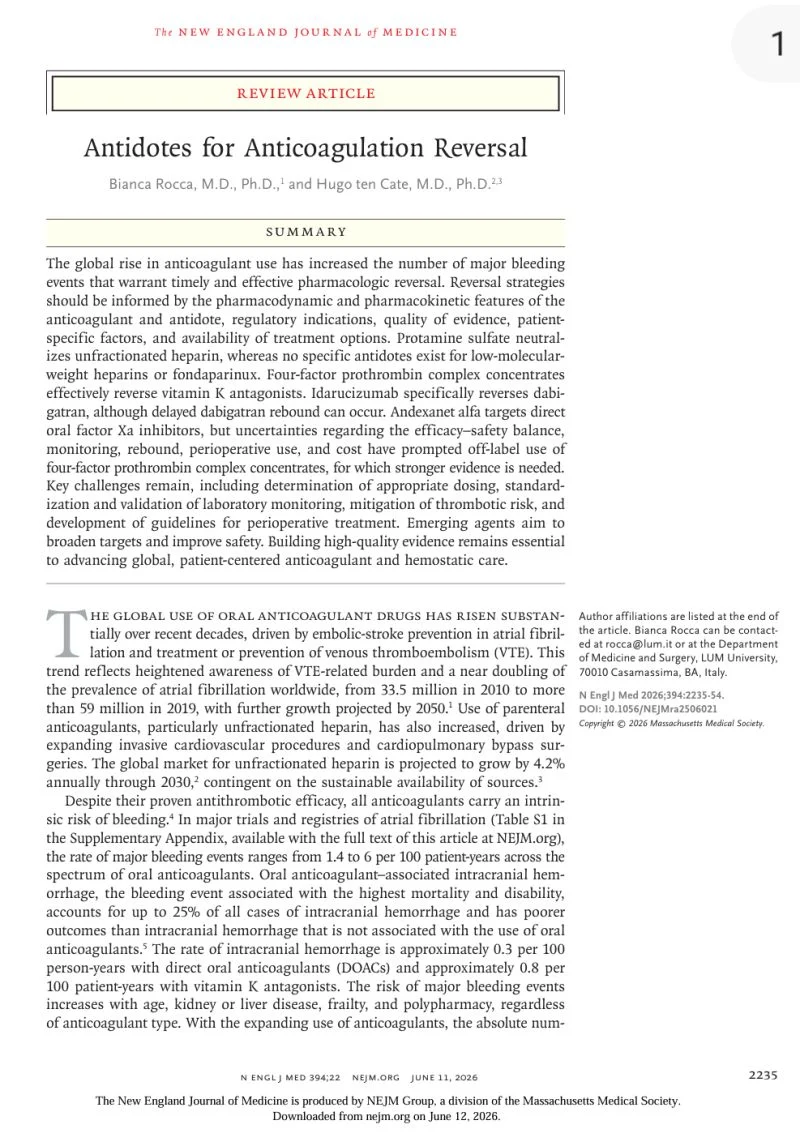
A new review in The New England Journal of Medicine provides an updated roadmap for reversal strategies and highlights that antidote selection should be driven not only by efficacy, but also by pharmacology, thrombotic risk, laboratory monitoring, and procedural needs.
Several key messages deserve attention.
- Unfractionated heparin Protamine remains the antidote of choice, but reversal is often incomplete for LMWH and ineffective for fondaparinux. Excess protamine may paradoxically worsen bleeding.
- Vitamin K antagonists Four-factor PCC plus intravenous vitamin K continues to represent the standard for life-threatening bleeding, offering faster INR correction than plasma-based approaches.
- Dabigatran Idarucizumab provides rapid and near-complete reversal, yet approximately 20% of patients may experience delayed dabigatran rebound, particularly in renal dysfunction, emphasizing the importance of follow-up laboratory testing.
- Factor Xa inhibitors Andexanet alfa remains controversial.
The ANNEXA-I trial demonstrated improved hemostatic efficacy compared with standard care, but this came at the cost of increased thrombotic complications. Importantly, no mortality benefit has been consistently demonstrated.
Perhaps the most striking observation from this review is that andexanet alfa has been voluntarily withdrawn from the United States market since December 2025 because of safety concerns, while maintaining conditional approval in Europe for selected patients with life-threatening bleeding receiving apixaban or rivaroxaban.
The proposed clinical framework is elegantly simple.
For DOAC-associated bleeding, clinicians should ask:
- Is the bleeding life-threatening or uncontrolled?
- Is there clinically relevant residual anticoagulant activity?
- What is the patient’s thrombotic risk?
- Is urgent surgery or perioperative unfractionated heparin anticipated?
These questions may be more important than the antidote itself.
The future is already emerging.
Ciraparantag and VMX-C001 are being developed as universal or bypassing reversal agents, potentially simplifying anticoagulation reversal strategies in the coming years.
As anticoagulant use continues to expand worldwide, reversal medicine is rapidly evolving into a discipline that sits at the intersection of hematology, critical care, emergency medicine, neurology, cardiology, and perioperative medicine.
The challenge is no longer simply reversing anticoagulation.
It is restoring hemostasis without provoking thrombosis.”
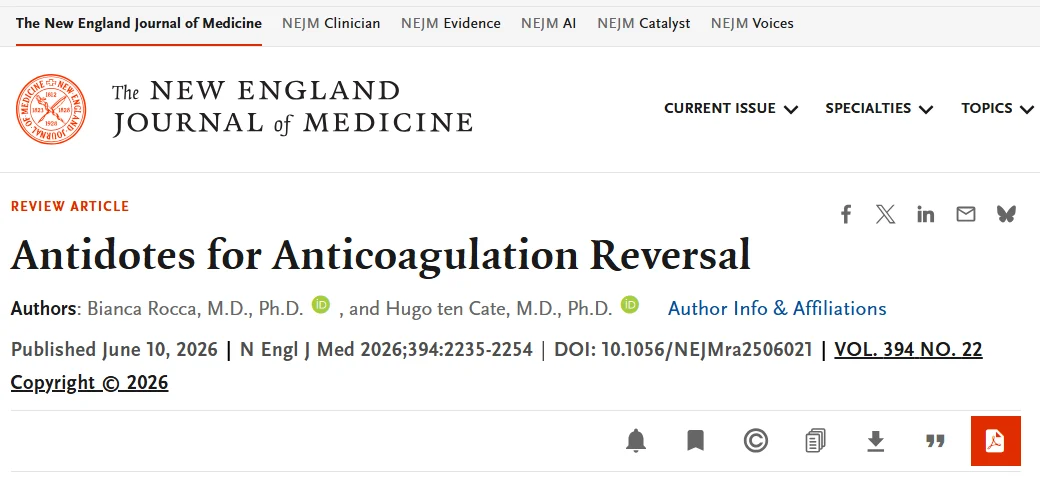
Title: Antidotes for Anticoagulation Reversal
Authors: Bianca Rocca and Hugo ten Cate
Stay updated on all scientific advances with Hemostasis Today.
-
Oct 19, 2026, 05:44Mavis Agnes Kisakye: Raising Awareness about Haemophilia and Other Blood Disorders at Luweero General Hospital
-
Oct 19, 2026, 05:43Mohsen Asadi: Women and Blood Clots – Understanding Risk Across Every Life Stage
-
Oct 19, 2026, 05:39Shivir Moosai: Warm AIHA in a Young Woman
-
Oct 19, 2026, 03:54Jennifer Trowbridge: How Mutant Blood Stem Cells Use Inflammation to Drive Their Own Expansion
-
Oct 19, 2026, 03:39Wyenona Hicks: Catching Up With Old Friends and New Colleagues at AABB 2026
-
Oct 19, 2026, 03:33Developing a Non-Invasive Treatment for Life-Threatening PE – University of Michigan College of Engineering
-
Oct 19, 2026, 03:28Jim Hoffman: How NETs Contribute to Gallstone Formation and Growth
-
Oct 19, 2026, 03:28Nicolas Hubacz: The Organized Chaos of Mitochondria
-
Oct 19, 2026, 03:02Neda Horvacki: Using ROTEM to Refine Transfusion Decisions in Acute Trauma