

Wilfried Dinh: Why Heart Patients Still Have Events Despite ”Optimal” Cardiovascular Therapy
Wilfried Dinh, Senior Clinical Program Leader at Boehringer Ingelheim, posted on Linkedln:
“Residual CV Risk: Why Heart Patients Still Have Events Despite “Optimal” Treatment
Even with guideline-directed therapy, coronary artery disease remains the number one killer globally. Here’s why—and what’s changing:
The Paradox:
Patients on statins, antiplatelets, and BP meds still experience recurrent heart attacks and cardiovascular death.
This is “residual cardiovascular risk”—the persistent danger that current standards don’t fully address.
Why Standard Therapy Falls Short:
Current treatments only partially target the mechanisms driving atherosclerosis:
∙ Lifestyle modification
∙ LDL-cholesterol reduction
∙ Blood pressure control
∙ Antiplatelet therapy
But these miss critical pathways in plaque progression and destabilization.
The Missing Pieces
Beyond traditional risk factors, emerging mechanisms include:
• Residual inflammatory pathways
• Metabolic dysfunction
• Persistent thrombotic risk
• Novel lipid pathways
New Therapies:
New evidence supports:
∙ Low-dose colchicine (anti-inflammatory)
∙ PCSK9 inhibitors (ultra-low LDL)
∙ GLP-1 receptor agonists (metabolic + CV benefits)
∙ SGLT2 inhibitors (heart failure + atherosclerosis)
∙ Novel antithrombotic strategies
The Future:
AI-driven analysis will enable:
∙ Precise patient stratification
∙ Personalized therapy selection
∙ Optimal risk-benefit balance
Key Takeaway:
“Optimal medical therapy” in 2026 looks different than it did 5 years ago.
Understanding residual risk mechanisms allows us to move beyond one-size-fits-all protocols toward precision cardiology.
The goal: not just treating disease, but preventing the events we couldn’t prevent before.”
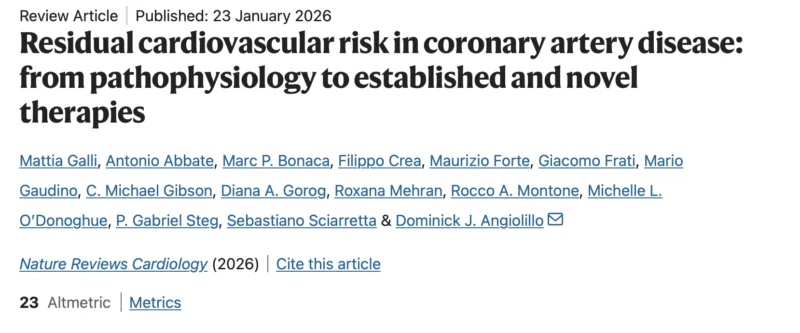
Title: Residual cardiovascular risk in coronary artery disease: from pathophysiology to established and novel therapies
Authors: Mattia Galli, Antonio Abbate, Marc P. Bonaca, Filippo Crea, Maurizio Forte,mGiacomo Frati, Mario Gaudino, C. Michael Gibson, Diana A. Gorog, Roxana Mehran, Rocco A. Montone, Michelle L. O’Donoghue, P. Gabriel Steg, Sebastiano Sciarretta, Dominick J. Angiolillo
Read full article here.
Stay updated with Hemostasis Today.
-
Jan 25, 2026, 15:57Céline Chapelle Shares Clinical Predictors From the API-CAT Trial
-
Jan 25, 2026, 15:42Francesco Lo Monaco on Heart Disease Starting Quiet While Your Labs Speak First
-
Jan 25, 2026, 15:25Muhammad Ibrahim on Efficacy and Safety of Extended DOACs Use in VTE
-
Jan 25, 2026, 15:08Tushar Pandey on Managing Thrombotic Thrombocytopenic Purpura
-
Jan 25, 2026, 14:55Carolina Contreras Cuevas Shares a Nationwide Study on VTE in PAD
-
Jan 25, 2026, 14:40Jeannie Devereaux Links PRP and Physical Therapy
-
Jan 25, 2026, 14:25Heghine Khachatryan on Anticoagulation After AFib Ablation: New Evidence from NEJM
-
Jan 25, 2026, 12:42Lale Tokgözoğlu on Cardiovascular Risk Factors in Women
-
Jan 25, 2026, 12:32Dino Mehic on Bleeding Assessment Tools and QoL in BDUC