

Luca Saba on Carotid Artery Stenosis—An Impactful Bias in Ischemic Stroke Classification
Luca Saba, Dean of School of Medicine at the University of Cagliari, shared a post on LinekedIn:
”New publication in JAMA Cardiology
Together with Peter Libby, we explore a long-standing assumption in stroke medicine that may need revision.
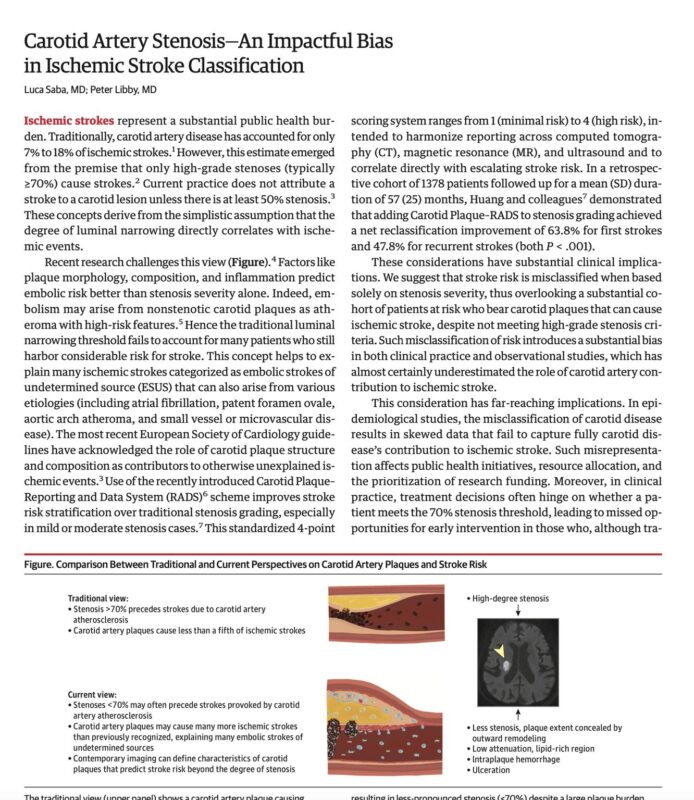
For decades, carotid artery disease has been considered responsible for only a small fraction of ischemic strokes, typically those associated with high-grade stenosis.
This view shaped both clinical guidelines and epidemiologic data.
We argue that this framework introduces a systematic bias in how stroke risk is assessed and attributed.
A significant number of ischemic strokes may in fact originate from nonstenotic but biologically high-risk carotid plaques: lesions characterized by hemorrhage, inflammation, or surface ulceration, which traditional stenosis-based classifications fail to capture.
This conceptual bias affects not only clinical decision-making, potentially excluding at-risk patients from early intervention, but also epidemiologic estimates and public health planning, by underestimating the true contribution of carotid atherosclerosis to the global burden of stroke.
We propose that plaque-centered risk models, such as the recently introduced Carotid Plaque–RADS, can complement traditional stenosis thresholds by integrating compositional and morphological information from CT, MRI, and ultrasound.
This work calls for a shift from a purely geometric definition of disease to a biological and predictive model, one that better reflects the mechanisms underlying ischemic events and may improve prevention strategies worldwide.”
Read the full article here.
Article: Carotid Artery Stenosis—An Impactful Bias in Ischemic Stroke Classification
Authors: Luca Saba, Peter Libby
Stay updated on all scientific advances in the field of thrombosis with Hemostasis Today.
-
Oct 9, 2026, 11:44Ayyappan V Nair: PRP and Rehabilitation – Can It Help Athletes with Partial Rotator Cuff Tears?
-
Oct 9, 2026, 11:29Jigesha Dholakia: Supporting the Hemophilia Community Through the Unite Walk
-
Oct 9, 2026, 11:06Nobles Green: How siRNA Therapy Helps the Body Form Stronger Clots
-
Oct 9, 2026, 10:53Switching From Emicizumab to Denecimig in Hemophilia A – Rare Disease Advisor
-
Oct 9, 2026, 10:40What New U.S. Data Reveal About GT – Glanzmann’s Research Foundation
-
Oct 9, 2026, 10:32Anjali Pandey: The Morphologic Clues to MDS With del(5q)
-
Oct 9, 2026, 10:13Reza Shojaei: 5 Leadership Responsibilities for a Sustainable Plasma Ecosystem
-
Oct 9, 2026, 08:38Johannes Gratz: Perioperative Care in Factor VII Deficiency – Treating the Patient, Not the Number
-
Oct 9, 2026, 08:28Ghanim Fajish: Vascular Cells May Retain a Prothrombotic Memory of Oxidative Stress