


Luca Saba: Why Does the Same Patient Have Different Plaque in Different Arteries?
Luca Saba, Dean of School of Medicine at the University of Cagliari, shared on LinkedIn about a recent article he and his colleague co-authored, published in Nature Cardiovascular Research, adding:
“The vulnerable territory.
Every now and then, you write an article that feels different.
Many years ago, I still remember reading about the concept of the vulnerable plaque.
It was a powerful idea: not all plaques are the same.
Some plaques are biologically quiet.
Others are unstable, inflamed, rupture-prone, and dangerous.
Then, over time, another important concept emerged: the vulnerable patient.
Because risk is not only inside the plaque.
It is also in the host: systemic inflammation, metabolic status, genetics, clonal hematopoiesis, diabetes, kidney disease, and the broader biological environment.
But one question has always remained open:
- Why does the same patient, exposed to the same systemic risk factors, develop aggressive atherosclerosis in one vascular bed and relatively little disease in another?
- Why does one arterial segment become lipid-rich and hemorrhagic, another fibrocalcific, another extensively calcified, while another remains surprisingly protected?
In other words:
Why is atherosclerosis systemic, but never uniform?
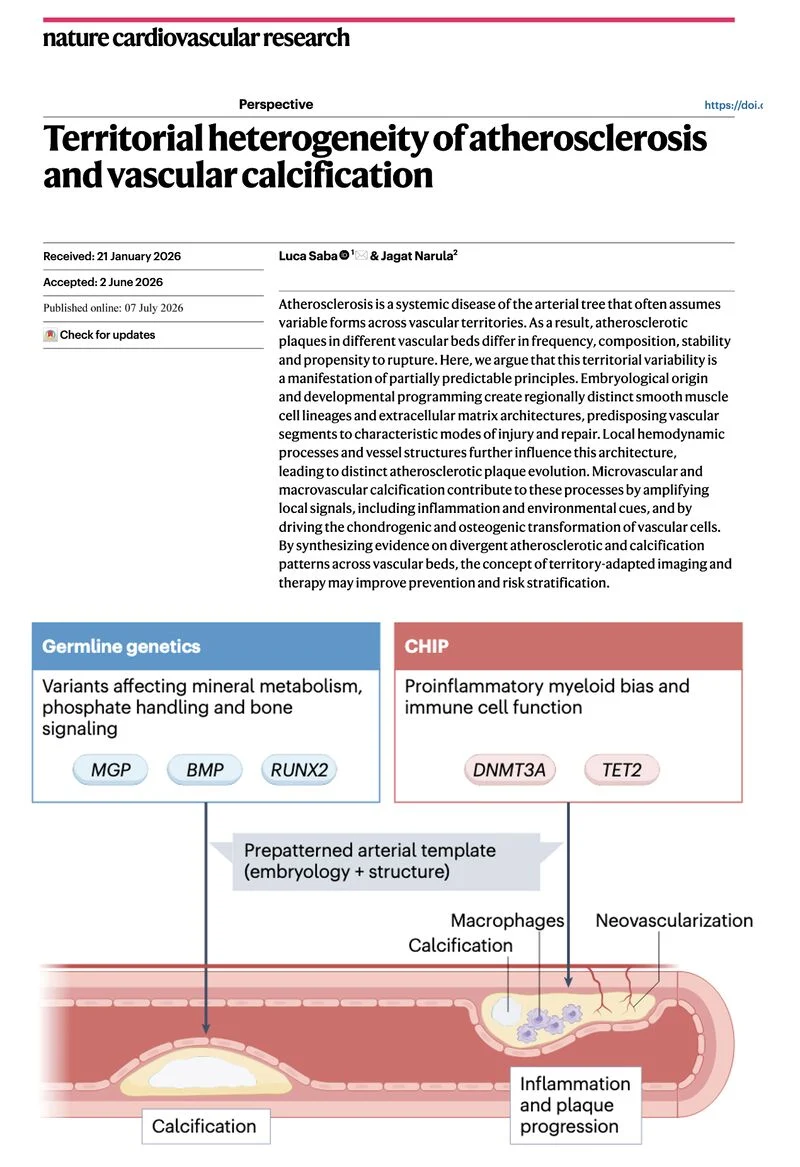
Today, together with Jagat Narula, I am very pleased to share our new Perspective published in Nature Cardiovascular Research:
‘Territorial heterogeneity of atherosclerosis and vascular calcification.’
In this article, we propose that the missing layer is the vulnerable territory.
The arterial tree is not a passive set of identical tubes exposed to the same risk factors: It is a mosaic of biologically distinct territories.
Each vascular bed has its own embryologic origin, smooth muscle cell identity, wall structure, hemodynamic environment, perivascular adipose tissue, calcification pattern, and mode of response to injury.
Systemic risk factors act on this pre-existing territorial template.
And what we call ‘atherosclerosis’ is the result of this interaction.
A calcified plaque in the coronary arteries does not necessarily mean the same thing as calcification in the femoral artery, the carotid bifurcation, the abdominal aorta, or the intracranial circulation: the same imaging label may carry different biological and clinical meanings depending on where it is found.
This is why the future may need to become more territory-aware.
Not only:
- Is there plaque?
- Is the patient high risk?
But also:
Which territory is vulnerable, and why?
From vulnerable plaque, to vulnerable patient, to vulnerable territory.
I am grateful to Nature Cardiovascular Research for publishing this Perspective and deeply honored to have developed this concept together with Jagat Narula.
There are some papers that you write.
And there are some papers that you feel.
This is one of them.”
Title: Territorial heterogeneity of atherosclerosis and vascular calcification
Authors: Luca Saba, Jagat Narula
Stay updated on all scientific advances with Hemostasis Today.
-
Oct 9, 2026, 15:27Mohamed Hegazi: Geostatistical Modelling Maps Global β-Thalassaemia Carrier Prevalence
-
Oct 9, 2026, 15:15Maha Othman: Uncovering the Consensus on TXA in TBI – Call for Collaboration on a Landmark Umbrella Review
-
Oct 9, 2026, 15:07Daniel D. Han: How Inhalation Product Exposure Impairs Cardiac and Platelet Recovery After MI
-
Oct 9, 2026, 14:58William Toole: How Ultrasound-Guided PRP Therapy Relieves Joint and Tendon Pain
-
Oct 9, 2026, 14:50Shayan Mohammadmoradi: In Corpus Christi for the 20th Midwest Platelet Conference
-
Oct 9, 2026, 14:37Tariq Tramboo: High Platelet Concentrate for Osteoarthritis Knee – Recent Meta-Analyses
-
Oct 9, 2026, 14:26Yousma Khan: Hematology Series – Beyond RBCs, WBCs and Platelets
-
Oct 9, 2026, 14:13Jesus Ardila Novoa: Why the WHO’s Historic Essential Medicines List Decision Is Just the Beginning
-
Oct 9, 2026, 14:07Chokri Ben Lamine: Pain After Allogeneic Stem Cell Transplantation in Sickle Cell Disease