


Pradeep Natarajan: Our New Genetic Study of Aortic Stenosis in ~3M
Pradeep Natarajan, Director, Preventive Cardiology at Massachusetts General Hospital, shared on LinkedIn:
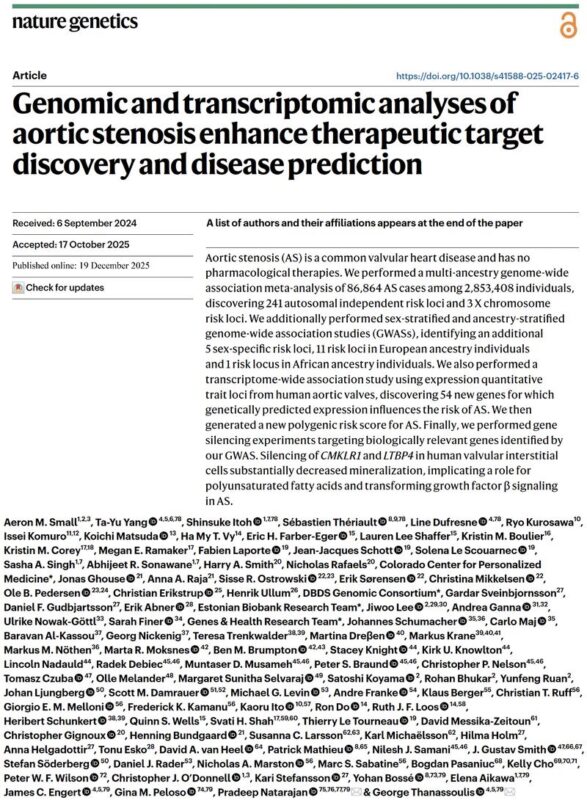
”Our new genetic study of aortic stenosis in ~3M led by Aeron Small and with George Thanassoulis uncovered 241 genome risk regions.
These may lead to new targets for medicines, as no effective medicines currently exist
A Springer Nature, Nature Portfolio
Mass General Brigham Research
Broad Institute of MIT and Harvard
Harvard Medical School
Massachusetts General Hospital
Mass General Brigham
Aortic stenosis afflicts >9M individuals worldwide, and still has no medical therapy, with a very high rate of morbidity and mortality.
Valve replacement/implantation in 70s-90s with several comorbidities has challenges.
Prevention is ideal but elusive.
We leverage genomics at significant scale to nominate several biological hypotheses leading to aortic valve pathogenesis.
In turn, those mechanisms could be leveraged for prevention similar to strategies in other medicines such as coronary artery disease.
Across 2.85M individuals (87K aortic stenosis cases) across 30 cohorts, we identified.
– 241 associated loci (an order of magnitude larger than our prior effort in 2023 )
– 5 loci showed significant differences in effects between men vs women
We performed a TWAS using AS GWAS summary statistics and transcriptomics from aortic valve tissue. 192 genes were identified, with 66 also having colocalization evidence.
Across genes prioritized, enriched pathways included: lipoprotein metabolism, growth factor signaling, TGFB biology, and cytoskeletal regulation.
To further validate, we pursued gene-silencing experiments for valvular interstitial cells in vitro for a subset of novel nominated genes. siRNAs for CMKLR1 and LTBP4 each decreased valvular calcification.
We took the totality of the data to generate a new PRS for AS, toward better identifying high-risk individuals meriting surveillance and preventive interventions.
HR ~1.9/SD, ΔC-stat 0.02-0.05. That’s now about the same as a CAD PRS, and comparable to traditional RFs. C-index and HR (for top 20th percentile) higher for all assessed risk factors except for age.
In summary,
– While AS presents late in life, it is highly polygenic.
– Several novel genes nominated to influence AS development.
– Key valve-specific biology and pathways can be manipulated.
– Genetics for AS can yield meaningful prediction (on par with factors we consider today)
This was a huge undertaking with a new consortium formed to enable this work.
Hats off to senior postdoc Aeron Small, now Brigham and Women’s Hospital cardiologist, for his leadership, rigor, tenacity, and thoughtfulness.
Gina Peloso, J.C. Engert, Elena Aikawa, Y. Bosse
And check out the paired publication by friends / colleagues Shinwan Kany, Patrick Ellinor, James Pirruccello using imaging and genetics to yield additional insights on aortic stenosis genetics and biology.”
Read the full article here.
Article: Genomic and transcriptomic analyses of aortic stenosis enhance therapeutic target discovery and disease prediction
Authors: Aeron Small, Pradeep Natarajan, George Thanassoulis et al.
Stay updated on all scientific advances with Hemostasis Today.
-
Oct 7, 2026, 16:44Amor Salah: 2026 NCS/SCCM Guidelines for Managing Antithrombotic-Associated ICH
-
Oct 7, 2026, 16:04NETs in Thrombosis: From Mechanism to Therapeutic Target
-
Oct 7, 2026, 15:28Amir Samimi: Prognostic Value of Platelet Count in Resected HNSCC
-
Oct 7, 2026, 15:21Eloïse Laouenan: Bridging Immunity and Thrombosis in MVTE
-
Oct 7, 2026, 15:10Uthra Sundaram: Honouring Donors During International Plasma Awareness Week
-
Oct 7, 2026, 15:04Daniel Victor Ortigoza: Should Frail Older Patients With AF Switch From VKA to DOACs?
-
Oct 7, 2026, 14:53Susan Noone: Donor Turned Recipient Shares Lifesaving Transfusion Story
-
Oct 7, 2026, 14:49Aimee Burtenshaw: The Impact of the Infected Blood Inquiry on Hospital Transfusion Laboratories
-
Oct 7, 2026, 14:41Vikash Jaiswal: Does Timing Matter for Calcium in Pre-Eclampsia Prevention?