


Dr. Rawnak Sharif Shares Clinical Case: High-Risk AF Patient with Traumatic SDH
Dr. Rawnak Sharif, Resident Medical Officer at Apollo Imperial Hospital, posted on LinkedIn:
“High-Risk AF Patient with Traumatic SDH: Strategic Anticoagulation
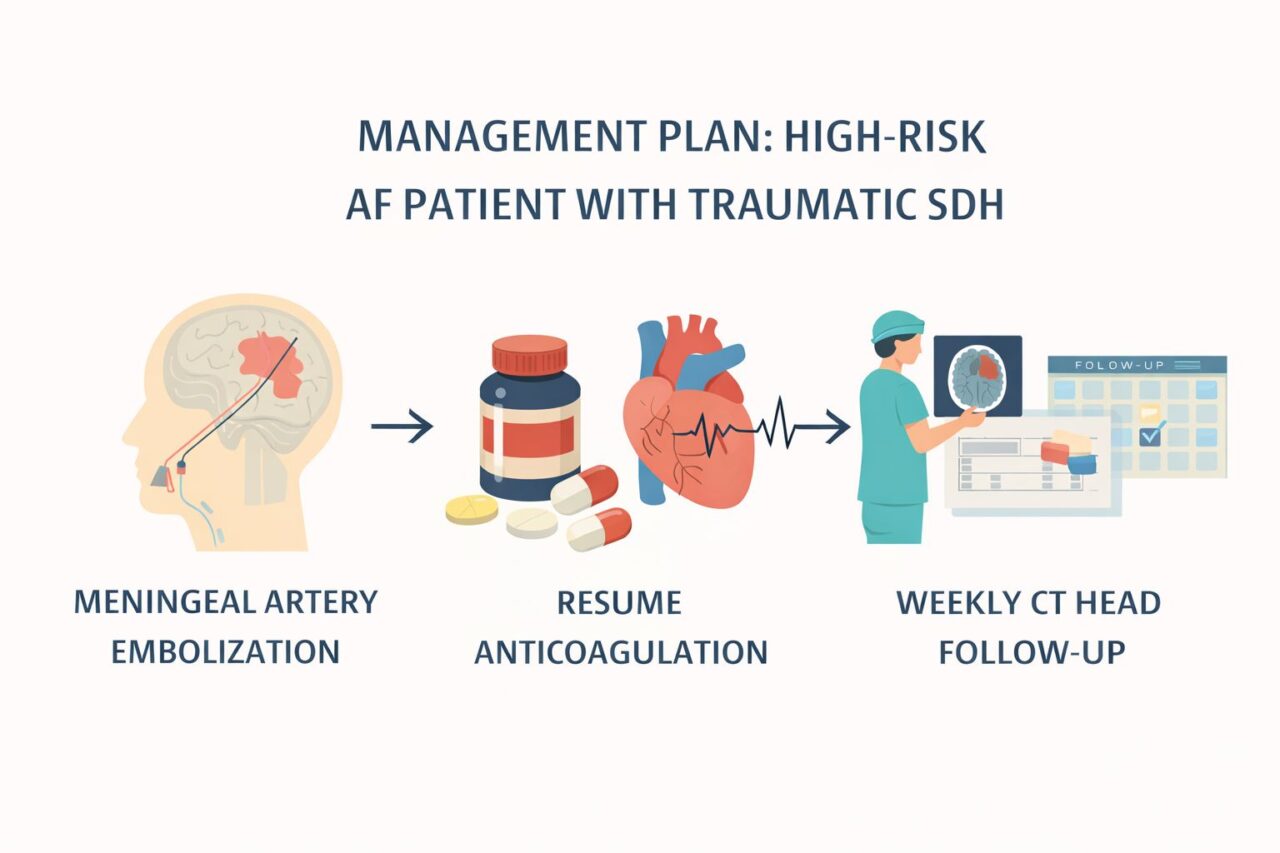
Case Summary:
A 69-year-old male with severe ischemic cardiomyopathy (left ventricular ejection fraction 20%, chronic total occlusion) on apixaban presented after alcohol ingestion with vomiting, headache, right ear bleeding and a fall. Imaging revealed a large left-sided subdural haematoma (SDH), intracerebral and subarachnoid haemorrhage, diffuse axonal injury and right parietal/temporal fractures. Computed tomography angiography (CTA) and computed tomography venography (CTV) showed no aneurysm or vascular lesion.
Management Plan:
- Meningeal artery embolisation (MMAE): To seal the bleeding source.
- Resumption of apixaban post-embolisation: For atrial fibrillation stroke prevention.
- Conservative neuro care: Antiedema therapy, antiepileptics, nimodipine and vitamin K.
- Weekly CT head follow-up: Until SDH stabilisation.
Clinical Summary for Practising Doctors:
- MMAE: Is increasingly validated for acute, subacute and chronic SDH. It targets the haematoma membrane’s vascular supply to reduce recurrence and promote resolution.
- Resumption of anticoagulation or antiplatelet therapy post-MMAE: Appears safe. Studies show no significant increase in SDH recurrence or haematoma size compared with withholding therapy.
- Early resumption (approximately 1 week to 1 month): May lower thromboembolic risk without increasing bleeding complications.
- Limitations: Most evidence is retrospective; patient selection bias exists. Large prospective trials are ongoing to define optimal timing and patient subsets.
Clinical Rationale:
- Traumatic SDH + AF: Requires balancing haemorrhage control with thromboembolic prevention.
- Embolisation addresses the bleeding source enabling safe anticoagulation resumption.
- Multidisciplinary decision-making (neurology, neurosurgery, cardiology) is essential.
- Structured imaging follow-up guides timing and safety.
1-Minute Bedside Checklist:
- Confirm SDH stability on repeat CT scan.
- Assess thromboembolic risk (CHA₂DS₂-VASc, devices, prior events).
- Assess bleeding risk (volume, location, comorbidities).
- Plan anticoagulation timing (post-embolisation, individually tailored).
- Choose agent (DOAC preferred if eligible).
- Multidisciplinary consultation and patient counselling.
References:
- Acta Neurochir 2025 – MMAE reduces SDH recurrence.
- PubMed 39880622 – Safe anticoagulation post-MMAE.
- PMC 10249073 – Early resumption feasible.
- Trials J 2025 – RELACS RCT, timing anticoagulation post-SDH.
Takeaway:
In high-risk atrial fibrillation patients with traumatic SDH, MMA embolisation enables safe and timely resumption of anticoagulation, reducing thromboembolic risk while minimising rebleeding. Weekly imaging and multidisciplinary care are key to optimal outcomes.”
Explore more cases for deeper insights into hemostasis with Hemostasis Today.
-
Oct 16, 2026, 16:22Shannon Farmer: Driving Patient Blood Management Forward in Australia and New Zealand
-
Oct 16, 2026, 16:01Obi Light Ogbonnia: The Greatest Reward Is Changing Lives, Not Winning Awards
-
Oct 16, 2026, 15:18Carmine Liberatore: Limited Accuracy of VTE Risk Scores in Multiple Myeloma
-
Oct 16, 2026, 14:55Alex Borstein and the Bleeding Phenotype of Hemophilia A Carriers
-
Oct 16, 2026, 13:59Aya Akmal Amin: Antiphospholipid Syndrome Management and Risk Stratification
-
Oct 16, 2026, 13:10Emanuel Sueldo: CAHT 2026 Celebrates Scientific Progress and Team Achievements
-
Oct 16, 2026, 13:05Maha Othman: Queen’s Health Sciences Advances CAT Risk Models and Pediatric ISTH-BAT Cut-Offs
-
Oct 16, 2026, 13:03Thrombosis Awareness Must Lead to Timely Action – Roche
-
Oct 16, 2026, 12:49Wolfgang Miesbach: 5-Year CBDR Data Confirms Emicizumab Safety and Efficacy in Hemophilia A