


3-Factor Prediction Tool Targets Inactivity After Stroke to Prevent Recurrent Heart Events
International Journal of Stroke (IJS) shared on X:
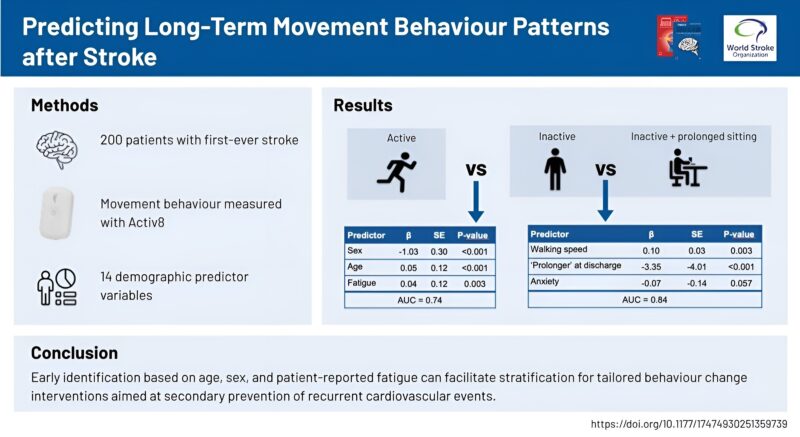
”Development of a clinical prediction rule to identify people at risk of inactive movement behavior patterns. Early identification based on age, sex, and patient-reported fatigue can facilitate stratification for interventions.”
Read the full article here.
Sage Journals recently published an article by Sophie Pagen et al.
A clinical prediction rule has been developed to identify survivors at risk of deteriorating movement behaviour, a key factor for recurrent cardiovascular events.
Based on age, sex, and self-reported fatigue, the tool enables early stratification for tailored interventions to promote physical activity and support secondary prevention.
While internally validated, external validation is needed before clinical application!
Latest updates on stroke management featured in Hemostasis Today.
-
Oct 9, 2026, 10:53Switching From Emicizumab to Denecimig in Hemophilia A – Rare Disease Advisor
-
Oct 9, 2026, 10:40What New U.S. Data Reveal About GT – Glanzmann’s Research Foundation
-
Oct 9, 2026, 10:32Anjali Pandey: The Morphologic Clues to MDS With del(5q)
-
Oct 9, 2026, 10:13Reza Shojaei: 5 Leadership Responsibilities for a Sustainable Plasma Ecosystem
-
Oct 9, 2026, 08:38Johannes Gratz: Perioperative Care in Factor VII Deficiency – Treating the Patient, Not the Number
-
Oct 9, 2026, 08:28Ghanim Fajish: Vascular Cells May Retain a Prothrombotic Memory of Oxidative Stress
-
Oct 9, 2026, 07:43Mehmet Cilingiroglu: The First Diagnosis of Coronary Thrombosis in a Living Patient
-
Oct 9, 2026, 07:21Federico Ravaioli: 40 kPa Spleen Stiffness May Help Avoid Endoscopy in Chronic PVT
-
Oct 9, 2026, 07:00Danny Reardon: Closing the Global Awareness Gap on Blood Clots