


Vincent Ten Cate: The Largest Blood-Based EWAS of Atherosclerosis to Date
Vincent Ten Cate, Group Leader at the University Medical Center Mainz, shared a post on LinkedIn about a recent article he and his co-authord, published in JACC, adding:
“Excited to share our new publication in JACC Journals, presenting the largest blood-based epigenome-wide association study (EWAS) of atherosclerosis to date.
Analyzing 767,735 CpG sites in 3,688 participants from the Gutenberg Health Study and the MyoVasc study, we identified 1,687, 3,131, and 5,852 differentially methylated CpG sites associated with carotid, coronary, and peripheral atherosclerosis, respectively, with 2,155 sites shared across multiple vascular beds.
The strongest signals mapped to four loci: an intergenic region near ALPP/ALPG, AHRR, PRSS23, and F2RL3, with additional prominent associations in ABCG1 and DHCR24 for coronary atherosclerosis.
These genes point toward pathways involving smoking exposure, platelet reactivity and thrombosis, inflammation, and lipid metabolism.
While having been identified in relation to presence of atherosclerosis at baseline, methylation-based scores also predicted future major adverse cardiovascular and cerebrovascular events in an independent cohort, years before their occurrence.
More than 90% of atherosclerosis-associated methylation sites overlapped with established cardiovascular risk factor signatures.
Smoking was by far the dominant contributor (up to 90% overlap), followed by inflammation (60%) and metabolic traits (44%).
Methylation at smoking-related CpG sites took decades to normalize to levels similar to those of non-smokers after smoking cessation, suggesting that blood DNA methylation acts as a long-term molecular record of cumulative cardiovascular risk exposure.
Importantly, prior experimental evidence suggests that such exposure-induced methylation changes may causally contribute to persistent risk.
These findings, generated as part of the curATime project biosignATure, raise the intriguing possibility that persistent exposure-driven epigenetic alterations could become future therapeutic targets.
We are grateful for the guidance of JACC EiC Harlan Krumholz throughout the review process, which helped strengthen the paper, and to all contributors and study participants that made this work possible in the first place.”
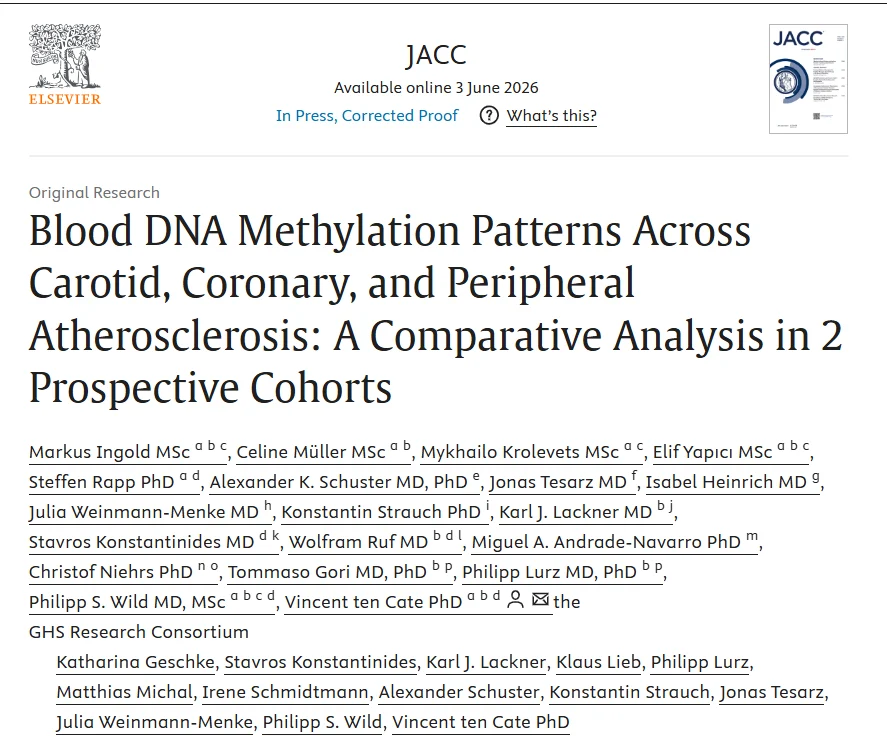
Title: Blood DNA Methylation Patterns Across Carotid, Coronary, and Peripheral Atherosclerosis: A Comparative Analysis in 2 Prospective Cohorts
Authors: Markus Ingold, Celine Müller, Mykhailo Krolevets, Elif Yapıcı, Steffen Rapp, Alexander K. Schuster, Jonas Tesarz, Isabel Heinrich, Julia Weinmann-Menke, Konstantin Strauch, Karl J. Lackner, Stavros Konstantinides, Wolfram Ruf, Miguel A. Andrade-Navarro, Christof Niehrs, Tommaso Gori, Philipp Lurz, Philipp S. Wild, Vincent ten Cate, Katharina Geschke, Klaus Lieb, Matthias Michal, Irene Schmidtmann
Stay updated on all scientific advances with Hemostasis Today.
-
Sep 14, 2026, 20:53YoonHwa An: Rusfertide in Polycythemia Vera – From Clinical Benefit to Strategic Value
-
Sep 14, 2026, 20:52Andres Alberto Mercado Pompa: External Validation of Prognostic Risk Scores in Cerebral Venous Thrombosis
-
Sep 14, 2026, 20:50Balaji Kirushnan: Advancing Regional Citrate Anticoagulation in CRRT – From Experience to Implementation
-
Sep 14, 2026, 20:48Valerie Dehondt: Nutritional Anemia Is Associated With Increased Risk of Severe COPD Exacerbations
-
Sep 14, 2026, 20:46Nupur Choudhury: Exploring AI-Based Detection of Anemia Using Eye and Fingernail Images
-
Sep 14, 2026, 20:44Shamee Shastry: Chart Before You Chase – Diagnosing Drug-Induced Hemolytic Anemia
-
Sep 14, 2026, 20:43David Reiner: Blood Tests That Can Reveal Nutrition Clues
-
Sep 14, 2026, 20:40Giuseppe Biondi Zoccai: Balancing Thrombosis and Bleeding in Acute MI With Hemophilia A
-
Sep 14, 2026, 20:39Kemal Karaagac: Kounis Syndrome as a Possible Cause of Very Late Stent Thrombosis