


Wolfgang Miesbach: Comparing Clinician-Assessed and Patient-Reported Bleeding Scores and Quality of Life
Wolfgang Miesbach, Professor of Medicine at Frankfurt University Hospital, shared on LinkedIn about a recent article by Callie Berkowitz et al, published in RPTH Journal adding:
“Regardless of Diagnosis, Elevated BAT Scores Were Associated with Impairments in QoL.
This cross-sectional study from UNC Chapel Hill examined agreement between clinician-assessed and patient-reported bleeding tools and their relationship to quality of life in 101 adults referred for bleeding disorder evaluation:
The ISTH-BAT and Self-BAT showed strong agreement for menstrual bleeding (α=0.69) and postpartum hemorrhage (α=0.79), but less so for hemarthrosis and muscle hematoma-suggesting self-report works well for gynecologic bleeding domains.
Higher BAT scores correlated significantly with impaired quality of life across multiple domains: fatigue, social functioning, pain interference, sleep disturbance, and physical function.
Most striking: These QoL impairments were driven by bleeding severity (BAT scores) rather than laboratory findings. Patients in the highest ISTH-BAT tertile (scores ≥12) reported fatigue 1.4 SD worse than the US general population, along with pain and sleep disturbances 1.0 SD worse.
Comparable Quality-of-Life Burden Among BDUC and Confirmed Bleeding Disorders.
Patients with bleeding disorder of unknown cause (BDUC) experienced comparable QoL impairments to those with confirmed VWD or platelet defects. A 7-8 point BAT increase corresponded to 0.5 SD worse outcomes-a clinically meaningful effect.
Clinical Implications
Bleeding phenotype profoundly impacts patient wellbeing independent of hemostatic test results, and BAT scores may help identify who most needs comprehensive bleeding disorder care services-including the 45% diagnosed with BDUC.
Congratulations to Callie Berkowitz, Nigel Key and co-authors.”
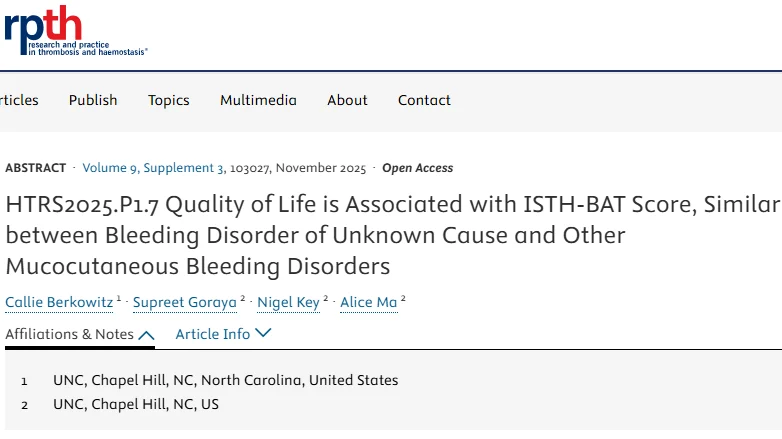
Title: HTRS2025.P1.7 Quality of Life is Associated with ISTH-BAT Score, Similar between Bleeding Disorder of Unknown Cause and Other Mucocutaneous Bleeding Disorders
Authors: Callie Berkowitz, Supreet Goraya, Nigel Key, Alice Ma
Read the Full Article on RPTH Journal.
Find more posts featuring Wolfgang Miesbac on Hemostasis Today.
-
Sep 25, 2026, 06:20Farjah Hassan Algahtani: How Can We Better Identify Patients at Risk of Blood Clots after Metabolic and Bariatric Surgery?
-
Sep 25, 2026, 05:59Carla Lewis: Kids Conquering Sickle Disease Joins Nemours Children’s Hospital for 2nd Annual Awareness Event
-
Sep 25, 2026, 05:47Omid Seidizadeh: Evolutionary Constraint and Population Variation Across Coagulation Genes
-
Sep 25, 2026, 05:40Gerald Bertrand: Presenting UMi-NGS Non-Invasive Foetal HPA Genotyping at DGTI 2026
-
Sep 25, 2026, 05:33Urge Congress to support the Sickle Cell Disease Comprehensive Care Act – ASH
-
Sep 25, 2026, 05:24Isabelle Mahé: Reduced-Dose Apixaban in Extended CAT Treatment
-
Sep 25, 2026, 05:15Maria Cherska: High Cholesterol Isn’t Always Diet or Lifestyle – Sometimes It’s Genetic
-
Sep 25, 2026, 05:07Nancy Braithwaite: BBTS Specialist Certificate in Transfusion Science Practice
-
Sep 24, 2026, 18:43Hugh Nguyen: Honored to Accept the Friend of Singapore Red Cross Award