


Wolfgang Miesbach: This Study from Children’s Hospital of Philadelphia Provides Crucial Insights Into Elevidys
Wolfgang Miesbach, Professor of Medicine at Frankfurt University Hospital, shared on LinkedIn:
”Real-World Data on DMD Gene Therapy: Important Safety Considerations.
This study from Children’s Hospital of Philadelphia provides crucial insights into delandistrogene moxeparvovec (Elevidys), the FDA-approved gene therapy for Duchenne muscular dystrophy:
- 11 young DMD patients (ages 4-6) followed for one year
- All patients showed statistically significant motor improvements
- Median 4-point increase in North Star Ambulatory Assessment scores
Safety Findings:
– 82% experienced treatment-related side effects (higher than clinical trials)
– 3 patients developed elevated cardiac enzymes (troponin-I) up to 43-fold above normal
– Most toxicities emerged 8-12 weeks post-treatment and responded to corticosteroids
– 2 patients with acute liver injury (ALI) who recovered with corticosteroid treatment.
Patient 7: Peak liver enzymes 15-51 fold above normal, met “Hy’s Law” criteria for drug-induced liver injury
Patient 10: Milder liver enzyme elevation (3.4-fold)
– Both patients recovered and no deaths occurred in their cohort of 11 patients.
Clinical Insight:
The study revealed asymptomatic cardiac enzyme elevations – a finding not routinely monitored in pivotal trials.
Authors suggest this may reflect an immune response to the AAV vector, emphasizing the need for enhanced cardiac monitoring protocols.
Critical Context:
This paper (data from Aug 2023-June 2024) predates 3 fatal liver failure cases reported in 2025:
– March 2025: 16-year-old non-ambulatory patient
– June 2025: Second non-ambulatory patient
– July 2025: Adult male in clinical trial
The authors note in their discussion that their findings “cannot be extrapolated to older, non-ambulatory patients, for whom limited efficacy data are available, and whose greater comorbidities may increase susceptibility to AAV-associated toxicity, including two reported mortality events from hepatotoxicity following delandistrogene moxeparvovec administration” – this appears to be referencing the deaths that occurred after their study period.
Current Status:
- FDA resumed shipments for ambulatory patients (July 2025)
- Non-ambulatory patients remain on hold pending safety review
- EMA rejected European approval (July 2025)
Congratulations to Dennis Keselman and co-authors, Ben Samelson-Jones, Susan Matesanz, Lindsey George.”
Read the full article here.
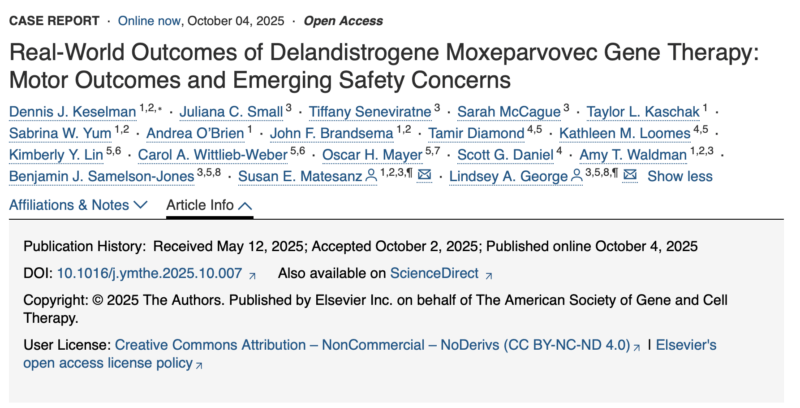
Article: Real-World Outcomes of Delandistrogene Moxeparvovec Gene Therapy: Motor Outcomes and Emerging Safety Concerns
Authors: Dennis J. Keselman, Juliana C. Small, Tiffany Seneviratne, Sarah McCague, Taylor L. Kaschak, Sabrina W. Yum, Andrea O’Brien, John F. Brandsema, Tamir Diamond, Kathleen M. Loomes, Kimberly Y. Lin, Carol A. Wittlieb-Weber, Oscar H. Mayer, Scott G. Daniel, Amy T. Waldman, Benjamin J. Samelson-Jones, Susan E. Matesanz, Lindsey A. George
Stay updated on all scientific advances with Hemostasis Today.
-
Oct 10, 2026, 10:40Juan Cristóbal Morales Muñoz: Pharmacokinetic Profiling of Factor VIII Concentrates in Chilean Patients
-
Oct 10, 2026, 10:32Randall Schaefer: When Your Prehospital Agency Reports Blood Product Wastage Rates, What is it Really Reporting?
-
Oct 10, 2026, 10:26Simone Strasser: ROTEM-Guided Transfusion Cuts Blood Product Use in Patients with Cirrhosis
-
Oct 10, 2026, 10:18Jérôme S.: WHO Launches Global Roadmap to Combat Hypertensive Disorders of Pregnancy
-
Oct 10, 2026, 10:07Maha Othman: Look Forward to an Amazing ISTH 2027 in Vancouver!
-
Oct 10, 2026, 10:02Rucha Patil: National Convening Highlights Opportunities for Equitable Hemophilia Care Across India
-
Oct 10, 2026, 09:52Yuria Ito: Should Ferritin Testing Become a Routine Part of Prenatal Care in Japan?
-
Oct 10, 2026, 09:48Ahmed Alotaibi: Can We “Remove” the ABO Problem from Group O Platelets?
-
Oct 10, 2026, 09:31Help Shape the New ASH Iron Deficiency Guidelines – American Society of Hematology