


Wolfgang Miesbach Explains The New 2-year Survival Data from the GTH-AHA-EMI Study
Wolfgang Miesbach, Professor of Medicine at Frankfurt University Hospital, shared on LinkedIn:
”This slide you’ll be seeing more often!
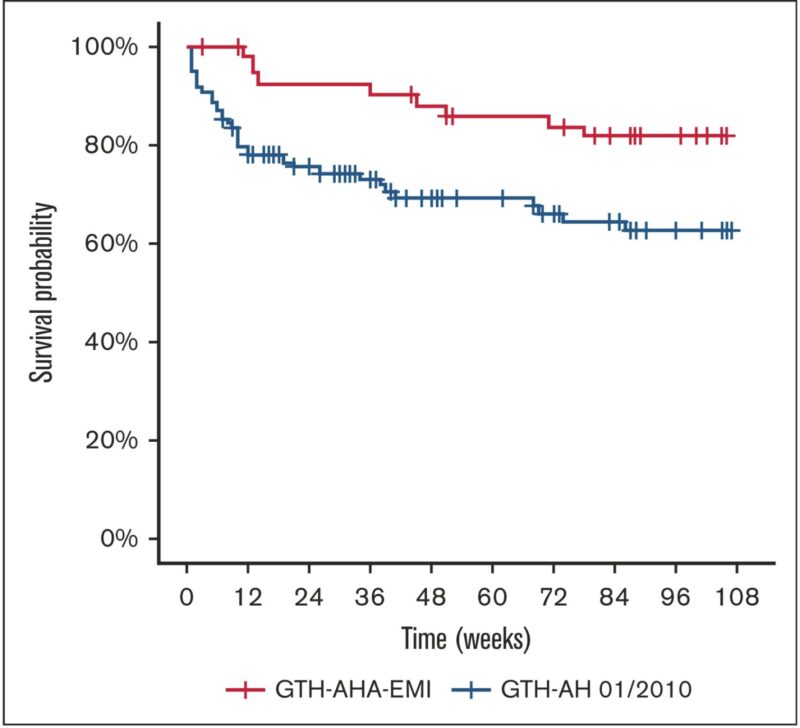
In acquired haemophilia A, this Kaplan-Meier survival curve demonstrates a remarkable 19% absolute survival benefit: The 2-year survival data from the GTH-AHA-EMI study just published shows something remarkable: 82% versus 63%, when emicizumab prophalxis lead to postponed immunosuppression (GTH-AHA-EMI) versus 63% with immediate IST (GTH-AH 01/2010).
The paradigm change: Emicizumab prophylaxis combined with postponed immunosuppression (IST) can protect patients from bleeding while deferring the intensive IST until they’re better able to tolerate it, what is fundamentally shifting the risk-benefit equation.
What else is new?
- Fatal infections: 4% with the new strategy vs. 16% with immediate IST – a 75% reduction in infection-related mortality
- Mortality reduction: The hazard ratio was slashed by 61% (HR 0.39)
- Efficacy maintained: 76% of patients achieved complete remission
- New IST regimens: 56% of patients received rituximab (vs. only 20% in the historical cohort), with lower cumulative corticosteroid doses and less cyclophosphamide exposure
- Spontaneous remission opportunity: 6 patients (15%) achieved remission without IST – a rate we couldn’t observe when forced into immediate treatment
- Safer IST introduction: When bleeding is controlled and patients are ambulatory, IST becomes nonurgent and can be introduced at lower risk of nosocomial infections
As the accompanying excellent commentary by Teitel and St-Louis emphasizes: effective prophylaxis renders IST nonurgent.
This isn’t a rigid protocol – it’s clinical flexibility that allows individualized decision-making for our frail AHA patients.
The full paper is now live in Blood Advances.
Congratulations to Andreas Tiede and the GTH-AHA working group on this outstanding study!”
Read the full article here.
Article: Sustained survival benefit of emicizumab and postponed immunosuppression in acquired hemophilia A
Authors: Inga M. Schimansky, Christiane Dobbelstein, Robert Klamroth, Christina Hart, Ulrich J. Sachs, Richard Greil, Paul Knöbl, Johannes Oldenburg, Wolfgang Miesbach, Christian Pfrepper, Karolin Trautmann-Grill, Patrick Möhnle, Katharina Holstein, Hermann Eichler, Sonja Werwitzke, Andreas Tiede
Stay updated with Hemostasis Today.
-
Oct 10, 2026, 02:38Brianne D.: Sex Differences in RIPK1 Signaling Following Intracerebral Hemorrhage
-
Oct 10, 2026, 02:17Dino Mehic: Managing Heavy Menstrual Bleeding in Patients with BDUC
-
Oct 10, 2026, 00:34Raphaëlle Dodart: Discussing the Mechanisms of Menstrual Hemostasis
-
Oct 10, 2026, 00:26Barbara Adams Krolak: Discussing the Growing Need for Blood Clot Prevention in Asia
-
Oct 9, 2026, 23:59Ana Pedrero Gil: Is Coagulopathy with Fibrinolysis Present in All Obstetric Hemorrhages?
-
Oct 9, 2026, 23:57Exploring the Psychosocial Needs of People with Bleeding Disorders in Kyrgyzstan – EAHAD
-
Oct 9, 2026, 23:53Bernard Slater Jr.: Serving on the Advisory Council for the NBDF West Virginia Chapter
-
Oct 9, 2026, 23:53Aurelio Maggio: Thalassemia Reports Real-Time Impact Factor Rises to 1.760
-
Oct 9, 2026, 23:52Stronger Connections, Stronger Organizations – World Federation of Hemophilia