


Mattia Galli On Genomadix Cube Test: A Rapid Genetic Test to Predict The Response to Clopidogrel
Mattia Galli, Assistant Professor at Sapienza University of Rome, Associate Editor of European Heart Journal, reposted from Mater Dei General Hospital on LinkedIn:
”Would you take a life-saving drug knowing that in one case out of three this does not work? Probably not.
In the heart of Rome, one of the first centers in Italy to finally offer the possibility of predicting the response to the most widely used anti-caking drug, clopidogrel, with a simple and rapid genetic test.
The result of the test is integrated with the most up-to-date international recommendations on the subject, to which I had the honor of contributing, to offer a personalized assessment and improve the prognosis of patients in each specific clinical context.
After years of scientific research, it is time to turn science into real benefits for a more targeted and personalized care of cardiovascular patients.”
Mater Dei General Hospital shared on LinkedIn:
”What is the Genomadix Cube test?
It is a simple and non-invasive genetic test that helps to understand how our body responds to some fundamental drugs in cardiology, such as antiplatelet drugs that inhibit P2Y12 (clopidogrel, prasugrel or ticagrelor)
Let’s find out more with Dr. Mattia Galli
Info and reservations
Tel. 06 83 803”
Read the full article in JACC.
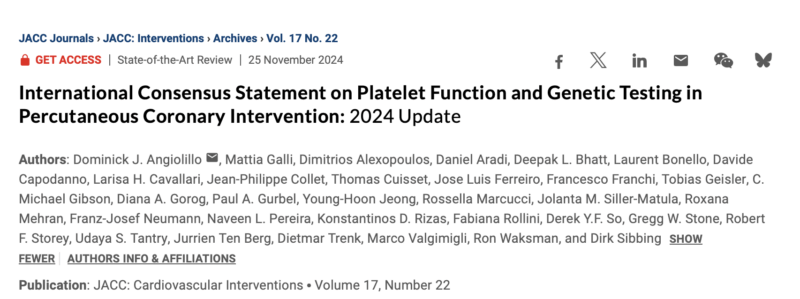
Article: International Consensus Statement on Platelet Function and Genetic Testing in Percutaneous Coronary Intervention: 2024 Update
Authors: Dominick J. Angiolillo, Mattia Galli, Dimitrios Alexopoulos, Daniel Aradi, Deepak L. Bhatt, Laurent Bonello, Davide Capodanno, Larisa H. Cavallari, Jean-Philippe Collet, Thomas Cuisset, Jose Luis Ferreiro, Francesco Franchi, Tobias Geisler, C. Michael Gibson, Diana A. Gorog, Paul A. Gurbel, Young-Hoon Jeong, Rossella Marcucci, Jolanta M. Siller-Matula, Roxana Mehran, Franz-Josef Neumann, Naveen L. Pereira, Konstantinos D. Rizas, Fabiana Rollini, Derek Y.F. So, Gregg W. Stone, Robert F. Storey, Udaya S. Tantry, Jurrien Ten Berg, Dietmar Trenk, Marco Valgimigli, Ron Waksman, Dirk Sibbing
Stay updated on all scientific advances with Hemostasis Today.
-
Nov 25, 2026, 02:17Ahmad G. Alzahrani: Why Iron Is Low Despite High Ferritin in Inflammatory Anemia?
-
Nov 24, 2026, 15:57100 Years of von Willebrand Disease – From VWF Structure to Clinical Management and Future Directions – Seminars in Thrombosis and Hemostasis
-
Nov 24, 2026, 15:46Matthew Hazell: Rare Blood – Connecting Science with the Patient Experience
-
Nov 24, 2026, 15:23Cold Agglutinin Disease: Beyond Hemolysis Toward Complement-Directed Treatment
-
Nov 24, 2026, 15:19Essama Telli: Recognizing Retiform Purpura as a Sign of Vascular Injury and Thrombosis
-
Nov 24, 2026, 15:11Kerstin Piayda: University Hospital Giessen Performs Europe’s First PE Procedure With Lightning Flash 3.0
-
Nov 24, 2026, 14:55Cecilia Kretz: Evaluating Aspirin-Free Antithrombotic Strategies in HeartMate 3 Patients
-
Nov 24, 2026, 14:54The Future of Global Hemophilia Care and the Impact of the World Health Assembly Resolution
-
Nov 24, 2026, 14:39Andrija Velevski: Why Oxygen Availability Does Not Guarantee Tissue Oxygenation