

Dr Abdul Mannan: Clonal Haematopoiesis – More Common, More Complex
Dr Abdul Mannan, Consultant Haematologist at Betsi Cadwaladr University Health Board, posted on LinkedIn:
“Clonal Haematopoiesis: More Commoon. More Complex. More Relevant Than We Realised.
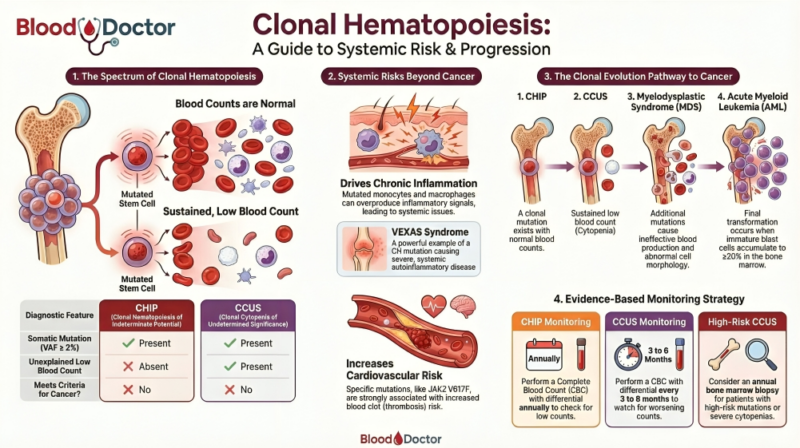
Today I shared an updated infographic on Clonal Haematopoiesis – a topic that has quietly moved from academic curiosity to something every clinician should have on their radar.
What struck me most while putting this together is how far beyond cancer this story goes.
For years, we framed CHIP and CCUS as “pre-leukaemic”. The problem is… that’s only half the picture.
These tiny clones behave like slow-burning fires.
They sit in the marrow, send out inflammatory signals, and nudge the immune system into a persistent “low-grade storm”. The result?
Higher rates of ischaemic heart disease, stroke, and heart failure, particularly with mutations like TET2, DNMT3A, JAK2 V617F.
And in the real world, that’s often where the danger lies.
The infographic breaks it down clearly:
- CHIP – mutation present, blood counts normal
- CCUS – mutation + sustained cytopenias
- High-risk CCUS – where leukaemic transformation risk climbs
- VEXAS – the perfect reminder that a “clonal process” doesn’t always behave like a cancer
It also highlights a simple monitoring approach that doesn’t overwhelm patients or clinics:
- CHIP → annual CBC
- CCUS → every 3–6 months
- High-risk patterns → consider marrow assessment and closer follow-up
As haematologists, we’re used to dealing with rapid, dramatic conditions.
Clonal haematopoiesis is the opposite.
Quiet. Slow. Easy to miss.
Until it isn’t.
If you’re teaching trainees, reviewing cardiology referrals, or running a general haematology clinic, this is a space worth understanding.
I’ll keep sharing more simplified, practical resources like this – to make the science accessible not just for exam preparation, but for real clinical decision-making.
Happy to discuss cases, interpretations, and grey areas.
The dialogue around this is just beginning.”
Follow the latest with Hemostasis Today.
-
Sep 20, 2026, 09:51Ceasovschih Alexandr: A Closer Look at Lipid Disorders in CKM Syndrome
-
Sep 20, 2026, 09:05World Stroke Academy: Can Adjunct IAT Improve Tissue Reperfusion?
-
Sep 20, 2026, 06:46Neeraj Songara: From Donated Blood to Engineered Therapeutics
-
Sep 20, 2026, 06:24Louise St. Germain Bannon: Improving Awareness and Care for Women Across the Lifespan
-
Sep 20, 2026, 05:17Maxime Dely: When ABO Compatibility Isn’t Enough for Safe Transfusion
-
Sep 20, 2026, 04:54William Aird: What Does a Complete History and Physical Really Mean?
-
Sep 20, 2026, 04:34Hons Saurabh Kaushik: Why Uncontrolled LDL Can Be Harmful
-
Sep 20, 2026, 03:58Salih Ehsan: The Complexities of HbF and HbA2
-
Sep 20, 2026, 03:22The Voices of People Living With Bleeding Disorders – EHC