


Why is DVT More Common In the Left Leg? Dr Raheel Moazzam’s New Study Gives Answers!
Dr Raheel Moazzam, Ultrasound specialist at ROC Clinic, posted on LinkedIn:
“Why is DVT more common in the left leg? It might be more than just “compression.”
I am excited to share the findings of my recent research at Imperial College London, where I investigated the anatomical markers that predispose individuals to Deep Vein Thrombosis (DVT).
While left-sided DVT is traditionally linked to May–Thurner syndrome (external compression by artery), my study explores a different angle: Intrinsic anatomy.
Key Takeaways from the Study:
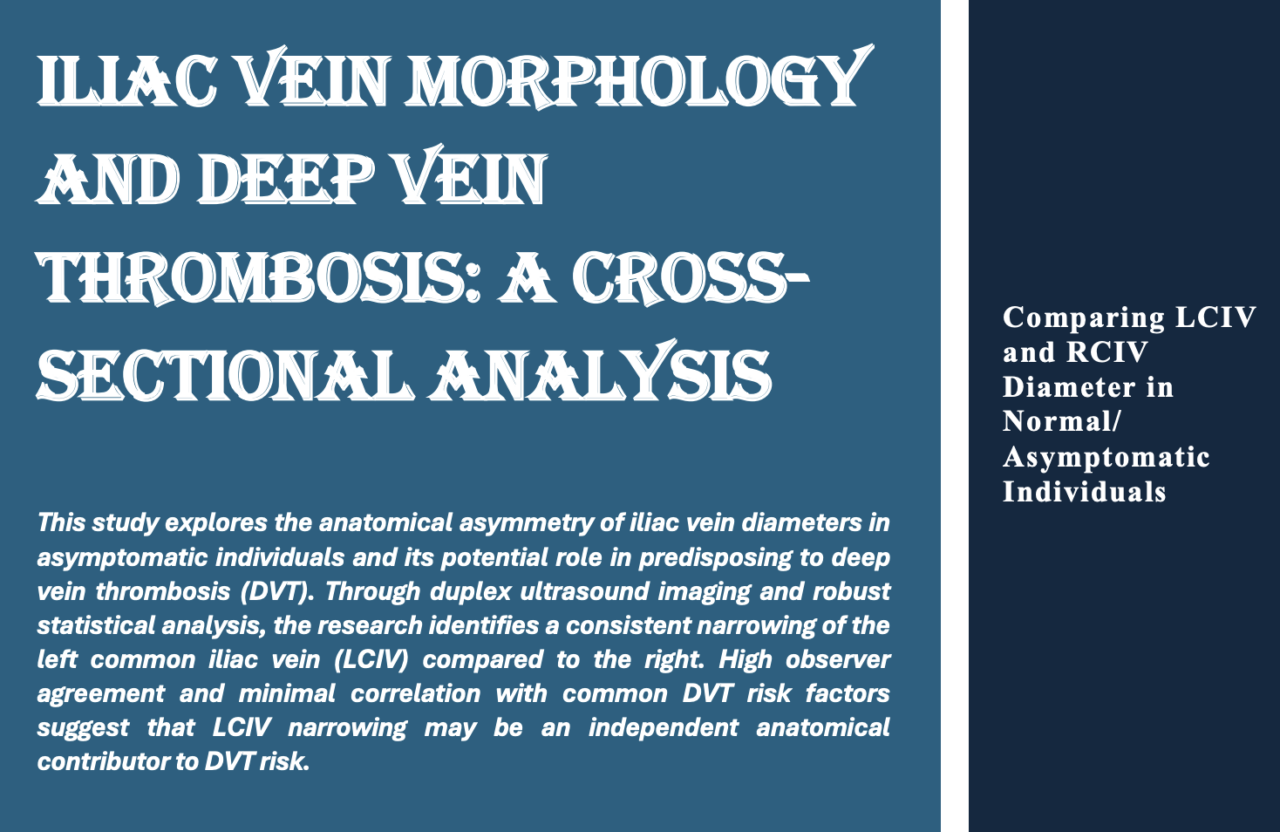
- The “Left-Side” Difference: Even in asymptomatic individuals without external compression, the left common iliac vein (LCIV) was significantly narrower—averaging 2mm smaller than the right.
- An Independent Risk Factor: This narrowing appears to be a stable, intrinsic anatomical trait. It did not correlate with common risk factors like BMI or hydration status, suggesting some of us may simply be “wired” with a higher baseline risk for venous stasis.
- Proactive vs. Reactive: This research highlights a potential shift in how we screen for DVT. By identifying these anatomical variations early via duplex ultrasound, we could move toward proactive prevention for high-risk individuals.
Vascular health is often about the things we cannot see. I hope this work contributes to better risk stratification and earlier interventions for those at risk of iliofemoral DVT.
A huge thank you to my mentor, Dr. Mohammed Farid Aslam, and the team at the Heart and Lungs Institute for their invaluable support.
I’ve attached the full article below. I’d love to hear your thoughts, especially from fellow vascular scientists and clinicians!”
Title: Iliac Vein morphology and deep vein thrombosis: a cross-sectional analysis
Authors: Dr Raheel Moazzam, Dr. Mohammed Farid Aslam
Read full study here.
More posts exploring DVT and other hematology diseases in Hemostasis Today.
-
Oct 22, 2026, 18:04Basem Goueli: Blood Clots in the NFL
-
Oct 22, 2026, 17:57Syed Ahmed: Viral Triggers of Immune Thrombocytopenia and Thrombosis
-
Oct 22, 2026, 17:49Valerie Tutwiler: Bridging Engineering and Medicine to Advance Thrombosis Research
-
Oct 22, 2026, 17:41Jesus Ardila Novoa: How Patient Education Can Transform Hemophilia Care
-
Oct 22, 2026, 17:30Filipe Gonçalves: Advancing Bleeding Disorder Diagnosis Through Multidisciplinary Collaboration
-
Oct 22, 2026, 17:17Storage Pool Deficiency An Overview of a Rare Platelet Disorder – EHC
-
Oct 22, 2026, 17:10Matthew Hazell: Optimizing the Use of Rare Red Blood Cell Units
-
Oct 22, 2026, 17:03Smita Patil: New Insights Into Platelet Alpha-Granule Secretion
-
Oct 22, 2026, 16:48Ahmed Alotaibi: Rare Rh Phenotype and Severe Fetal Anaemia