


Deepak Yadav: Is Ablation a Substitute for Anticoagulation in Preventing Recurrent Stroke?
Deepak Yadav, Consultant and Assistant Professor of Neurology at Amrita Hospital, shared on LinkedIn about a recent article by Kazumi Kimura et al, published in JAMA Neurology:
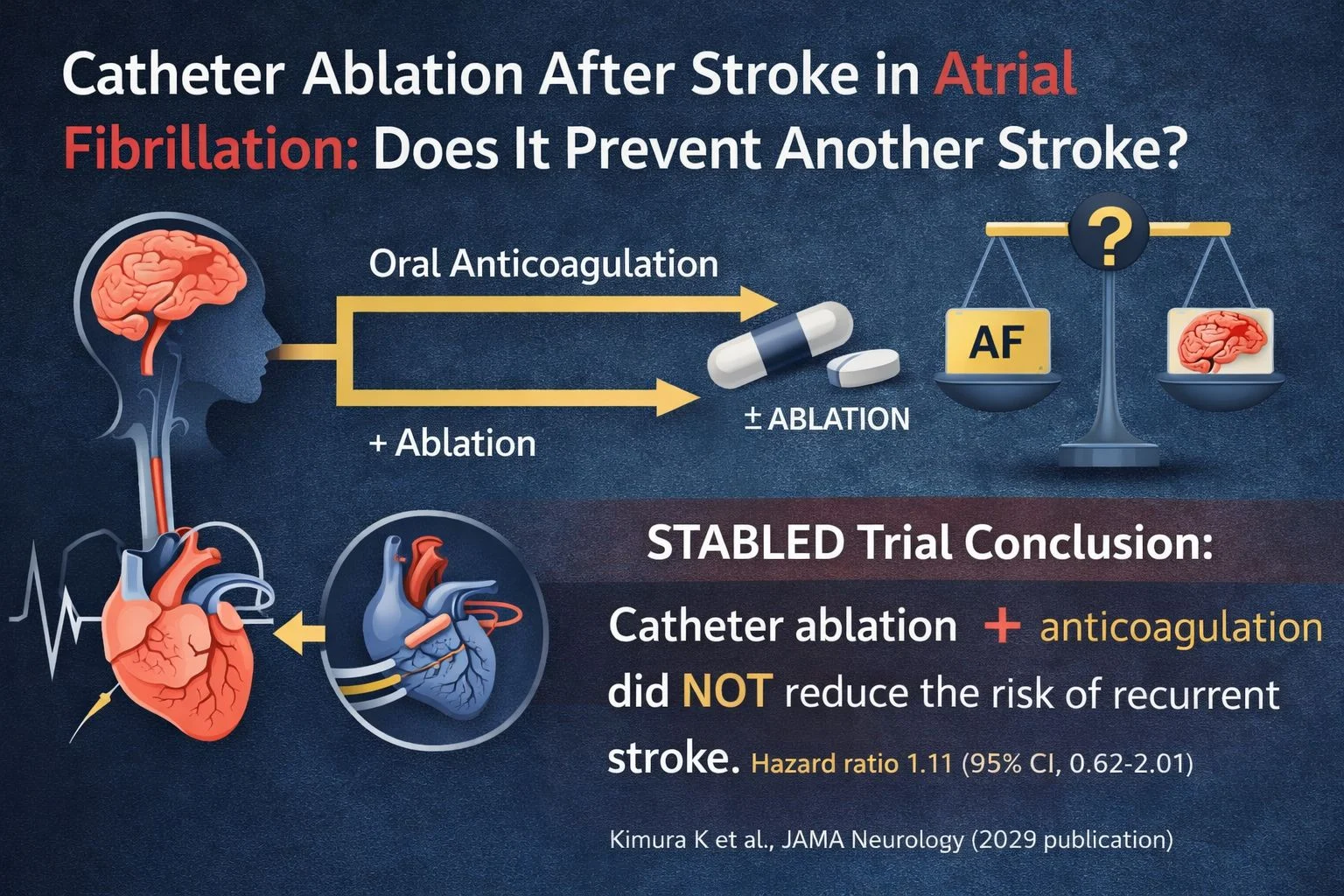
”Catheter Ablation After Stroke in Atrial Fibrillation: Does It Really Prevent Another Stroke?
For years, many of us believed that catheter ablation for atrial fibrillation might reduce recurrent stroke risk.
The logic seemed strong:
- AF leads to embolic risk
- Restore sinus rhythm, reduce emboli, prevent stroke.
But a new randomized clinical trial just challenged that assumption.
A new study published in JAMA Neurology (March 2026) tested this question directly.
The Study
The STABLED Randomized Clinical Trial
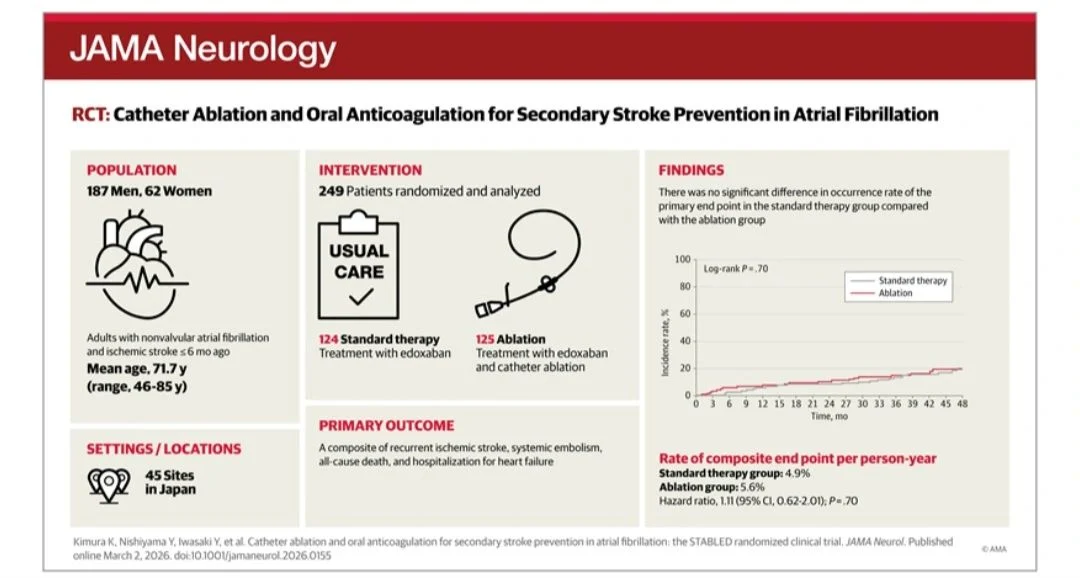
Patients with:
- Non-valvular atrial fibrillation
- Recent ischemic stroke
Already receiving anticoagulation (edoxaban) were randomized to:
1.Standard therapy (anticoagulation)
2.Standard therapy plus catheter ablation
- 249 patients
- 45 centers in Japan
- Median follow-up > 3 years
The Primary Outcome
Composite of:
- Recurrent ischemic stroke
- Systemic embolism
- All-cause death
- Heart failure hospitalization
The Result?
No significant difference.
Event rates:
- Standard therapy: 4.9% per person-year
- Ablation group: 5.6% per person-year
- Hazard ratio: 1.11
Meaning:
Catheter ablation did NOT reduce recurrent stroke or major cardiovascular outcomes.
Why This Matters
This challenges an important clinical assumption.
While catheter ablation:
- Improves symptoms
- Improves rhythm control
It may not reduce stroke risk beyond anticoagulation in patients who already had a stroke.
Clinical Takeaway
For secondary stroke prevention in atrial fibrillation: Anticoagulation remains the cornerstone.
Rhythm control strategies like ablation should be considered primarily for:
- Symptom control
- Quality of life
- Tachycardia-mediated cardiomyopathy – not necessarily stroke prevention.
But There Is a Caveat
The authors note that the study may have been underpowered due to lower-than-expected event rates.
So the final answer may still require larger trials.
But for now:
Ablation is not a substitute for anticoagulation in preventing recurrent stroke.
Reference
Kimura K, Nishiyama Y, Iwasaki Y, et al.
Catheter Ablation and Oral Anticoagulation for Secondary Stroke Prevention in Atrial Fibrillation – The STABLED Randomized Clinical Trial.
JAMA Neurology. Published March 2, 2026.
doi:10.1001/jamaneurol.2026.0155
Question for the community
- Would this evidence change your referral strategy for AF ablation after stroke?
- Or do you still believe rhythm control could have long-term stroke benefits?
Let’s discuss.”
Title: Catheter Ablation and Oral Anticoagulation for Secondary Stroke Prevention in Atrial Fibrillation. The STABLED Randomized Clinical Trial
Authors: Kazumi Kimura, Yasuhiro Nishiyama, Yu-ki Iwasaki, Wataru Shimizu, Kazunori Toyoda, Yuki Sakamoto, Takehiro Katano, Teppei Yamamoto, Masataka Takeuchi, Kenta Kumagai, Kazuma Tsuto, Kaoru Sugi, Kengo Kusano, Masatoshi Koga, Seiji Okubo, Takahiro Sato, Hirotoshi Hamaguchi, Akihiro Yoshida, Ayako Kuriki, Kaoru Tanno, Kazuo Kitagawa, Nobuhisa Hagiwara, Hiroyuki Daida, Yasuyuki Iguchi, Shigeru Fujimoto, Susumu Miyamoto, Masayuki Fukuzawa, Masako Sugimoto, Atsushi Takita, Toshiaki Otsuka, Ken Okumura
Read the Full Article on JAMA Neurology
Stay updated on all scientific advances with Hemostasis Today.
-
Oct 22, 2026, 06:43Giacomo Buso: Lifelong Carotid Risk vs. Late-Stage Trial Neutrality
-
Oct 22, 2026, 06:35Aastha Gupta: Navigating the Diagnostic Challenge of Restricted NK-Cell Repertoires in Flow Cytometry
-
Oct 22, 2026, 06:25Ahmed Alotaibi: Platelet Refractory, But HLA-negative – What Are You Missing?
-
Oct 22, 2026, 06:17Alessandra Bosch: Swiss Medical Weekly Publishes National Guidance on Desmopressin for Bleeding Disorders
-
Oct 22, 2026, 05:24Archil Jaliashvili: Hemoglobin Dose in Red Cell Transfusion
-
Oct 22, 2026, 03:40Hussein Burestom: Blood and Plasma as Strategic Resources for National Health Security
-
Oct 22, 2026, 03:28João Paulo Marochi Telles: Antibiotic Treatment in Febrile Neutropenia
-
Oct 21, 2026, 18:13Wolfgang Miesbach: Hereditary Hemorrhagic Telangiectasia Is an Overlooked Bleeding Disorder
-
Oct 21, 2026, 17:55Gayatri Kotwal։ New Review on Anemia, Pain, and Nutritional Deficiencies in Cancer Patients