


Heghine Khachatryan: How DOACs Can Cause False-Positive FVIII Inhibitor Results
Heghine Khachatryan, Editor-in-Chief of Hemostasis Today, Head of Hemophilia and Thrombosis Center at Yeolyan Hematology and Oncology Center, shared RPTH‘s post on LinkedIn:
“Direct oral anticoagulants (DOACs) have transformed the prevention and treatment of thrombosis.
However, their presence in plasma can significantly interfere with clot-based laboratory assays, including one of the most critical tests in hemophilia care — the Factor VIII inhibitor assay.
A recent brief report published in Research and Practice in Thrombosis and Haemostasis highlights an important diagnostic challenge:
DOACs may produce false-positive results in FVIII inhibitor testing, potentially leading to misinterpretation and inappropriate clinical decisions.
The study demonstrates that:
- DOACs interfere with clot-based FVIII inhibitor assays
- The degree of interference varies between agents
- Activated charcoal–based DOAC removal can significantly restore assay reliability
For clinicians and laboratory specialists, this serves as an important reminder:
Accurate inhibitor diagnostics require awareness of anticoagulant interference and appropriate pre-analytical handling of samples.
Strengthening collaboration between clinical hematologists and coagulation laboratories remains essential for precise diagnosis and optimal patient care.”
Research and Practice in Thrombosis and Haemostasis shared a post on LinkedIn, about a recent article by Rick Timmerije et al, adding:
“Could anticoagulants be quietly distorting one of our most important hemophilia assays?
Direct oral anticoagulants (DOACs) are widely used, but they can create a hidden diagnostic trap.
A new RPTH study shows that DOACs can interfere with the factor VIII inhibitor (Nijmegen–Bethesda) assay, producing false-positive inhibitor results that could mislead clinical decisions.
Here’s the key signal:
- All tested DOACs caused concentration-dependent false-positive FVIII inhibitor results.
Dabigatran produced the strongest interference, while apixaban showed the least effect.
Why this matters clinically
- False inhibitor diagnosis
- Unnecessary immunosuppression
- Inappropriate use of bypassing agents
- Delayed recognition of true acquired hemophilia
But there is a practical solution:
Activated charcoal–based DOAC removal restored assay accuracy, bringing inhibitor measurements back within normal assay variability.
Translation:
Sometimes the problem isn’t the patient, it’s the assay.
Big questions for clinicians and labs:
- Should DOAC removal become routine before inhibitor testing?
- How many ‘inhibitors’ might actually be assay interference?
- Do other clot-based assays face similar hidden bias?”
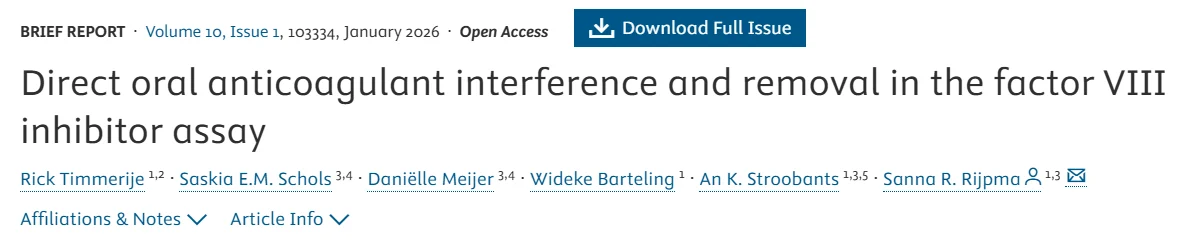
Title: Direct oral anticoagulant interference and removal in the factor VIII inhibitor assay
Authors: Rick Timmerije, Saskia E.M. Schols, Daniëlle Meijer, Wideke Barteling, An K. Stroobants, Sanna R. Rijpma
Read Full Article on RPTH
Othe posts featuring Heghine Khachatryan on Hemostasis Today.
-
Jul 24, 2026, 17:16Mona Ranade։ Can Artificial Intelligence Accelerate Stroke Treatment?
-
Jul 24, 2026, 17:06Eunice Obinna: Hemoglobin and Hematocrit – What Do They Really Tell Us?
-
Jul 24, 2026, 16:52Subodh Grewal: RBC and Platelet Histogram Interpretation
-
Jul 24, 2026, 16:47Samwel Mikaye: Advancing the Global Fight Against Postpartum Hemorrhage
-
Jul 24, 2026, 16:17Michele Spino Bolles: How Stroke Certification Standards Improve Patient Outcomes
-
Jul 24, 2026, 15:53Duy Thai Duong Le: Highlights from an Inspiring Week at ISTH 2026
-
Jul 24, 2026, 15:26Satish Kumar Devarapu: Returning from ISTH 2026 with New Perspectives
-
Jul 24, 2026, 15:09Everton Amorim: The Diagnostic Significance of Elliptocytosis
-
Jul 24, 2026, 14:54Imran Shahid: Morphological Assessment in the Differentiation of True and Pseudothrombocytopenia