


Samwel Mikaye: Understanding D-Dimer in Clinical Practice
Samwel Mikaye, Medical Doctor at MSK, shared a post on LinkedIn:
”What is D-Dimer?
D-dimer is a protein fragment produced when a blood clot is broken down in the body. It is normally undetectable or very low in the blood, but levels rise when the body forms and breaks down clots.
It is used primarily as a lab test to help rule out clotting disorders.
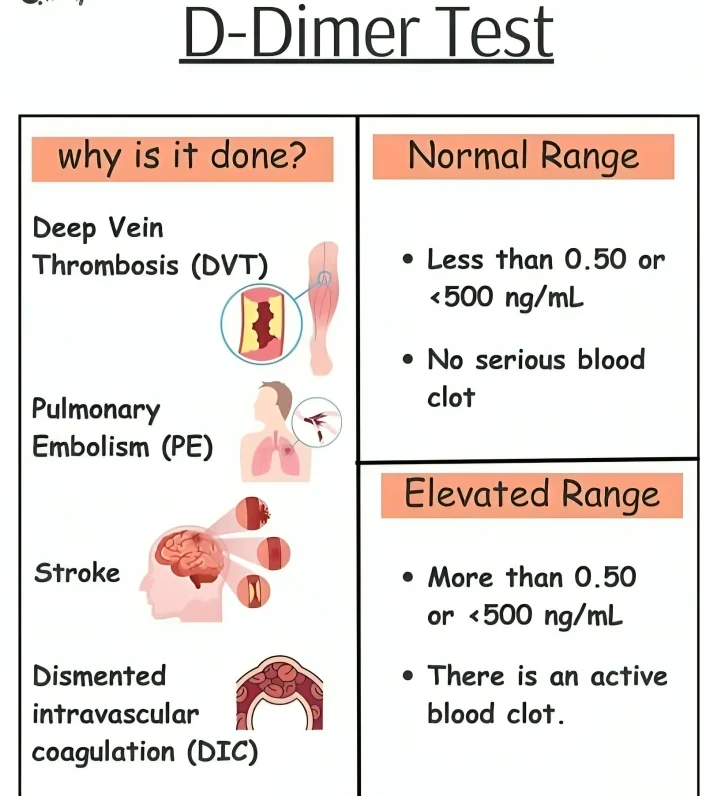
Common Uses of D-Dimer Test
- Suspected Deep Vein Thrombosis (DVT) – Clots in deep veins, usually in legs.
- Pulmonary Embolism (PE) – Clots in the lungs.
- Disseminated Intravascular Coagulation (DIC) – Abnormal widespread clotting and bleeding.
- Sometimes used to monitor clot breakdown in known clotting conditions.
Interpretation
- Normal/Low D-dimer → Clotting disorder unlikely.
- High D-dimer → Suggests recent or ongoing clot formation and breakdown, but not specific. Many conditions can raise D-dimer:
- Infection
- Inflammation
- Recent surgery or trauma
- Liver disease
- Cancer
Important: A high D-dimer does not confirm a clot. Imaging (like Doppler ultrasound or CT scan) is usually needed to diagnose DVT or PE.
Advantages
- Quick blood test.
- Good for ruling out clots in low-risk patients.
Limitations
- Non-specific – many conditions can raise it.
- Not useful alone to diagnose a clot.
- Less reliable in elderly patients or those with chronic illnesses.
Think of D-dimer as a ‘smoke alarm’: a high level signals something may be wrong with clotting, but you need further tests to find the fire (actual clot).”
Other posts featuring Samwel Mikaye on Hemostasis Today.
-
Sep 25, 2026, 07:25Varun Capoor: How Therapeutic Apheresis and Transfusion Medicine Can Complement Clinical Management in SCD
-
Sep 25, 2026, 07:14Manshi Kesharwani: SAK-GQDs Modulate Thrombus Burden and Endothelial Function in Deep Vein Thrombosis
-
Sep 25, 2026, 06:20Farjah Hassan Algahtani: How Can We Better Identify Patients at Risk of Blood Clots after Metabolic and Bariatric Surgery?
-
Sep 25, 2026, 05:59Carla Lewis: Kids Conquering Sickle Disease Joins Nemours Children’s Hospital for 2nd Annual Awareness Event
-
Sep 25, 2026, 05:47Omid Seidizadeh: Evolutionary Constraint and Population Variation Across Coagulation Genes
-
Sep 25, 2026, 05:40Gerald Bertrand: Presenting UMi-NGS Non-Invasive Foetal HPA Genotyping at DGTI 2026
-
Sep 25, 2026, 05:33Urge Congress to support the Sickle Cell Disease Comprehensive Care Act – ASH
-
Sep 25, 2026, 05:24Isabelle Mahé: Reduced-Dose Apixaban in Extended CAT Treatment
-
Sep 25, 2026, 05:15Maria Cherska: High Cholesterol Isn’t Always Diet or Lifestyle – Sometimes It’s Genetic