


Ifeanyichukwu Ifechidere: What Do You Understand about Anticoagulant Interference in Coagulation Tests?
Ifeanyichukwu Ifechidere, Biomedical Scientist at Sheffield Teaching Hospitals NHS Foundation Trust, shared a post on LinkedIn:
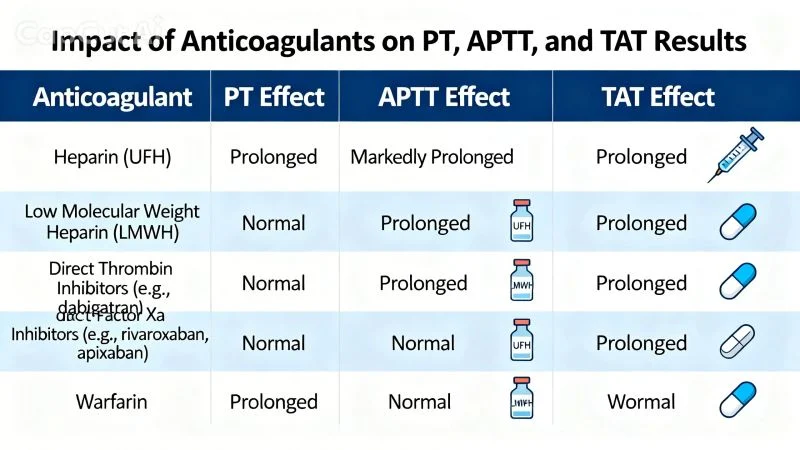
“What Do You Understand About Anticoagulant Interference in Coagulation Tests?
One of the most common – and most misinterpreted – causes of abnormal coagulation results is anticoagulant interference.
Before diagnosing a factor deficiency or inhibitor, we must always ask:
Is this a true coagulopathy – or drug effect?
Failure to recognize anticoagulant interference leads to:
- Unnecessary factor assays
- Misdiagnosis
- Delayed procedures
- Incorrect clinical decisions
Let’s break it down clearly.
1. Heparin (UFH)
Most affected test: APTT
APTT: Prolonged
PT: Normal or mildly prolonged
Thrombin Time (TT): Markedly prolonged
Clue: Prolonged TT that corrects with heparin neutralization.
2. Low Molecular Weight Heparin (LMWH)
APTT: Often normal
Anti-Xa assay required for monitoring
Important: A normal APTT does NOT exclude LMWH effect.
3. Direct Oral Anticoagulants (DOACs)
These are increasingly common and frequently confuse interpretation.
- Direct Thrombin Inhibitors (e.g., dabigatran)
APTT: Prolonged
TT: Very sensitive (markedly prolonged)
- Direct Factor Xa Inhibitors (e.g., rivaroxaban, apixaban)
PT: May be prolonged (reagent-dependent)
APTT: Variable
Anti-Xa (drug-specific) assay preferred
Key issue: Routine PT/APTT cannot reliably quantify DOAC effect.
4. Warfarin
PT/INR: Prolonged
APTT: May be mildly prolonged
Classic isolated prolonged PT pattern.
Why This Matters in the Laboratory
Anticoagulant interference can mimic:
- Factor deficiencies
- Liver disease
- DIC
- Inhibitors
Without medication history, interpretation becomes guesswork.
Practical Laboratory Approach
Before escalating to mixing studies or factor assays:
- Confirm medication history
- Consider timing of last dose
- Review thrombin time
- Use drug-specific assays when indicated
- Communicate with clinicians
Take-Home Message
Not every prolonged PT or APTT indicates pathology.
Sometimes, it simply reflects pharmacology.
Interpretation without clinical context is incomplete.”
Stay updated with Hemostasis Today.
-
Sep 29, 2026, 03:53Nahrwan Masaoodi: Iron Deficiency Can Exist Without Anemia
-
Sep 29, 2026, 03:38Muhammad Yousaf: Iron Deficiency Beyond Diet
-
Sep 29, 2026, 03:21Parvez Ahmed Chowdhury: Synthesizing Aspirin in the Organic Chemistry Lab
-
Sep 29, 2026, 03:12Ahmed Hamandi: Building the Future of Hematopoietic Transplantation in Iraq
-
Sep 29, 2026, 03:09M V Chandrakanth: Aspirin in CRC – Old Drug, New Precision Oncology?
-
Sep 29, 2026, 03:07Caroline Pothet: Advancing Treatment Development in Sickle Cell Disease and Thalassaemia
-
Sep 29, 2026, 02:53Astha Jain: Thalassemia Care Through a Public Health Lens
-
Sep 29, 2026, 02:50Emma Groarke: Starting a New Career Path in Homeland
-
Sep 28, 2026, 19:14Aditya Sharma: An Outstanding Start to the Final Day of VSS 2026!