

Robert Talac: Is PRP Truly Autologous?
Robert Talac, Medical Director at Renaxis Regenerative Orthopedic Center, shared a post on LinkedIn:
“PRP Is Not Fully Autologous.
We should probably talk about that.
I’ve been in regenerative medicine for over 30 years.
For most of that time, PRP was widely accepted as the gold standard of autologous biologics.
I want to challenge that.
Here’s what’s actually in a standard PRP preparation:
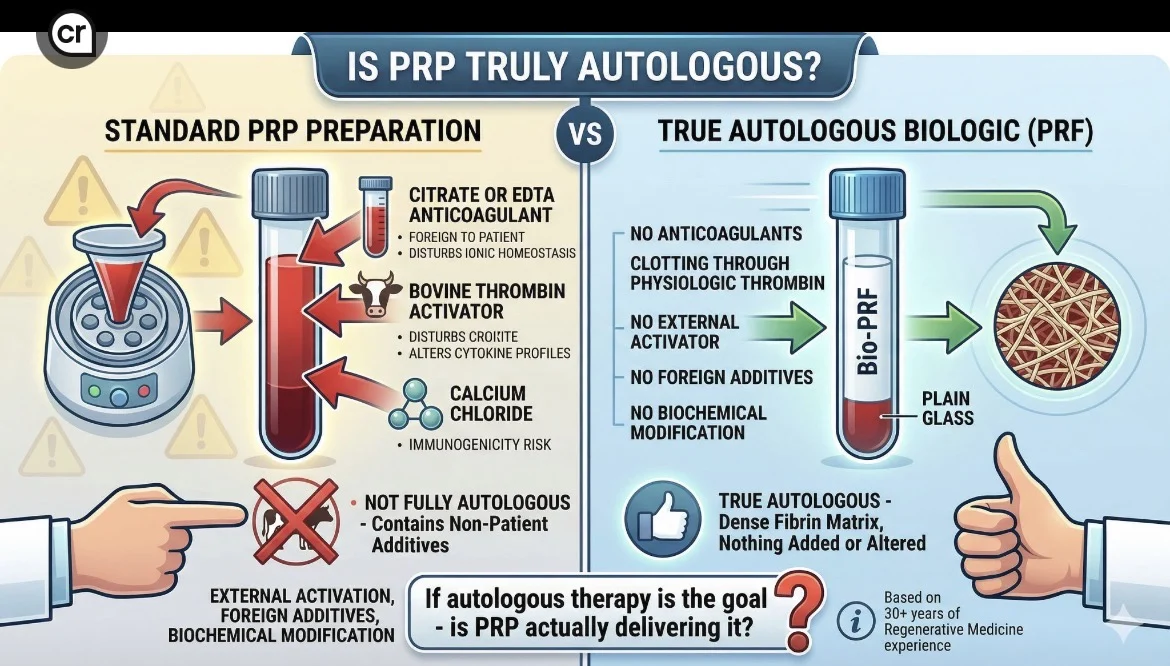
- Citrate or EDTA anticoagulants (not from the patient)
- Bovine thrombin as an activator (not from thepatient)
- Calcium chloride to trigger clotting (not from the patient)
None of these are autologous. And it’s not a minor footnote.
EDTA and citrate disturb natural ionic homeostasis and alter cytokine profiles.
Bovine thrombin carries a documented immunogenicity risk, potentially triggering antibody responses against the patient’s own clotting factors.
This is not a fringe concern. It’s in the published data.
Platelet-Rich Fibrin (PRF), by contrast, uses no anticoagulant.
- Blood is drawn and immediately centrifuged.
- Clotting occurs through physiologic thrombin alone.
- No external activator, no foreign additive, no biochemical modification.
One caveat worth naming: many commercial PRF kits use silica or silicone-coated tubes as clot activators.
Those are foreign materials, too.
Which is why I use plain glass tubes (Bio-PRF) – the only truly additive-free option.
The result?
A dense autologous platelet-rich fibrin matrix. Nothing added. Nothing altered.
We’ve spent decades debating PRP activation protocols, platelet concentrations, and leucocyte ratios. Maybe the more important question is simpler:
If autologous therapy is the goal – is PRP actually”
Stay updated with Hemostasis Today.
-
Sep 30, 2026, 01:52Javed Anees: DADA2 – When a Young Stroke Is More Than a Stroke
-
Sep 30, 2026, 01:51How a Venous Thrombus Becomes Revascularized – ISTH
-
Sep 29, 2026, 22:45Victor Agunyego: Paracetamol – The Most Common Drug We Underestimate
-
Sep 29, 2026, 22:42Nova Sinclair: Advancing the Future of Hematology – Meet Our 2027 Organizing Committee
-
Sep 29, 2026, 22:41Lorenz Räber: Intracoronary Imaging in PCI – Why, When, How, and Which Modality?
-
Sep 29, 2026, 22:31Selma Turkovic: Pleased to Deliver the Opening Presentation at Kingston Hospital
-
Sep 29, 2026, 22:31Miguel Teran: Ultrasound and Simulation in Arterial Blood Sampling
-
Sep 29, 2026, 22:28Mohammad Refaei: Navigating Your Career in Hematology From Training to Practice
-
Sep 29, 2026, 22:27Matteo Foschi: 10 Clinical Pearls for Antithrombotic Therapy in Secondary Stroke Prevention