


Thomas Rocco Jr: How AI is Transforming the Management of High Blood Pressure and Cardiovascular Health
Thomas Rocco Jr, Clinical Professor Emeritus of Medicine at University of Rochester Medical Center, shared a post on LinkedIn about a recent article by Fahimeh Varzideh et al, adding:
“This article, published in the journal Hypertension, provides a comprehensive review of how artificial intelligence (AI) is transforming the management of high blood pressure and cardiovascular health.
The authors conclude that while technologies like cuffless monitoring are still maturing, the integration of AI into cardiovascular medicine offers a transformative framework for precision care, potentially leading to earlier diagnosis and significantly improved long-term patient outcomes.
This article demonstrates how AI is shifting hypertension care from a reactive model to a more personalized, predictive and patient-centered approach.
Core Themes and Key Findings:
Continuous and Cuffless Monitoring.
The review highlights the evolution of blood pressure (BP) measurement beyond the traditional inflatable cuff.
AI algorithms (such as Deep Learning and Extreme Gradient Boost) are now being used to estimate BP using data from wearables, including photoplethysmography (PPG) from smartwatches, electrocardiography (ECG), and heart sounds.
Precision Phenotyping and Risk Prediction:
AI’s ability to process ‘big data’—including genetics, proteomics, and socioeconomic factors—allows for better risk stratification.
It can identify specific ‘phenotypes’ or subgroups of hypertension, helping clinicians predict which patients are at a higher risk for complications like stroke, heart failure, or chronic kidney disease.
Personalized Treatment Strategies:
The article discusses how AI can reduce ‘therapeutic inertia’ (the failure to adjust treatment when goals aren’t met).
AI-guided titration algorithms and ‘digital twins’ (virtual physiological models of a patient) can help doctors determine the most effective medication regimens and optimal BP targets for an individual rather than relying on a one-size-fits-all threshold.
Secondary Hypertension and Diagnostics:
Machine learning models are increasingly capable of detecting ‘secondary hypertension’ (high blood pressure caused by another medical condition) and identifying undiagnosed cases by spotting subtle patterns in electronic health records that human clinicians might miss.
Implementation Challenges:
Despite the promise, the authors note several critical hurdles that must be addressed before widespread clinical adoption.
Data Bias and Ethics:
Ensuring algorithms are fair across different racial and ethnic groups.
Interpretability:
Moving away from ‘black box’ models so that clinicians can understand why an AI made a specific recommendation.
Regulatory Hurdles:
The need for standardized validation and oversight of AI-driven medical devices.”
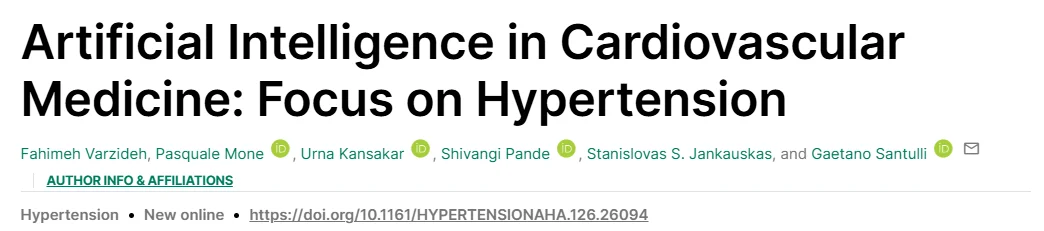
Title: Artificial Intelligence in Cardiovascular Medicine: Focus on Hypertension
Authors: Fahimeh Varzideh, Pasquale Mone, Urna Kansakar, Shivangi Pande, Stanislovas S. Jankauskas, Gaetano Santulli
Read the Full Article on Hypertension
Stay updated on all scientific advances with Hemostasis Today.
-
Sep 25, 2026, 13:32Gevorg Yaghjyan: Low Drug Levels, Higher Cardiovascular Risk in Lupus
-
Sep 25, 2026, 12:53Bastu Odoka: What Happened to Blood Donation?
-
Sep 25, 2026, 12:43Thomas Dayspring: Reshaping the Biology of Atherosclerotic Plaques with New Therapies
-
Sep 25, 2026, 12:14Garima Sharma: Community Clinical Linkages for Better Postpartum Cardiovascular Care
-
Sep 25, 2026, 10:49Shefina S: From Presenting to Hosting at TRANSCON 2026
-
Sep 25, 2026, 10:37Michelle Leona Cecil: Hemophilia Advocacy and the Power of Community
-
Sep 25, 2026, 10:13Michael Baria: Platelet Concentration and PRP Outcomes in Partial Rotator Cuff Tears
-
Sep 25, 2026, 08:55Hitarth Mehta: BHMS Students Gain Practical Exposure to Haemophilia Diagnosis
-
Sep 25, 2026, 07:25Varun Capoor: How Therapeutic Apheresis and Transfusion Medicine Can Complement Clinical Management in SCD