


Simon Senanu: Hypersegmented Neutrophils – A Classic Sign of Megaloblastic Anemia
Simon Senanu, Medical Laboratory Scientist at Perkins Medical Centre, shared a post on LinkedIn:
“Hypersegmented Neutrophils – A Classic Sign of Megaloblastic Anemia
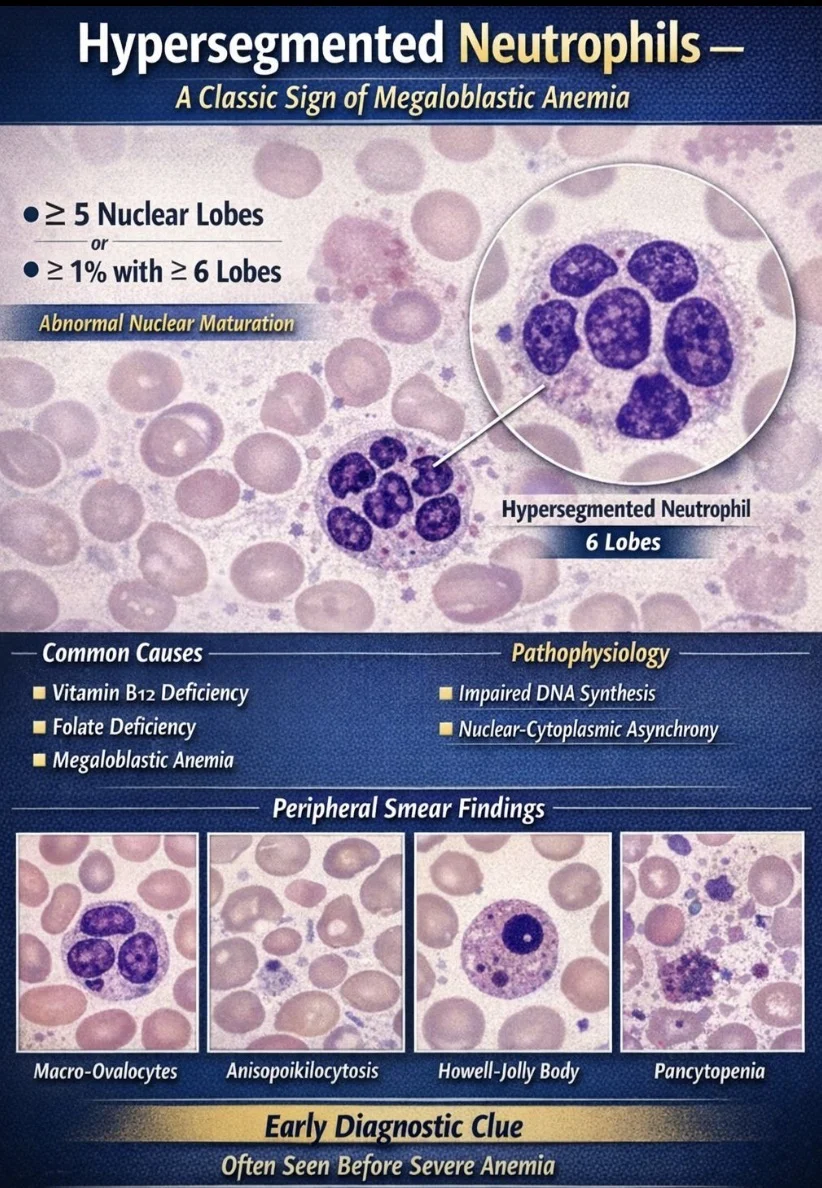
On a peripheral blood smear, some neutrophils display an unusually high number of nuclear lobes.
These are known as hypersegmented neutrophils – a key morphological clue that should never be overlooked.
What Are Hypersegmented Neutrophils?
A neutrophil is considered hypersegmented when it has:
- ≥5 nuclear lobes
or - ≥1% of neutrophils with ≥6 lobes
This reflects abnormal nuclear maturation, not increased neutrophil activity.
Pathophysiology
Hypersegmentation results from impaired DNA synthesis.
When DNA replication is defective, nuclear division is delayed – while cytoplasmic maturation continues normally.
This leads to nuclear-cytoplasmic asynchrony, the hallmark of megaloblastic processes.
The defect primarily affects rapidly dividing cells, especially in the bone marrow.
Common Causes
- Vitamin B12 deficiency
- Folate deficiency
- Megaloblastic anemia
Less commonly:
- Myelodysplastic syndromes
- Certain medications (e.g., methotrexate)
- Chronic alcoholism
Peripheral Smear Clues
Hypersegmented neutrophils rarely appear in isolation.
Look for accompanying features:
- Macro-ovalocytes, which are enlarged, oval RBCs
- Anisopoikilocytosis, indication variation in size and shape
- Howell-Jolly bodies (in severe cases)
- Leukopenia and thrombocytopenia, suggesting pancytopenia
Often, hypersegmented neutrophils are one of the earliest detectable signs – even before anemia becomes severe.
Correlation with RBC Indices
Laboratory findings often include:
- Elevated MCV (macrocytosis)
- Increased RDW
- Possible pancytopenia in advanced cases
However, early in the disease, MCV may still be normal – making smear review critical.
Laboratory Pitfall
Do not confuse true hypersegmentation with:
- Smear artifacts
- Degenerative nuclear changes in old samples
Proper smear preparation and timely analysis are essential.
Clinical Significance
Hypersegmented neutrophils are more than a morphological finding – they are a diagnostic signal.
Their presence should prompt evaluation of:
- Vitamin B12 levels
- Folate status
- Underlying marrow pathology
Laboratory Takeaway
When you see hypersegmented neutrophils, think defective DNA synthesis.
In hematology, morphology often reveals pathology before numbers do.
Do you routinely quantify hypersegmentation, or rely on pattern recognition during smear review?”
Other posts featuring Simon Senanu on Hemostasis Today.
-
Oct 5, 2026, 22:55Steve Humphreys: A Big Thank You to BSHT for Providing Me With a Recent Skills Exchange Award
-
Oct 5, 2026, 22:52William McKeown: Great to Be in Istanbul for the Opening of the EHC 2026
-
Oct 5, 2026, 22:48Laura Quintas Lorenzo: A New Approach to Healthcare for von Willebrand Disease at EHC 2026
-
Oct 5, 2026, 22:46Anas Zayad: Pleased to Share Our New Review on Thrombosis in SCD and Beta Thalassemia
-
Oct 5, 2026, 22:44Cihan Ay: Honouring Eric Kandel and Eugene Braunwald at the Medical University of Vienna
-
Oct 5, 2026, 22:42Heather L. Gornik: Testing for Aortic and Arterial Thrombosis at VSS 2026
-
Oct 5, 2026, 22:34Hasan Abbas Zaheer: Honoured to Have Co-Authored One of the Four Reviews in The Lancet Thalassemia Series
-
Oct 5, 2026, 22:34Kamyar Shameli: Understanding the Coagulation Cascade – How Anticoagulants Prevent Blood Clots
-
Oct 5, 2026, 22:31Risika Samanta: Pediatric ITP in a 12-year-old – An Atypical Presentation without a Viral Prodrome