


Dhananjaya Kotebagilu Narayana Vamyanmane: High-Resolution Ultrasound Evaluation of Bowel Wall Ischemia
Dhananjaya Kotebagilu Narayana Vamyanmane, Pediatric Radiologist and Al Imaging Innovator, Consultant at Manipal Hospitals, shared a post on LinkedIn:
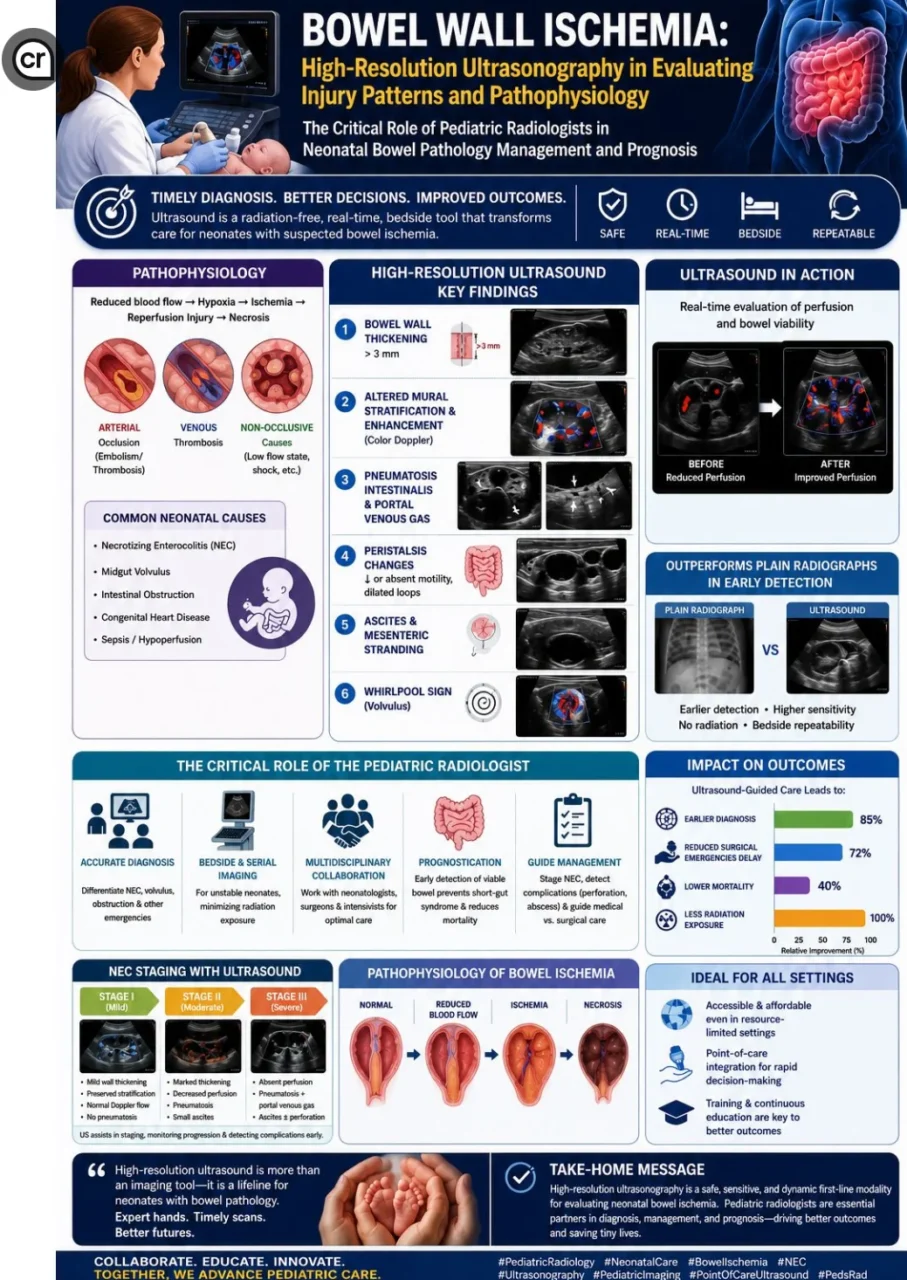
“Bowel Wall Ischemia: High-Resolution Ultrasonography in Evaluating Injury Patterns and Pathophysiology
The Critical Role of Pediatric Radiologists in Neonatal Bowel Pathology Management and Prognosis.
Bowel wall ischemia represents a serious condition, particularly in neonates, where timely diagnosis can significantly impact outcomes. High-resolution ultrasonography (HRUS) has emerged as a valuable, radiation-free tool for assessing injury patterns, understanding pathophysiology, and guiding management in pediatric patients.
Pathophysiology and Ultrasound Patterns:
Intestinal ischemia occurs due to reduced blood flow—often from arterial occlusion (embolism/thrombosis), venous thrombosis, or non-occlusive causes—leading to hypoxia and potential reperfusion injury. In neonates, this is frequently linked to conditions like necrotizing enterocolitis (NEC), midgut volvulus, or other obstructions.
Key HRUS findings include:
- Bowel wall thickening (more than 3 mm) or thinning (‘paper-thin’ appearance in advanced arterial ischemia).
- Altered mural stratification and enhancement (assessed with color Doppler for vascularity).
- Pneumatosis intestinalis (gas in the bowel wall) and portal venous gas — highly concerning for necrosis.
- Peristalsis changes: Reduced or absent motility, dilated loops with fluid stasis.
- Ascites, mesenteric stranding, or whirlpool sign (in volvulus).
HRUS excels in real-time evaluation of perfusion, wall viability, and dynamic changes, often outperforming plain radiographs in early detection and monitoring progression.
Role of the Pediatric Radiologist:
Pediatric radiologists play a pivotal role beyond diagnosis.
- Differentiate high versus low obstructions and identify surgical emergencies (e.g., volvulus vs. NEC).
- Provide serial bedside imaging for unstable neonates, minimizing radiation exposure.
- Collaborate in multidisciplinary teams to predict prognosis — early detection of viable bowel can prevent short-gut syndrome and reduce mortality.
In NEC, ultrasound helps stage disease, detect complications like perforation, and guide conservative versus surgical management.
Clinical Implications:
High-resolution US offers a safe, accessible first-line modality, especially in resource-variable settings. Its integration into point-of-care protocols by trained neonatologists and radiologists enhances rapid decision-making.
Advancing expertise in these techniques is essential for improving neonatal survival and quality of life in bowel pathologies.
This review underscores the transformative potential of ultrasound in pediatric gastrointestinal emergencies. Collaboration and continuous education in pediatric radiology remain key.”
Stay updated with Hemostasis Today.
-
Oct 20, 2026, 16:51Suzan Nakasendwa: A Growing Stroke Challenge in Uganda
-
Oct 20, 2026, 16:38Steve Moon: How Does Smoking Cessation Duration Affect Ischemic Stroke Risk
-
Oct 20, 2026, 16:25Cedrice Mentor: Reducing Platelet Wastage Through Cold Storage
-
Oct 20, 2026, 16:09Thirunavukkarasu Angappan: Can a Purified Fibrinogen Concentrate Replace Cryoprecipitate
-
Oct 20, 2026, 16:01Kalyan Roy: Platelet Conservation Through Evidence-Based Transfusion Practice
-
Oct 20, 2026, 15:28Stacy E. Croteau: 33 Countries, One Mission – Better Bleeding Disorder Care
-
Oct 20, 2026, 15:19Teresa Barnes: What Does a Pulmonary Embolism Mean for Jalen Hurts?
-
Oct 20, 2026, 15:04Laura S.: Could Speaking Up Prevent Maternal Deaths from Thrombosis?
-
Oct 20, 2026, 14:44Pete Stibbs: VTE in Professional Athletes – When Fitness Is Not Enough