

What Happens When Molecular Science and Clinical Insight Move Together? – McMaster University Department of Medicine
McMaster University Department of Medicine shared on LinkedIn:
”What happens when molecular science and clinical insight move together?
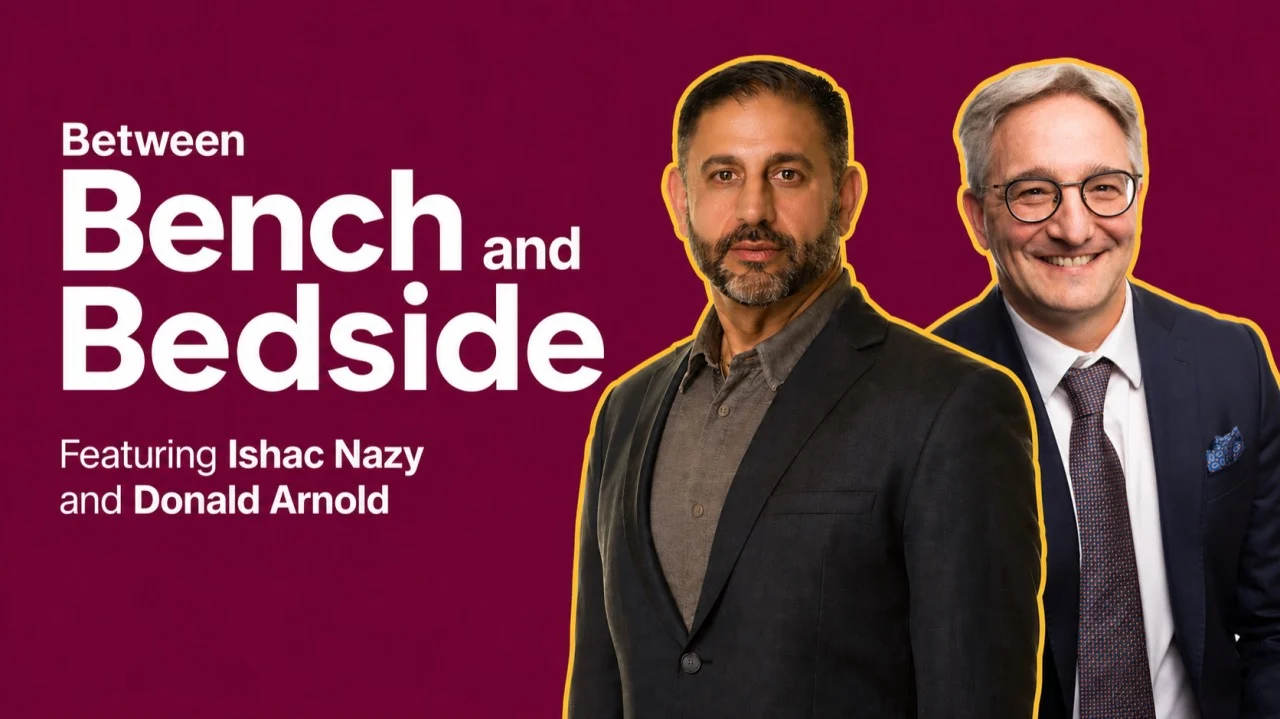
For nearly 20 years, Department of Medicine professors Ishac Nazy, PhD and Donald Arnold have built a research partnership that moves between bench and bedside, using clinical observation and basic science to better understand complex blood disorders and improve patient care.
Together, as co-directors of the Michael G. DeGroote Centre for Transfusion Research, their team has helped uncover mechanisms behind major immune-mediated blood disorders, including immune thrombocytopenia, vaccine-induced immune thrombocytopenia and thrombosis, and heparin-induced thrombocytopenia.
Their collaboration shows what becomes possible when different ways of thinking are not only brought into the same department, but put to work on the same problems.
By: Mike Ayers
Ishac Nazy trained as a biochemist and enzymologist; he works with proteins, antibodies, and the molecular machinery underlying disease.
Donald Arnold approaches science from another perspective; he starts with the patient, considering symptoms, treatments and how discoveries improve clinical approaches.
For close to 20 years, Nazy and Arnold, both professors in McMaster University’s Department of Medicine, have built a research partnership centred around their unique strengths, moving back and forth between clinical observation and basic science until clearer answers come into view.
Together, they co-direct the Michael G. DeGroote Centre for Transfusion Research (MCTR), hosted at McMaster University, and their team’s research has uncovered mechanisms underlying major blood disorders.
Their work is an example of what can happen when a diversity of expertise is not simply housed in the same department but also put to work together.
Different perspectives on blood disorder research
Arnold is a clinical hematologist.
‘My research spans clinical trials, methodology, bleeding disorders, platelet disorders and transfusion medicine,’ he says. ‘Sometimes that means large datasets, and other times it means watching closely as patients present in clinic, tracing patterns of disease and treatment responses that do not yet have a clear explanation.’
Nazy came into medical research from an entirely different route.
His early work focused on infectious diseases and antibiotic resistance, not hematology.
In fact, he says that when he joined the team at the MCTR, his understanding of blood disorders was ‘literally at zero.’
As the research program grew, Nazy brought together scientists with expertise spanning immunology, transfusion medicine, structural biology and hematology, helping create the collaborative environment that continues to drive many of the team’s discoveries.
‘The beauty of our collaboration is that fundamentally Ishac and I are wired differently,’ Arnold says.
While Nazy is focused on mechanisms, such as how an antibody can circulate in the body for so long or why a platelet count can fall so low, Arnold is focused on patients: what a disease is doing, how treatments are tolerated, and what matters most in care.
Under Arnold and Nazy‘s leadership, the MCTR has grown into one of the world’s leading centres for research in immune-mediated blood disorders, training the next generation of clinician-scientists and basic scientists while fostering collaborations across Canada and internationally.
How a bench-to-bedside collaboration began
Both professors trace the start of their partnership to John Kelton, who was dean and vice-president of the Faculty of Health Sciences from 2001-2016.
Kelton is himself a practicing hematologist at Hamilton Health Sciences. Kelton saw value in bringing together diverse scientific expertise.
Before they met, Arnold was already developing a specialization in platelet disorders when he was encouraged to spend time in the lab to better understand the tests used to diagnose the diseases he was seeing in the clinic.
Nazy was recruited to strengthen the basic science side of their future dynamic.
Looking back, Nazy laughs at how little he knew about hematology at first.
But that was precisely the point.
The team did not want someone trained to think exactly like everyone else in the field; instead, they needed someone who knows how to do science and generate transformative insights.
This fresh idea-generating method, bench to bedside, then back again, has shaped their collaborations ever since.
One of Nazy and Arnold’s first collaborations focused on rituximab, then a relatively experimental treatment for immune thrombocytopenia (ITP), a rare blood disorder that can impair blood clotting, increasing the likelihood of bruising and bleeding.
Arnold initially thought the logical starting point was whether rituximab worked, but Nazy saw another question underneath.
Because of Nazy’s background in infectious disease, he wondered what the drug might be doing downstream.
Could patients with ITP still mount a strong immune response to bacteria after medication?
The question was particularly relevant for ITP patients, many of whom require immune-suppressant drugs or even splenectomy.
That question led to a finding doctors could use right away.
Working together, the pair helped show that patients with ITP should be vaccinated before starting rituximab, not after.
They revealed that the drug reduces the number of immune cells available to make new antibodies, but it does not remove antibodies the body has already produced, enabling a sustained immune response.
This discovery was an early representation of how their dynamic works.
A clinical problem was revealed through molecular science, which, in turn, proved more useful when applied to patient care.
Changing the understanding of HIT and VITT
Their collaborative approach became especially important during the COVID-19 pandemic, when they helped characterize vaccine-induced immune thrombocytopenia and thrombosis (VITT), a newly recognized syndrome. By combining clinical observations with laboratory investigations, the team rapidly contributed to the understanding of disease mechanisms, improved diagnostic approaches, and informed patient management worldwide.
Similarly, for Arnold, the significance of their recent collaborative work on heparin-induced thrombocytopenia (HIT), a rare immune reaction to the blood thinner heparin that lowers platelet counts and can trigger dangerous blood clots, is not incremental.
‘Together we uncovered a new way of thinking about a disease that’s been around for decades,’ he says.
By returning to what Arnold describes as first principles, their team found a precise explanation for the damage caused by HIT: a single antibody was doing the damage, surrounded by many other decoy antibodies that are effectively irrelevant.
Conceptual shifts such as this matter because a better understanding at the molecular level can lead to better diagnosis, more accurate testing, and more targeted care.
And not just for HIT, but for autoimmune diseases in general.
That same progress continues to play out in the team’s newest study, published in Blood.
Building on their earlier finding that the harmful antibodies behind HIT come from a lone source, the researchers developed small, engineered antibody fragments that can home in on those harmful antibodies and block them, without being sidelined by the harmless ones.
This discovery further advances accurate HIT testing by reducing false positives and again demonstrates how Arnold’s clinical questions and Nazy’s lab-based research can work together to improve patient care.
Over the last several years, Nazy notes, their research group at the MCTR has helped uncover other disease mechanisms at a remarkably fast pace for work of this complexity.
Nevertheless, the group’s success prompts the question: What would have happened if this distinct team-based approach had not existed?
Arnold’s answer is immediate. ‘These questions would never have even been asked in the first place.’
Nazy imagines a similar absence from his perspective; he jokes that he would be ‘spinning my wheels doing science.’
Without this kind of partnership, a basic scientist like Nazy may be working with a handful of samples, relying heavily on models or isolated materials, without a clinical context needed to know what matters most.
Important science would still have happened that way. But the connections between discovery and patient impact would have been entirely uncertain.
What collaborative research makes possible
Arnold says researchers working in silos often do not even know what questions to ask to maximize impact. Bringing different perspectives together on the same problem, he says, is when ‘amazing things start to happen.’
Nazy has already turned that lesson into advice for younger scientists.
He says he often tells junior basic scientists to find ‘a really good friend on the clinical side, not a token collaborator, but someone who can help connect your skills to a problem that matters to patients.’
Fundamentally, that connection matters in medicine, where the most useful knowledge often answers a practical need: a better diagnosis, a sharper understanding of disease, or a treatment that can reach patients sooner.
That may be the clearest measure of the partnership between Nazy and Arnold.
Not that a clinician became a biochemist, or a biochemist became a clinician. But from different perspectives, they recognized gaps and turned molecular clues into clinical breakthroughs.”
Stay updated with Hemostasis Today.
-
Oct 27, 2026, 16:28Rose Agor: Celebrating Two New Publications in Haematology Research
-
Oct 27, 2026, 16:21Pregnancy and Thrombosis-What Clinicians Need to Know – World Thrombosis Day
-
Oct 27, 2026, 16:13Lesley Van Wyk: DIC vs TTP vs HUS – The Key Diagnostic Clues
-
Oct 27, 2026, 16:02Ahmad G. Alzahrani: AF and Vascular Risk Factors – Should We Add Antiplatelet Therapy?
-
Oct 27, 2026, 16:02Iron Deficiency and Thrombocytosis: How Iron Availability Shapes Hematopoietic Lineage Decisions
-
Oct 27, 2026, 15:46Christiane Berger-Schaffitzel: New PhD Project Explores Snake Venom and Haemostasis
-
Oct 27, 2026, 13:51Muhammed Hajmusa: ESMO 2026 Highlights the Challenge of Anticoagulation in ROS1-Positive Lung Cancer
-
Oct 27, 2026, 13:39Luca Galassi: Retrieved Venous Thrombi as a Tool for Predicting Post-Thrombotic Syndrome
-
Oct 27, 2026, 11:43Tareq Abadl: Hidden Interferences Behind Unexpected Laboratory Results