


Edward Lee Carter: Anticoagulation Drift – The Patient Changes, the Plan Should Too
Edward Lee Carter, Clinical Pharmacist Practitioner at U.S. Department of Veterans Affairs, shared a post on LinkedIn:
“The greatest threat to long-term anticoagulation may not be choosing the wrong drug. It may be failing to recognize that the patient has changed.
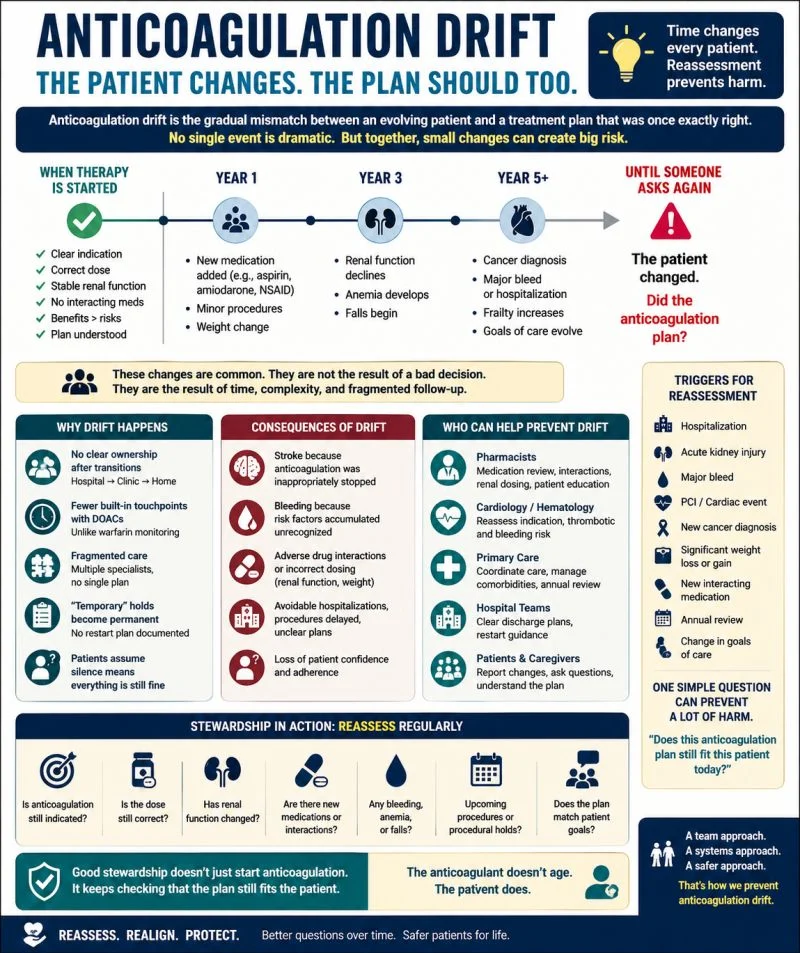
I find myself thinking about something I call anticoagulation drift.
It’s not an established medical term. It’s simply my way of describing a phenomenon I see in clinical practice.
A patient starts anticoagulation, and everything is appropriate.
- The indication is clear.
- The dose is correct.
- Kidney function is stable.
- There are no significant drug interactions.
- The benefits clearly outweigh the risks.
Then time passes. Not days. Years.
Kidney function declines. Weight changes. Aspirin is added after PCI.
Amiodarone is started. Falls become more frequent. Hgb slowly trends downward. A cancer diagnosis changes the clinical picture.
No single event is dramatic.
No guideline is ignored.
No clinician made a bad decision.
The patient simply evolved.
But sometimes the anticoagulation plan didn’t evolve with them.
That’s what I think of as anticoagulation drift: a gradual mismatch between an evolving patient and a treatment plan that was once exactly right.
Ironically, one of the greatest successes in anticoagulation may also contribute to this challenge.
Warfarin requires frequent INR monitoring, creating regular opportunities to reassess therapy.
DOACs have transformed anticoagulation by making treatment safer, simpler, and more convenient. But fewer touchpoints mean we have to be intentional about building reassessment back into the system.
I believe the next frontier in anticoagulation isn’t simply developing a better anticoagulant.
It’s building better anticoagulation stewardship.
I appreciate the work of organizations like the Anticoagulation Forum and Hemostasis Today which continue to advance the conversation beyond selecting the right medication toward longitudinal stewardship, transitions of care, quality improvement, and continuous reassessment.
I also see many of these principles in action every day within the VA Pharmacist involvement, standardized pathways, quality dashboards, transition-of-care processes, and multidisciplinary collaboration all create opportunities to recognize change before it becomes harm. No healthcare system is perfect, but systems that intentionally reassess are better positioned to keep patients safe.
Perhaps stewardship isn’t asking:
‘Did we choose the right anticoagulant?’
Perhaps the better question is one we should ask at every transition of care and every meaningful clinical change:
‘Does this anticoagulant still fit the patient sitting in front of me today?’
Because anticoagulants don’t age.
Patients do.
And maybe the future of anticoagulation isn’t defined by the next breakthrough drug.
Maybe it’s defined by how we recognize that our patients have changed before harm occurs.
What systems or processes have been most effective in preventing patients from quietly ‘drifting’ away from a treatment plan that was once exactly right?”
Other posts featuring Edward Lee Carter on Hemostasis Today.
-
Oct 6, 2026, 22:43Alessandra Bosch: Pediatric GTH Opens with Regional Experts Convening on Pediatric Hemostasis and Thrombosis
-
Oct 6, 2026, 22:39Managing Thrombotic Risk in Pregnancy: How the Lab May Help – Sysmex Europe
-
Oct 6, 2026, 22:33Ahmet Davut Aksu: A Multi-Objective Approach to Enhance Fibrinolysis, Selectivity, and Inhibition Resistance
-
Oct 6, 2026, 22:29Muhammad Abubakar: New Study on Iron Biology to Be Presented at ASH 2026 and Published in Blood
-
Oct 6, 2026, 22:24David McIntosh: Calling On Decision-Makers to Prioritize Donors and Clinical Access During IPAW 2026
-
Oct 6, 2026, 22:21Zoltan Nagy: With All Eyes on Optogenetics Today, What Can It Do in Megakaryocytes and Platelets?
-
Oct 6, 2026, 22:13Khalid A. Fakhro: Sidra Medicine Hosts RAPID 2026 Advancing Diagnostics and Treatments for Inborn Errors of Immunity
-
Oct 6, 2026, 22:04Denis Oduor: Preparedness for Postpartum Haemorrhage Must Include Preparedness for Blood
-
Oct 6, 2026, 21:57Farhad Moradpour: Health Equity and Public Health – What Drives Anemia Disparities in Ethnic Minority Populations?