


Edward Lee Carter: Understanding Ketorolac Dosing When More Is Not Always Better
Edward Lee Carter, Clinical Pharmacist Practitioner at U.S. Department of Veterans Affairs, shared a post on LinkedIn:
“One of the hardest things in medicine isn’t discovering better treatments.
It’s recognizing when an accepted standard deserves to change.
Ketorolac is a fascinating example.
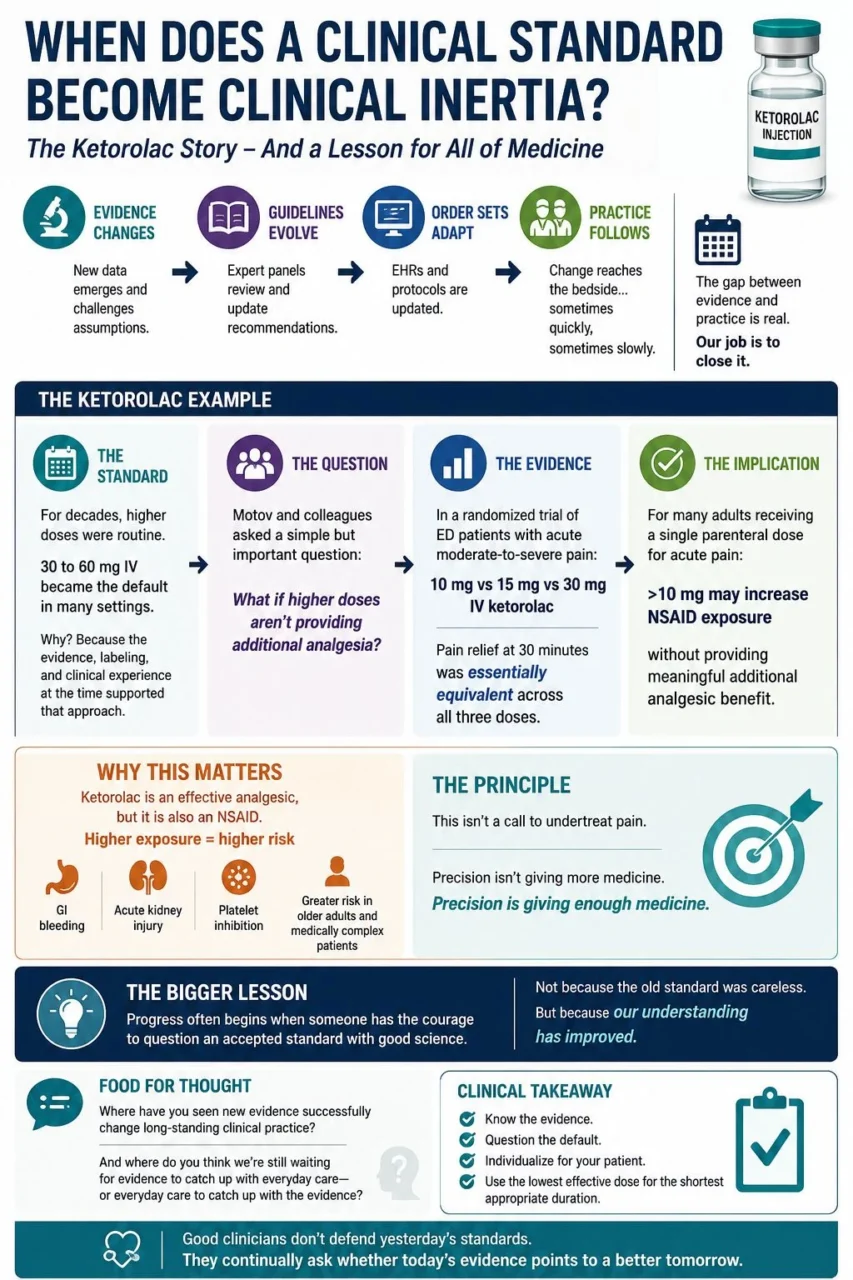
For decades, higher doses became routine in emergency departments and urgent care settings. Even today, I still commonly encounter default doses of 30 to 60 mg in outpatient practice.
Not because anyone was practicing incorrectly.
Not because clinicians ignored the evidence.
But because the available evidence, product labeling, and clinical experience at the time supported that approach.
Then Sergey Motov and colleagues asked a deceptively simple question:
What if higher doses weren’t providing additional analgesia?
In their landmark randomized controlled trial, adults presenting to the emergency department with acute moderate-to-severe pain received 10 mg, 15 mg, or 30 mg IV ketorolac.
The results surprised many clinicians.
Pain relief was essentially equivalent across all three doses.
That single study sparked an important conversation.
Since then, additional randomized trials, observational studies, and a 2023 systematic review and meta-analysis have largely supported the same conclusion:
For many adults treated in the emergency department, 10 to 20 mg IV ketorolac is probably as effective as doses of 30 mg or greater, although lower doses may modestly increase the need for rescue analgesia in some patients.
That distinction matters.
Ketorolac isn’t simply an analgesic.
It is also a potent NSAID associated with gastrointestinal bleeding, acute kidney injury, and platelet inhibition, risks that generally increase with greater exposure.
This isn’t a call to undertreat pain.
It’s a reminder that precision isn’t giving more medicine.
Precision is giving enough medicine.
One reason this topic resonates with me is that it illustrates how medicine evolves.
- Evidence changes.
- Guidelines evolve.
- Order sets adapt.
- Practice follows.
Sometimes quickly.
Sometimes over many years.
Sometimes not at all.
In my own practice, I still frequently see 30 to 60 mg selected as the default dose. That doesn’t mean clinicians are practicing poorly.
It reminds us that translating evidence into everyday care often takes far longer than generating the evidence itself.
Perhaps the biggest lesson from ketorolac isn’t about ketorolac.
It’s that progress often begins when someone has the courage to question an accepted standard with good science.
Not because the old standard was careless.
Because our understanding has improved.
As clinicians, our responsibility isn’t to defend yesterday’s practice.
Our responsibility is to continually ask whether today’s evidence can help us care for our patients even better tomorrow.
• Motov et al. Annals of Emergency Medicine (2017): Comparison of 10 mg vs 15 mg vs 30 mg IV ketorolac.
• Forestell et al. Annals of Emergency Medicine (2023): Systematic review and meta-analysis of ketorolac dosing strategies.”
Other posts featuring Edward Lee Carter on Hemostasis Today.
-
Oct 20, 2026, 14:14Advancing Thalassaemia and Sickle Cell Care Through Nordic Collaboration – TIF
-
Oct 20, 2026, 14:01Ashkan Forouzani։ Warfarin or DOACs in Protein C and S Deficiency?
-
Oct 20, 2026, 13:20The Global Blood Crisis – Are We Solving the Wrong Problem?
-
Oct 20, 2026, 06:45Grant Garcia: Why Does a Blood Clot Diagnosis Immediately End an Athlete’s Season?
-
Oct 20, 2026, 06:35Parag Tamhankar: Landmark Study Reveals Genetic Spectrum and Targeted Therapies for ALPS in the Indian Population
-
Oct 20, 2026, 06:26Nina Houben: Neonatal Blood Transfusion Symposium and PhD Defense
-
Oct 20, 2026, 05:46Jan T. Kielstein: DNP Poisoning and Hemoadsorption The Limits of Rescue Therapy
-
Oct 20, 2026, 05:33Giulia Di Paolo: Connecting Plasma Donation to the Patients Who Depend on It
-
Oct 20, 2026, 05:20James Knowles: Exploring Plasma Manufacturing and Strengthening Industry Collaboration