


Abdul Mannan: Not All Type 1 VWD Starts in the VWF Gene
Abdul Mannan, Consultant Haematologist at Betsi Cadwaladr University Health Board, shared a post on LinkedIn:
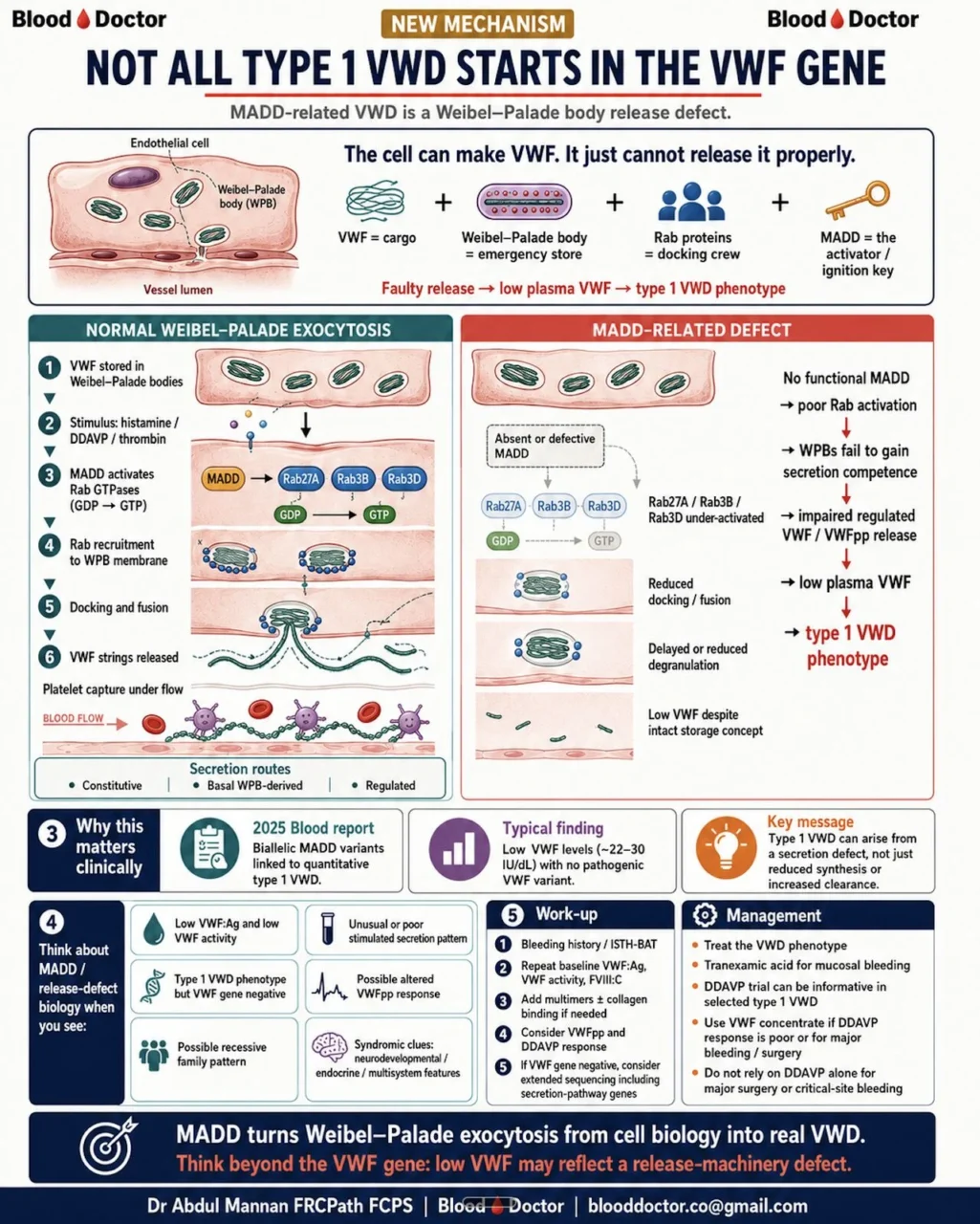
“‘The endothelial cell has plenty of VWF. It just can’t get it out the door.’
Most type 1 VWD gets explained one of two ways: the endothelial cell makes too little VWF, or it clears VWF too fast.
A 2025 Blood paper adds a third mechanism, and it changes how I think about unexplained low VWF.
Endothelial cells store VWF inside Weibel-Palade bodies, ready to release on demand.
Getting it out needs a docking crew: Rab27A and Rab3 GTPases, switched on by a protein called MADD.
Kat et al. showed in 2021 that MADD is the activator for this Rab docking crew (Blood Advances 2021).
Hordijk et al. studied three children with biallelic MADD variants. All had VWF levels of 22-30 IU/dL and no VWF gene mutation.
Their endothelial cells had no MADD protein, low Rab27A and Rab3D activity, and reduced histamine-induced VWF release (Blood 2025).
Same cargo. Same storage unit. Broken alarm system.
I would think about this when you see a type 1 VWD phenotype, a normal VWF gene, and especially any neurodevelopmental or multisystem features alongside the bleeding history.
This is not a first-line test yet.
But it tells us type 1 VWD is not only a VWF gene disease.
It can be a secretion disease too.
Have you seen a low VWF case where the gene test came back clean?”
Other posts from Abdul Mannan on Hemostasis Today.
-
Oct 4, 2026, 05:03Hisham Fahmi: Thromboprophylaxis in Children With ALL A Risk Adapted Approach
-
Oct 4, 2026, 05:00Mary Cushman: Erin Michos Highlights Rising Heart Disease Mortality Among Younger Women in the US
-
Oct 4, 2026, 04:48Liv Tybjærg Nordestgaard: Is Fasting Necessary Before Blood Sampling?
-
Oct 4, 2026, 04:31Sonal Sonu: Gen Z doesn’t just set trends – Gen Z saves lives
-
Oct 4, 2026, 04:22Registration Opens for 2027 Highlights of ASH – American Society of Hematology
-
Oct 4, 2026, 04:06Konstantinos Stavroulakis: Vessel Preparation in Lower Limb Revascularization
-
Oct 4, 2026, 03:34Liselotte Hyveled: Exploring Opportunities to Improve Hemophilia and Sickle Cell Care in Ghana
-
Oct 4, 2026, 02:46Arman Qamar: Drug-Coated Balloons in Coronary Bifurcation PCI
-
Oct 4, 2026, 01:13Francesc Formiga: Updated Evidence on LAA Closure Versus Oral Anticoagulation in AF