


Dr Abdul Mannan: Patient Has CAPS with 7000 Platelets – Do You Anticoagulate?
Dr Abdul Mannan, Consultant Haematologist at Betsi Cadwaladr University Health Board, shared a post on LinkedIn:
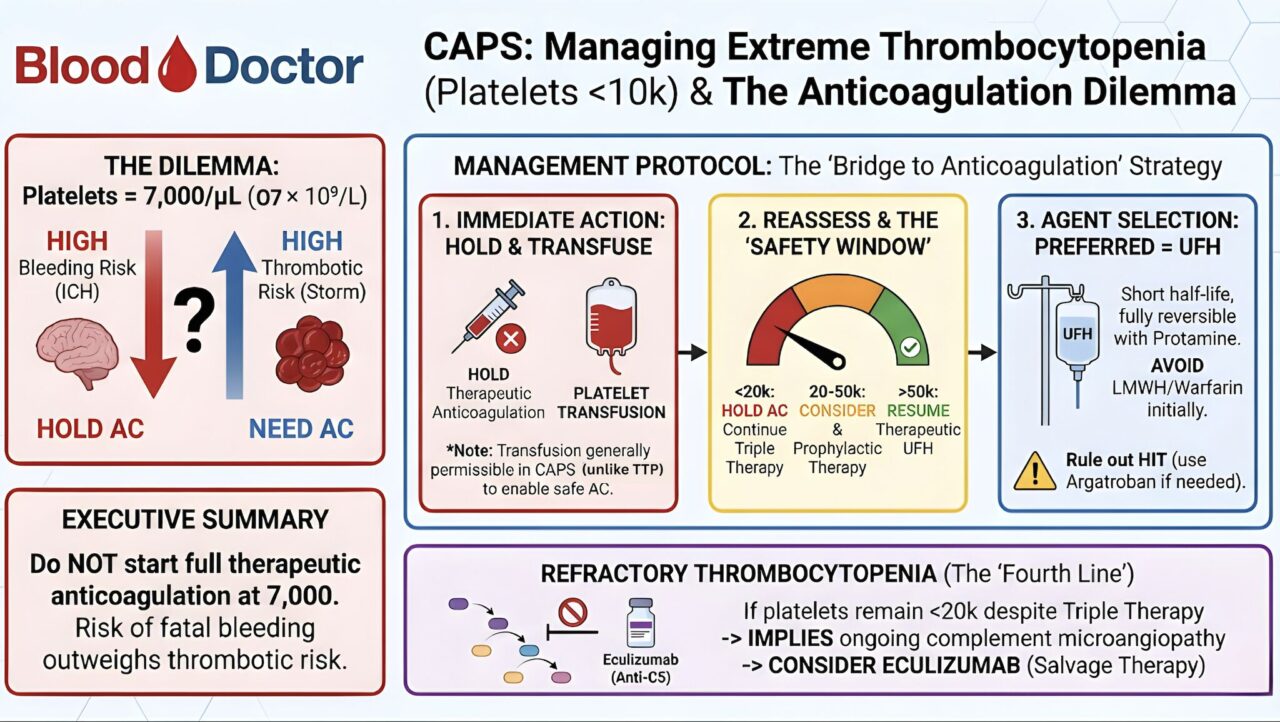
“Platelets 7,000. Your patient has CAPS (Catastrophic Antiphospholipid Syndrome). Do you anticoagulate?
This is the dilemma every haematologist dreads.
Catastrophic APS (CAPS) throws you into a perfect storm: sky-high thrombotic risk meets dangerous bleeding territory. The instinct is to anticoagulate aggressively. But at 7,000 platelets, that can be fatal.
Here’s the “Bridge to Anticoagulation” approach:
Step 1: HOLD and TRANSFUSE
Stop therapeutic anticoagulation
Give platelet transfusions (unlike TTP, this is safe in CAPS)
Continue immunosuppression and plasma exchange
Step 2: Watch the Safety Window
Platelets <20k: Hold anticoagulation, continue triple therapy
Platelets 20-50k: Consider prophylactic dosing
Platelets >50k: Resume therapeutic anticoagulation
Step 3: Choose UFH
Short half-life, reversible with protamine
Avoid LMWH and warfarin initially
Rule out HIT if platelet recovery stalls
Fourth line: Eculizumab If platelets stay below 20k despite triple therapy, think complement-mediated microangiopathy. Eculizumab can be a lifesaver here.
The bottom line? Don’t let fear of thrombosis push you into fatal bleeding at 7,000. Build the platelet bridge first.
CAPS Task Force recommendations (2020) and real-world experience support this stepwise approach.
Have you managed CAPS with severe thrombocytopenia? What was your strategy?”
More posts from Dr Abdul Mannan on Hemostasis Today.
-
Oct 7, 2026, 04:09James P. Crowley: Could the Microbiome Protect Us From Severe EBV Infection?
-
Oct 7, 2026, 03:58Sohanur Rohanman Sohan: Explainable AI for Anemia Prediction Using Machine Learning
-
Oct 7, 2026, 03:00Sandeep Kumar: A Second Chance for a Child with Fanconi Anemia
-
Oct 7, 2026, 02:41Kemal Karaagac: Optimising DOAC Resumption After Major Bleeding in Atrial Fibrillation
-
Oct 7, 2026, 02:21Joseph Aslan: mPTP Inhibition Targets Platelet Procoagulant Activity and Thrombosis
-
Oct 7, 2026, 02:07Manuel Monreal: ECG Improves Risk Stratification in Acute Pulmonary Embolism
-
Oct 6, 2026, 22:43Alessandra Bosch: Pediatric GTH Opens with Regional Experts Convening on Pediatric Hemostasis and Thrombosis
-
Oct 6, 2026, 22:39Managing Thrombotic Risk in Pregnancy – How the Lab May Help – Sysmex Europe
-
Oct 6, 2026, 22:33Ahmet Davut Aksu: A Multi-Objective Approach to Enhance Fibrinolysis, Selectivity, and Inhibition Resistance