


Ifeanyichukwu Ifechidere: What Do You Understand about Anticoagulant Interference in Coagulation Tests?
Ifeanyichukwu Ifechidere, Biomedical Scientist at Sheffield Teaching Hospitals NHS Foundation Trust, shared a post on LinkedIn:
“What Do You Understand About Anticoagulant Interference in Coagulation Tests?
One of the most common – and most misinterpreted – causes of abnormal coagulation results is anticoagulant interference.
Before diagnosing a factor deficiency or inhibitor, we must always ask:
Is this a true coagulopathy – or drug effect?
Failure to recognize anticoagulant interference leads to:
- Unnecessary factor assays
- Misdiagnosis
- Delayed procedures
- Incorrect clinical decisions
Let’s break it down clearly.
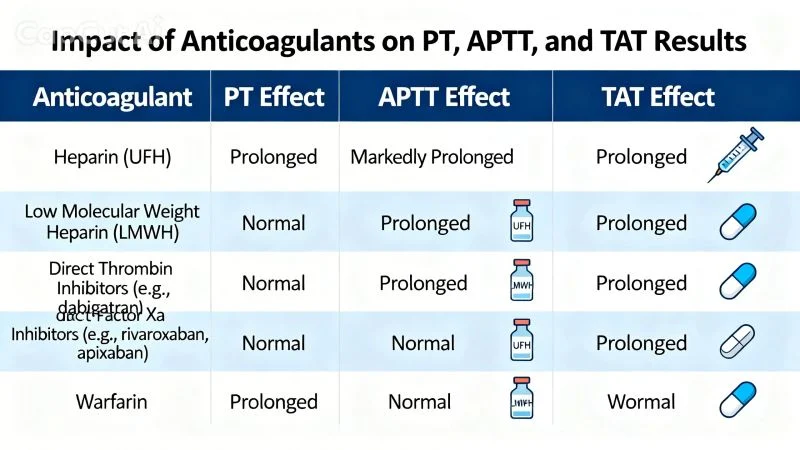
1. Heparin (UFH)
Most affected test: APTT
APTT: Prolonged
PT: Normal or mildly prolonged
Thrombin Time (TT): Markedly prolonged
Clue: Prolonged TT that corrects with heparin neutralization.
2. Low Molecular Weight Heparin (LMWH)
APTT: Often normal
Anti-Xa assay required for monitoring
Important: A normal APTT does NOT exclude LMWH effect.
3. Direct Oral Anticoagulants (DOACs)
These are increasingly common and frequently confuse interpretation.
- Direct Thrombin Inhibitors (e.g., dabigatran)
APTT: Prolonged
TT: Very sensitive (markedly prolonged)
- Direct Factor Xa Inhibitors (e.g., rivaroxaban, apixaban)
PT: May be prolonged (reagent-dependent)
APTT: Variable
Anti-Xa (drug-specific) assay preferred
Key issue: Routine PT/APTT cannot reliably quantify DOAC effect.
4. Warfarin
PT/INR: Prolonged
APTT: May be mildly prolonged
Classic isolated prolonged PT pattern.
Why This Matters in the Laboratory
Anticoagulant interference can mimic:
- Factor deficiencies
- Liver disease
- DIC
- Inhibitors
Without medication history, interpretation becomes guesswork.
Practical Laboratory Approach
Before escalating to mixing studies or factor assays:
- Confirm medication history
- Consider timing of last dose
- Review thrombin time
- Use drug-specific assays when indicated
- Communicate with clinicians
Take-Home Message
Not every prolonged PT or APTT indicates pathology.
Sometimes, it simply reflects pharmacology.
Interpretation without clinical context is incomplete.”
Stay updated with Hemostasis Today.
-
Sep 22, 2026, 19:02Blocking Histone-Induced Platelet-Erythrocyte Interactions With Polyanions – Platelets Journal
-
Sep 22, 2026, 18:49Abdul Rahman Hamad: Early Action for Better Outcomes in Deep Vein Thrombosis
-
Sep 22, 2026, 18:37Carmine Siniscalchi: Age-Adjusted D-Dimer Cutoffs in DVT Diagnosis
-
Sep 22, 2026, 18:37Stefano Romeo: The Cardiovascular Patient Journey is Still Full of Gaps
-
Sep 22, 2026, 18:11Bharath Kumar V.։ Advancing Safer Anticoagulation for Cancer-Associated Thrombosis
-
Sep 22, 2026, 18:10Fatima Zahra: ASH Released New Guidelines on the Diagnosis of Iron Deficiency
-
Sep 22, 2026, 17:49Nirav Dhanesha: Targeting FXI for Safer Anticoagulation
-
Sep 22, 2026, 17:17Eric Lambert: Intravascular Imaging and the Future of Precision PCI
-
Sep 22, 2026, 16:45Claudiu Stoicescu: Are We Starting Cardiovascular Risk Assessment Too Late?