


Mboglen Diane: Why ATLS 11 Places Hemorrhage Control Before Airway Management
Mboglen Diane, Executive Assistant to Chief Executive Officer at Pro Career Builder, Medical Doctor at Vision Health Clinic, shared a post on LinkedIn:
“Massive bleeding kills faster than airway compromise.
That single reality has led to one of the most important updates in trauma care in recent years.
For decades, healthcare professionals have been taught the ATLS primary survey:
- Airway
- Breathing
- Circulation
- Disability
- Exposure
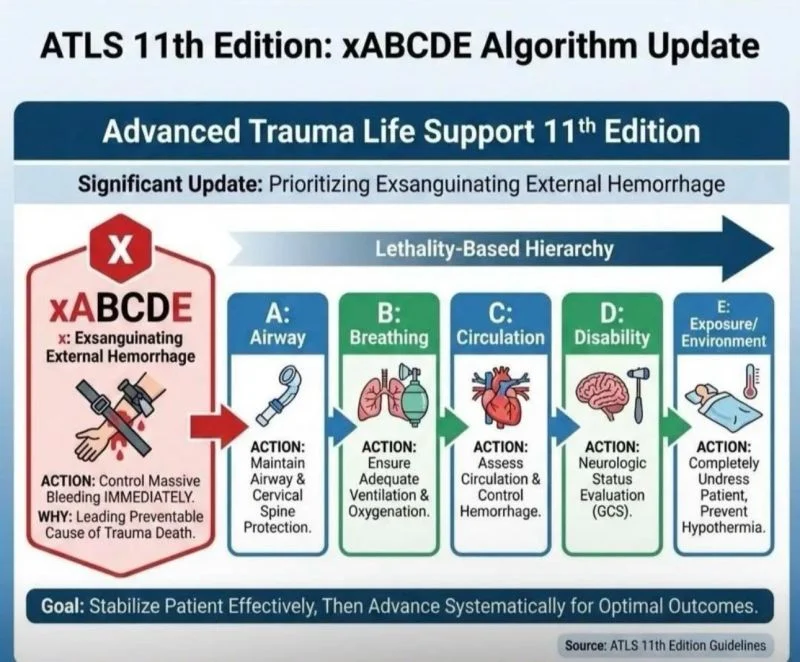
With the release of ATLS 11, the sequence has evolved to: ABCDE
The ‘X’ represents exsanguinating (catastrophic) hemorrhage—severe bleeding that must be identified and controlled immediately, even before airway assessment.
Why?
Because a patient can lose a critical volume of blood and die within minutes.
If catastrophic bleeding is not stopped, securing the perfect airway may not change the outcome.
This update reflects growing evidence from civilian and military trauma care showing that rapid hemorrhage control saves lives.
The priority is now clear:
- Control catastrophic bleeding
- Apply direct pressure, tourniquets, or hemostatic dressings when indicated
- Then proceed with Airway, Breathing, Circulation, Disability, and Exposure
ATLS 11 is a reminder that medicine continuously evolves with evidence.
As healthcare professionals, staying current with these changes helps us provide safer, more effective care when seconds matter most.
What are your thoughts on the shift from ABCDE to xABCDE?
Have you already incorporated this approach into your trauma practice?”

Stay updated with Hemostasis Today.
-
Sep 16, 2026, 16:06Katrina Louise Manalaysay: In Your 20s, You Might be Given the Opportunity to Donate Blood for the First Time
-
Sep 16, 2026, 15:45Matthew Hazell: A Brilliant Explanation of Phenotype vs Genotype Using a LEGO House
-
Sep 16, 2026, 15:23Ahmad Al-Ramahi: Presenting the Military Pharmacists Blood Training Course at the FIP World Congress
-
Sep 16, 2026, 15:21HIT Reimagined: Can 12-Lipoxygenase Inhibition Stop Immune Thrombosis?
-
Sep 16, 2026, 14:42Ruchi Punamia: Beyond the Blood Bank and The Clinical Impact of Apheresis
-
Sep 16, 2026, 14:06Kalyan Roy: Celebrating Apheresis, Advancing Care, Saving Lives
-
Sep 16, 2026, 13:38Andrew Zapfel: Advancing Sickle Cell Disease Care and Research
-
Sep 16, 2026, 13:30Thirunavukkarasu Angappan: Why Plasma-Derived Factor VIII Still Matters for Inhibitor Patients
-
Sep 16, 2026, 13:22Matthew Hazell: New BSH Guidance for Fetal, Neonatal and Paediatric Transfusion