


Mike Doss: The Critical Role of EMS in Preventing the Trauma Triad of Death
Mike Doss, Education Training Coordinator at DocGo, Adjunct Instructor at Volunteer State Community College, shared a post on LinkedIn:
“There is a phrase in EMS that needs to be dragged out into the parking lot and beaten with a clipboard.
‘It’s just an IFT.’
No, Skippy.
It is not ‘just an IFT’ when the patient has been shot, stabbed, crushed, wrecked, dropped, broken, anticoagulated, under-resuscitated, over-fluided, half-packaged, half-warmed, or barely holding their blood pressure together through grit, catecholamines, and the grace of whatever higher power they believe in.
Calling it an interfacility transfer does not magically turn a trauma patient into a routine discharge.
It means one facility looked at that patient and said, ‘They need something we cannot provide here.’
That should get your attention.
Because sometimes you are not transporting a stable trauma patient.
Sometimes you are transporting a patient who is temporarily behaving.
And there is a big damn difference.
Let’s talk about the trauma triad of death.
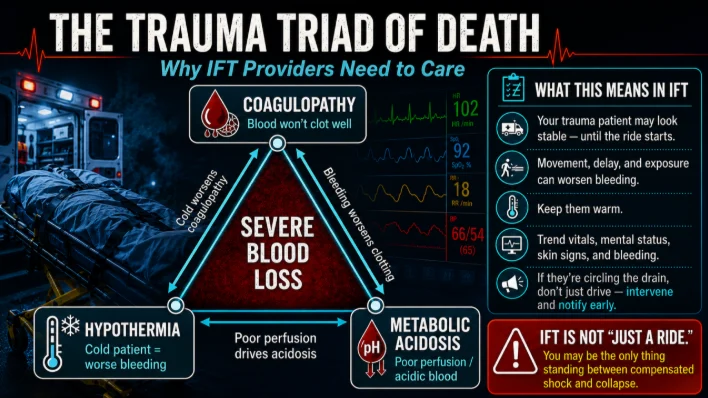
The trauma triad of death is the ugly little relationship between: Hypothermia Coagulopathy Metabolic acidosis.
That sounds like something from a trauma lecture where everybody nods while secretly checking the lunch menu.
So let’s say it like normal people.
The patient gets cold.
Cold patients do not clot worth a flip.
They keep bleeding.
The bleeding causes poor perfusion.
Poor perfusion makes the body acidotic.
Acidosis makes clotting worse.
Worse clotting means more bleeding.
More bleeding means worse shock.
Worse shock means the patient starts circling the drain.
And there you are in the back of the truck, bouncing down the road, realizing this was not nearly as ‘routine’ as somebody made it sound.
That is the triad.
It is not academic.
It is not just for the trauma bay.
It is not just for flight teams, critical care transport, or the folks with fifteen pumps and a vent.
It matters to IFT.
It matters to basic EMTs.
It matters to paramedics.
It matters to anyone who puts a trauma patient on a stretcher and moves them from one place to another.
‘Stable’ is not a magic word.
One of the biggest traps in EMS is hearing the word stable and letting your brain clock out.
‘They’re stable.’
Fantastic.
Stable compared to what?
Stable five minutes ago?
Stable after two liters of fluid and pain meds?
Stable while lying flat, warm, still, and surrounded by nurses?
Stable before you moved them three times, uncovered them, loaded them into a cold ambulance, and drove them across town?
Stable is not a permanent condition.
Stable is a snapshot.
And trauma patients are notorious for looking decent right up until they very suddenly do not.
A young trauma patient can compensate like a champ until the tank is empty. Then they do not drift downhill politely. They fall off a cliff.
An elderly patient on blood thinners may look fine while bleeding into places you cannot see.
A pelvic fracture can behave until you start moving the patient around like furniture.
An abdominal bleed can smile at you, answer questions, and still be writing checks the body cannot cash.
So when someone tells you the trauma patient is stable, your next thought should not be, ‘Cool, easy ride.’
Your next thought should be:
Stable now. What is the trend?
IFT is where the wheels can come off.
Here is the part folks do not like to admit.
Transport changes things.
Movement changes things.
Temperature changes things.
Time changes things.
That beautiful little hospital room where the patient looked okay?
That was controlled.
Now you are moving them.
You are transferring them from bed to stretcher.
You are rolling them through hallways.
You are taking them outside.
You are loading them.
You are exposing them.
You are bouncing them down roads that apparently were last paved during the Carter administration.
You are moving a trauma patient away from the sending staff and toward a receiving team that does not yet have hands on them.
That gap matters.
That is where good EMS providers earn their paycheck.
Not by pretending every transport is an emergency.
But by recognizing the ones that can become one.
Hypothermia: Stop freezing your trauma patients.
Let me say this clearly.
Keeping a trauma patient warm is not being nice.
It is not customer service.
It is not ‘comfort care.’
It is bleeding control.
Cold trauma patients bleed worse.
Their clotting system does not work as well.
Their physiology gets uglier.
And we help create the problem every time we strip them down, leave them uncovered, move them through cold air, and then park them in a patient compartment set to ‘meat locker’ because we are sweating through our uniform.
Do not do that.
Cover the patient.
Use blankets.
Use heat when appropriate.
Limit exposure.
Warm the truck.
Keep wet clothing and linens from staying against the patient if you can safely address it.
And for the love of all that is holy, do not leave them uncovered because ‘we’re only going across town.’
Across town is long enough for a trauma patient to get colder.
Across town is long enough for bleeding to get worse.
Across town is long enough for your ‘stable’ patient to become everybody’s problem.
Coagulopathy: Blood that won’t clot is bad news.
Coagulopathy means the blood is not clotting the way it should.
That is a problem.
I realize that sounds painfully obvious, but apparently we need to say painfully obvious things out loud because we still have people treating trauma transfers like a scheduled Uber with oxygen.
Trauma patients may have clotting problems because of blood loss, injury, hypothermia, acidosis, medications, dilution from fluids, or all of the above.
You may not be able to fix all of that in the back of the ambulance.
But you can respect it.
You can avoid unnecessary movement.
You can reassess dressings.
You can check for bleeding that restarted after transfer.
You can watch the sheets, the stretcher, the floor, and the patient.
You can respect pelvic injuries.
You can pay attention to patients on anticoagulants.
You can stop assuming that because bleeding looked controlled in the ER, it will stay controlled after loading.
Bleeding is sneaky.
Sometimes it is dramatic.
Sometimes it is quiet.
Sometimes it is under a blanket, behind a dressing, inside the abdomen, inside the pelvis, or inside the skull.
The blood does not have to be on your boots for the patient to be in trouble.
Acidosis: Poor perfusion has consequences.
Metabolic acidosis in trauma is usually tied to poor perfusion.
The body is not getting enough oxygenated blood to the tissues.
Cells start operating in survival mode.
Waste builds up.
Chemistry gets ugly.
You may not have a lab value in the back of the truck.
That is fine.
You still have eyes.
Use them.
Is the patient becoming restless?
More anxious?
More confused?
Cooler?
Paler?
Clammier?
Is the heart rate creeping up?
Is the pressure drifting down?
Are the respirations changing?
Are the pulses getting weaker?
Is that calm patient suddenly telling you, ‘I don’t feel right?’
That statement right there should light up your brain.
Patients do not always read the textbook before they crash.
Sometimes they just get quiet.
Sometimes they get weird.
Sometimes they get scared.
Sometimes they tell you exactly what is coming, and we miss it because the monitor has not screamed yet.
Do not wait for the monitor to think for you.
The monitor is a tool.
You are supposed to be the provider.
Trend the patient, not just the numbers.
A single set of vitals is a Polaroid.
A trend is the movie.
And I need you watching the movie.
A blood pressure of 104/68 might not make anybody panic by itself.
But if that patient was 132/84 twenty minutes ago, and now their heart rate is 118, their skin is cool, and they are asking why they feel dizzy, that is not ‘still stable.’
That is a patient telling you where this story is headed.
Do not document one set of vitals and call it a day.
Trend them.
Manual when appropriate.
Repeat them.
Compare them.
Think about them.
And yes, mental status counts.
Skin signs count.
Work of breathing counts.
Bleeding checks count.
Pain changes count.
The patient’s overall appearance counts.
EMS is not just numbers on a screen.
It is pattern recognition.
And if you cannot recognize the pattern, you are just babysitting a monitor with a driver’s license.
Before you leave the sending facility.
Before you roll out with a trauma patient, take a breath and ask some grown-up EMS questions.
What actually happened?
Where is the injury?
Where could they be bleeding?
What has changed since arrival?
What were the first vitals?
What are the most recent vitals?
Are they trending better, worse, or just being held together?
Are they on blood thinners?
Have they received fluids?
Blood products?
TXA?
Pain medication?
Sedation?
Antibiotics?
Do they have tourniquets, pressure dressings, splints, pelvic binders, chest tubes, drains, or anything else I need to know about?
Are they warm?
Are they packaged correctly?
Do I have enough help to move them safely?
Do I need ALS?
Do I need a different unit?
Do I need to call somebody before this becomes a problem?
And here is the big one: What am I going to do if this patient deteriorates halfway there?
Because ‘hope they make it’ is not a treatment plan.
Neither is ‘drive faster.’
Sometimes you need to move with purpose.
Sometimes you need to notify early.
Sometimes you need to pull over and intervene.
Sometimes you need to say, ‘This patient is not appropriate for this level of transport.’
That is not being difficult.
That is being a provider.
During Transport: Do not go into stretcher taxi mode.
Once the doors close, do not disappear into your phone, your paperwork, or your fantasy football lineup.
This is trauma.
Pay attention.
Keep them warm.
Recheck bleeding.
Recheck dressings.
Reassess pain.
Trend vitals.
Watch mental status.
Watch skin signs.
Look at the patient, not just the monitor.
Ask how they feel.
Listen when they answer.
If something changes, act like it matters.
And document the trend like a grown professional.
‘Patient tolerated transport well’ is not enough when the patient’s heart rate climbed, pressure dropped, skin got pale, and you had to notify receiving.
Tell the story.
The chart should show what you saw, what changed, what you did, who you notified, and how the patient responded.
That is not just billing.
That is patient care.
That is continuity.
That is your professional reputation.
Notify early, not when you hit the bay door.
If the patient starts going sideways, call it early.
Do not wait until you are backing into the receiving facility to casually announce, ‘Hey, they’re looking a little rough.’
No kidding, genius. Now everyone is behind.
Notify the receiving facility early.
Follow your protocols.
Contact medical control if required.
Update dispatch.
Request help if needed and available.
Give the receiving team time to get ready.
A good heads-up can change the first five minutes after arrival.
And in trauma, five minutes can matter.
Early notification is not panic.
It is professionalism.
This is why IFT matters.
IFT gets looked down on in EMS, and I am tired of pretending it does not.
Some people act like IFT is where EMS skills go to retire.
That is nonsense.
IFT providers move septic patients.
Cardiac patients.
Stroke patients.
Vent patients.
Psych patients.
Dialysis patients.
Post-op patients.
High-risk OB patients.
And yes, trauma patients.
Sometimes the patient is stable.
Sometimes the patient is not.
Sometimes the sending facility has done everything right, and the patient still deteriorates.
Sometimes the report sounds clean, and the patient is a mess.
Sometimes the transfer packet is thicker than a phone book and somehow still does not answer the one question you actually needed answered.
That is the job.
IFT is not lesser EMS.
Bad IFT is lesser EMS.
Good IFT requires assessment, judgment, communication, documentation, and the willingness to speak up when something smells wrong.
The Bottom Line.
The trauma triad of death is not just a trauma center lecture slide.
It is a back-of-the-ambulance problem.
Hypothermia makes bleeding worse.
Bleeding makes perfusion worse.
Poor perfusion drives acidosis.
Acidosis makes clotting worse.
And that cycle can turn your ‘stable transfer’ into a bad day real quick.
So do the job.
Keep trauma patients warm.
Trend the vitals.
Watch the mental status.
Check the bleeding.
Respect the mechanism.
Respect the medications.
Respect the movement.
Notify early.
Document the changes.
And stop letting the phrase ‘just an IFT’ make you lazy.
Because sometimes you are not just giving a ride.
Sometimes you are the only thing standing between compensated shock and collapse.
Act like it.”
Stay updated with Hemostasis Today.
-
Sep 20, 2026, 04:54William Aird: What Does a Complete History and Physical Really Mean?
-
Sep 20, 2026, 04:34Hons Saurabh Kaushik: Why Uncontrolled LDL Can Be Harmful
-
Sep 20, 2026, 03:58Salih Ehsan: The Complexities of HbF and HbA2
-
Sep 20, 2026, 03:22The Voices of People Living With Bleeding Disorders – EHC
-
Sep 20, 2026, 01:18Sebastian Mafeld: Has 2026 Changed How We Treat Pulmonary Embolism?
-
Sep 20, 2026, 01:16Pall T. Onundarson: DOACs – Monitoring, Tailoring Dose and Identifying Problems
-
Sep 20, 2026, 01:15Thierry Fumeaux: From Efficacy to Effectiveness – The Value of Real-World Evidence
-
Sep 20, 2026, 01:14Said El Shamieh: VEGFA Genetic Variants and Bleeding Risk During Warfarin Therapy
-
Sep 20, 2026, 01:04Omar Danoun: Levetiracetam May Increase Thromboembolic Risk With DOACs