


Ney Carter Borges: Contemporary Trends and Outcomes of Percutaneous Coronary Intervention for Stent Thrombosis
Ney Carter Borges, Member Cardiologist of Global Physician Association at Cleveland Clinic Florida, shared a post on LinkedIn:
”Contemporary Trends and Outcomes of Percutaneous Coronary Intervention for Stent Thrombosis
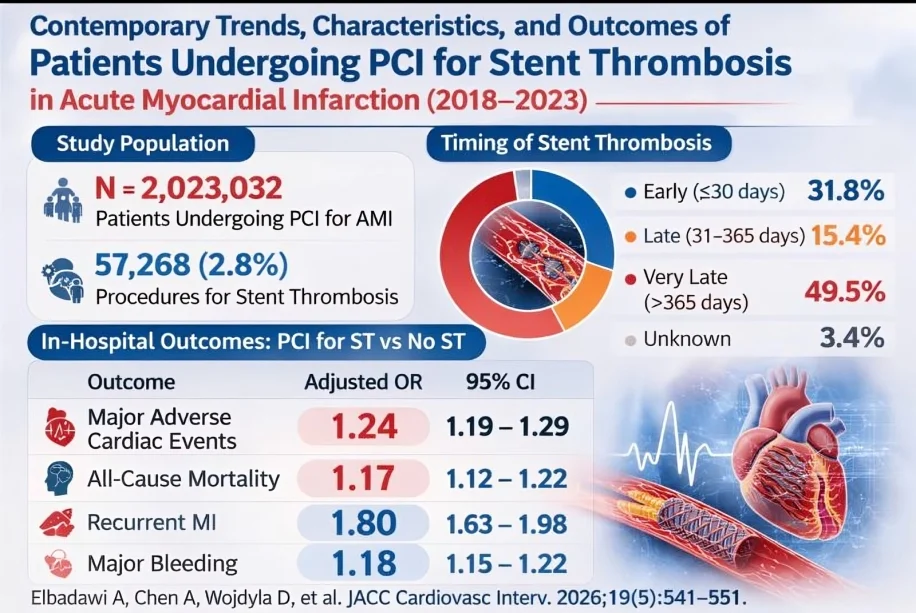
Stent thrombosis (ST) remains one of the most serious complications following percutaneous coronary intervention (PCI), frequently presenting as acute myocardial infarction (AMI). A contemporary analysis from the National Cardiovascular Data Registry (NCDR) CathPCI registry evaluated trends and outcomes of PCI performed for ST between April 2018 and June 2023. The study included 2,023,032 patients undergoing PCI for AMI, of whom 57,268 cases (2.8%) were attributed to stent thrombosis.
Regarding timing, very late ST (>365 days) represented the largest proportion of cases (49.5%), followed by early ST (≤30 days) at 31.8%, late ST (31–365 days) at 15.4%, and unknown timing in 3.4% of cases. Importantly, the incidence of PCI for ST remained stable over time, despite advances in contemporary PCI techniques, including newer-generation drug-eluting stents, potent P2Y12 inhibitors, and intracoronary imaging.
Clinically, patients with ST tended to be younger, more frequently male, and more likely to present with STEMI, cardiogenic shock, cardiac arrest, and ventricular arrhythmias, reflecting a high-risk population. Compared with PCI for non-ST lesions, PCI performed for ST was associated with significantly worse in-hospital outcomes, including higher rates of major adverse cardiac events (adjusted OR 1.24), all-cause mortality (OR 1.17), recurrent myocardial infarction (OR 1.80), and major bleeding (OR 1.18).
These findings highlight that, despite technological and pharmacologic advances, stent thrombosis remains a rare but high-risk complication of PCI, emphasizing the need for improved preventive strategies, optimized antithrombotic therapy, and procedural techniques to reduce its clinical impact.”
Other posts featuring Ney Carter Borges on Hemostasis Today.
-
Sep 30, 2026, 01:52Javed Anees: DADA2 – When a Young Stroke Is More Than a Stroke
-
Sep 30, 2026, 01:51How a Venous Thrombus Becomes Revascularized – ISTH
-
Sep 29, 2026, 22:45Victor Agunyego: Paracetamol – The Most Common Drug We Underestimate
-
Sep 29, 2026, 22:42Nova Sinclair: Advancing the Future of Hematology – Meet Our 2027 Organizing Committee
-
Sep 29, 2026, 22:41Lorenz Räber: Intracoronary Imaging in PCI – Why, When, How, and Which Modality?
-
Sep 29, 2026, 22:31Selma Turkovic: Pleased to Deliver the Opening Presentation at Kingston Hospital
-
Sep 29, 2026, 22:31Miguel Teran: Ultrasound and Simulation in Arterial Blood Sampling
-
Sep 29, 2026, 22:28Mohammad Refaei: Navigating Your Career in Hematology From Training to Practice
-
Sep 29, 2026, 22:27Matteo Foschi: 10 Clinical Pearls for Antithrombotic Therapy in Secondary Stroke Prevention