

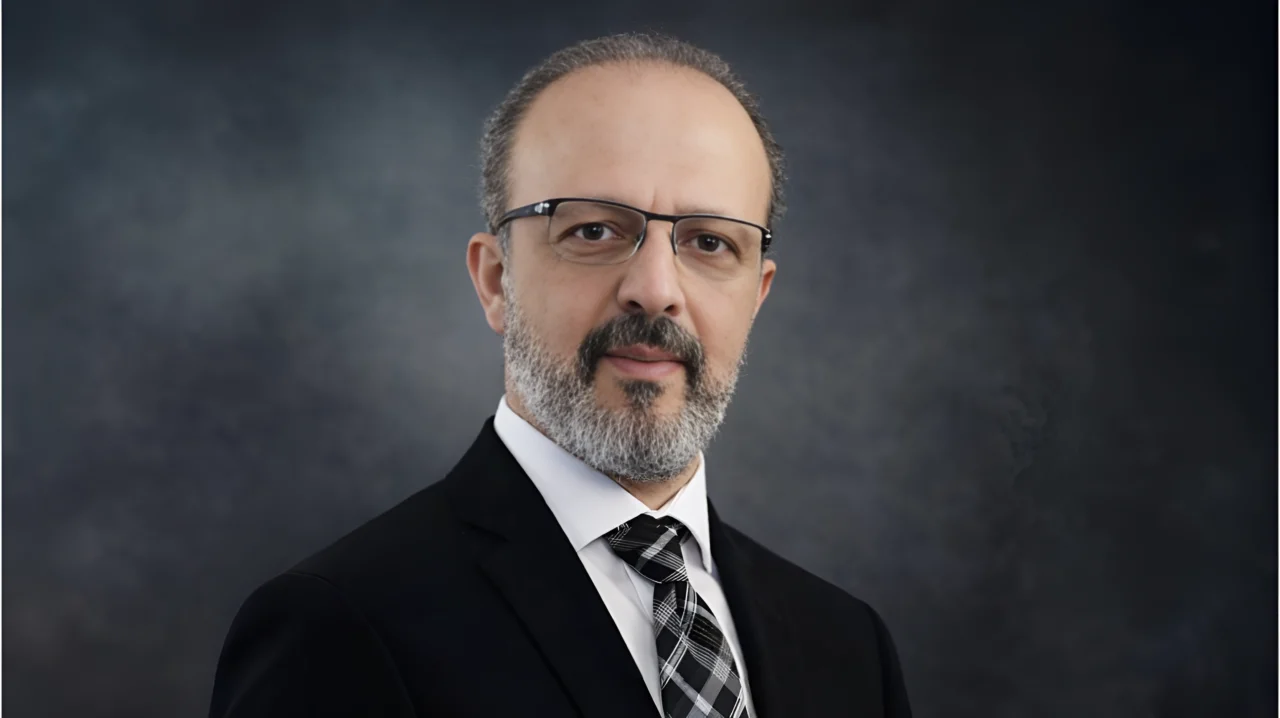
Reza Shojaei: Why Dried Plasma May Be the Most Important Plasma Innovation in Decades
Reza Shojaei, Chief Operating Officer at Canadian Plasma Resources, shared on LinkedIn:
“What if the most important plasma product in the world fits in your backpack?
- Needs no fridge.
- Stays stable for 2 years at room temperature.
- Is ready to transfuse in under 3 minutes.
It’s not a concept. It’s not a clinical trial.
It already exists, and a world-first installation took place in Paris 3 months ago.
Most people in our industry haven’t heard about it.
In this week’s edition, we cover:
- Why frozen plasma fails outside of hospitals, and what fills that gap
- The 80-year history of dried plasma: rise, fall, and dramatic return
- Freeze-dried vs. spray-dried: what’s the difference and why it matters
- The Paris milestone that changes the scale equation
- The evidence: honest about what we know and what we still need to prove
- 5 direct implications for plasma collection and global supply strategy
Fewer than 30,000 units of dried plasma exist in the entire world right now.
That number tells you everything about how much work remains.
The Cold Chain Problem: Why Plasma Is So Hard to Deliver
Plasma, the liquid part of blood that carries the proteins your body needs to stop bleeding, is one of the most powerful tools in trauma care.
When someone is seriously injured and bleeding heavily, getting plasma into them quickly can mean the difference between life and death. The science on this is clear (Mould-Millman et al., 2024).
But there is a catch. Standard plasma has to be frozen. It sits in hospital freezers at minus 18 degrees Celsius or colder. Before it can be used, it needs to be thawed, a process that takes 30 to 45 minutes. And once thawed, it must be used within 24 hours, or it will go to waste (Buckley et al., 2019).
Think about what that means outside of a hospital. A soldier bleeding in the field. A road accident victim in a remote area. A patient in a low-income country where cold storage is unreliable.
In those situations, standard frozen plasma is simply not an option. The cold chain breaks, and people die who did not have to.
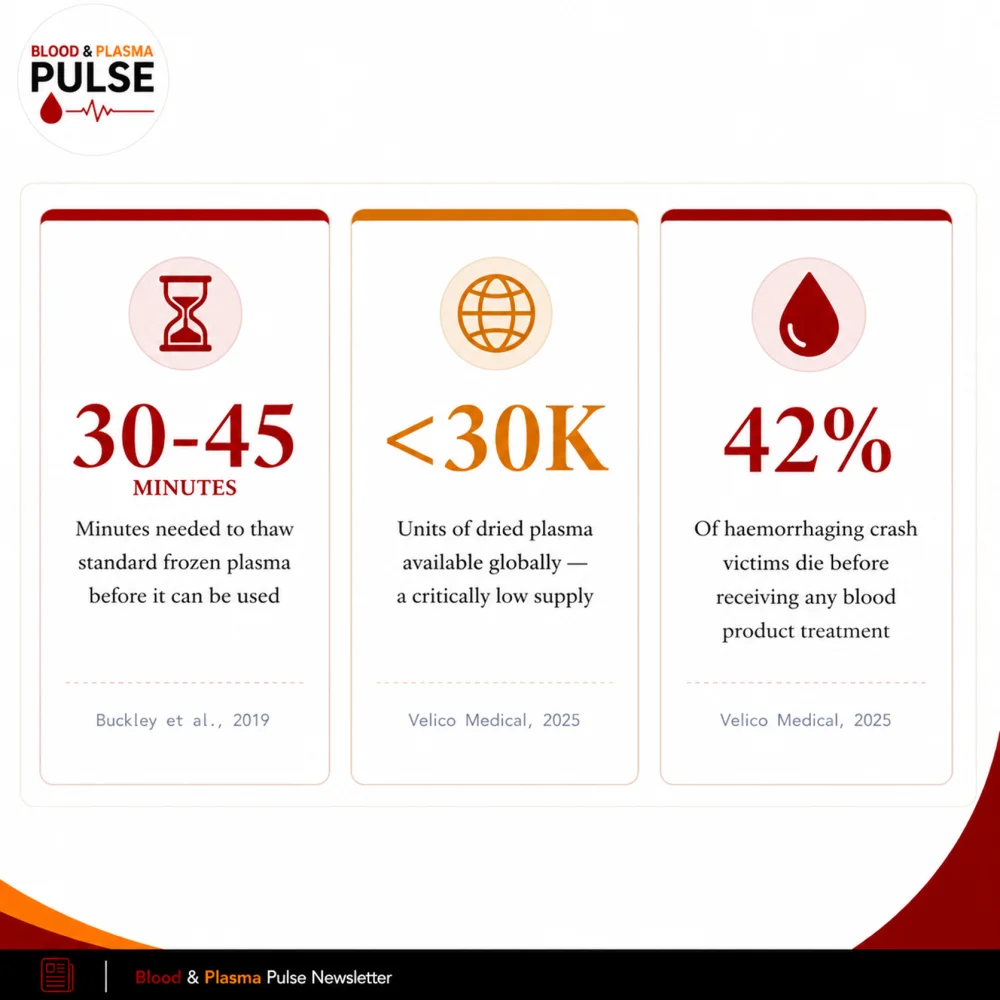
Figure 1. The logistics gap in plasma delivery — and why dried plasma matters. Sources: Buckley et al. (2019); Velico Medical (2025).
Now imagine a different product. One that sits on a shelf at room temperature for two years.
One that weighs almost nothing. One that a paramedic, a soldier, or a village health worker can mix with water and have ready to give within 3 minutes; no thawing, no electricity, no cold chain required (Peng et al., 2024).
That product exists. It has existed, in different forms, since World War II. And right now, in 2026, it is experiencing the most significant revival in its 80-year history.
An 80-Year Story: The Rise, Fall, and Return of Dried Plasma
Dried plasma was not invented recently. Its story stretches back to 1938, when a scientist named Max Strumia first developed the drying process at Bryn Mawr in the United States (Lier et al., 2023).
Within a few years, the U.S. and British militaries were producing it by the millions for use on World War II battlefields (Buckley et al., 2019).
The idea was brilliant in its simplicity. Normal plasma, once frozen, is fragile and demanding.
But if you remove all the water from it, through a careful drying process, what is left is a stable powder that does not need refrigeration, is light enough to carry anywhere, and springs back to life when you add water.
Hundreds of thousands of soldiers were treated with it. It saved lives across Europe and the Pacific (Singh et al., 2024).
Did You Know?
In 2024, researchers at the University of Toronto managed to reconstitute a sample of Canadian dried plasma from 1943, over 80 years old.
When they tested it, they found intact albumin (a critical protein), anti-thrombin, plasminogen, and other clotting proteins still present. It was not usable clinically, but it was a remarkable proof of how stable dried plasma can be (Singh et al., 2024).
Then, in the early 1950s, disaster struck. Cases of hepatitis, a serious liver infection, were being traced back to plasma transfusions.
The problem was not the drying process itself, but the fact that plasma was pooled from thousands of donors, and the technology to screen for hepatitis did not yet exist. In 1953, the United States suspended its dried plasma programme.
By 1968, it had been withdrawn entirely (Lier et al., 2023).
Two countries refused to give up on it: France and Germany. They continued to develop safer versions, with improved donor screening and pathogen-reduction processes, and have used dried plasma in their military operations for decades (Sailliol et al., 2013).
But for most of the world, dried plasma fell into obscurity.
Now, 70 years later, the technology has caught up with the idea. Modern pathogen reduction processes, single-donor products, and new manufacturing methods have eliminated the hepatitis risk that ended the original programme.
And the result is a new generation of dried plasma products that are safer, faster, and more versatile than anything available in the 1940s.
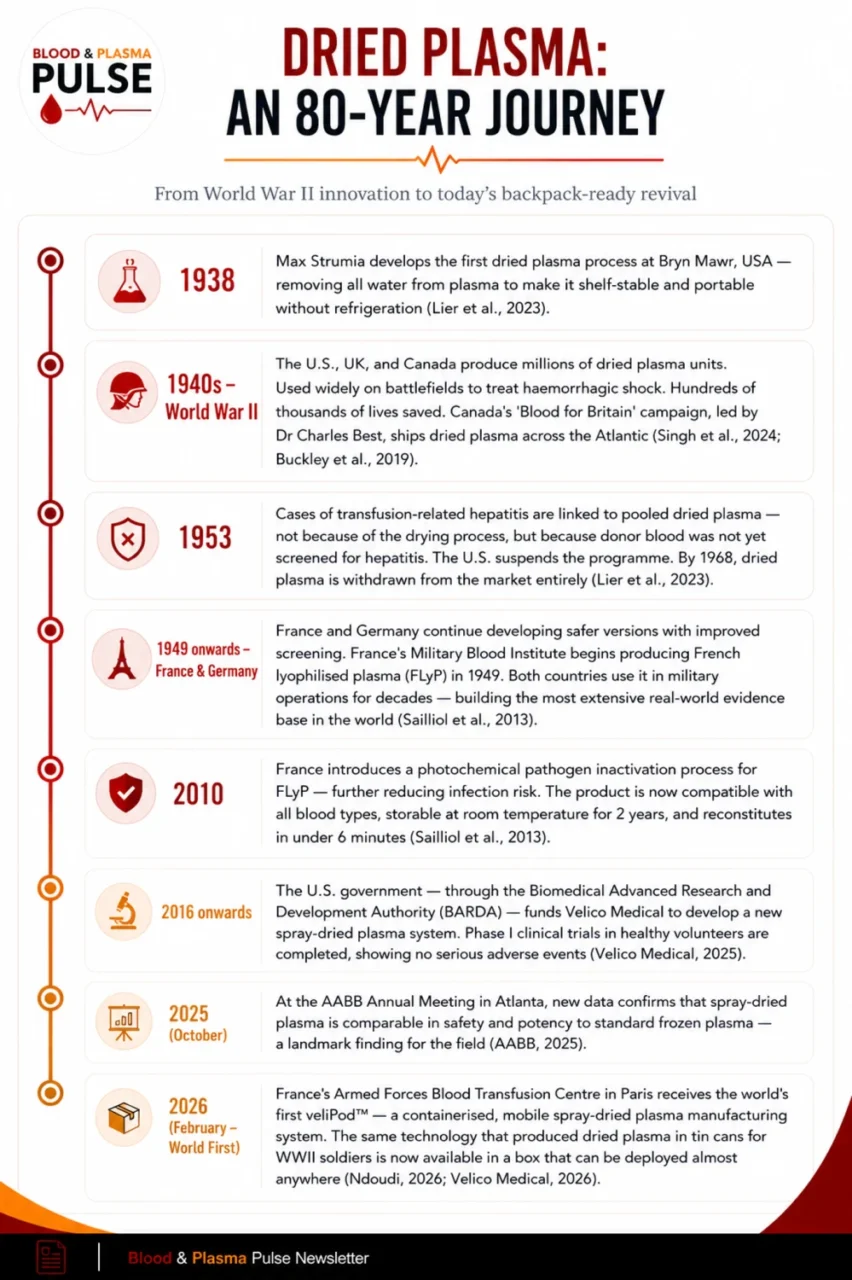
Figure 2. The 80-year history of dried plasma — from WWII battlefield innovation to the world’s first mobile production system in Paris, 2026. Sources: Lier et al. (2023); Buckley et al. (2019); Singh et al. (2024); Sailliol et al. (2013); Velico Med
Freeze-Dried, Spray-Dried, What’s the Difference, and Why Does It Matter?
When people talk about ‘dried plasma,’ they are actually talking about a family of products made using different methods.
Understanding the differences matters because they determine how quickly the plasma can be produced, how light it is to carry, and how quickly it can be used in an emergency. The three main types are:
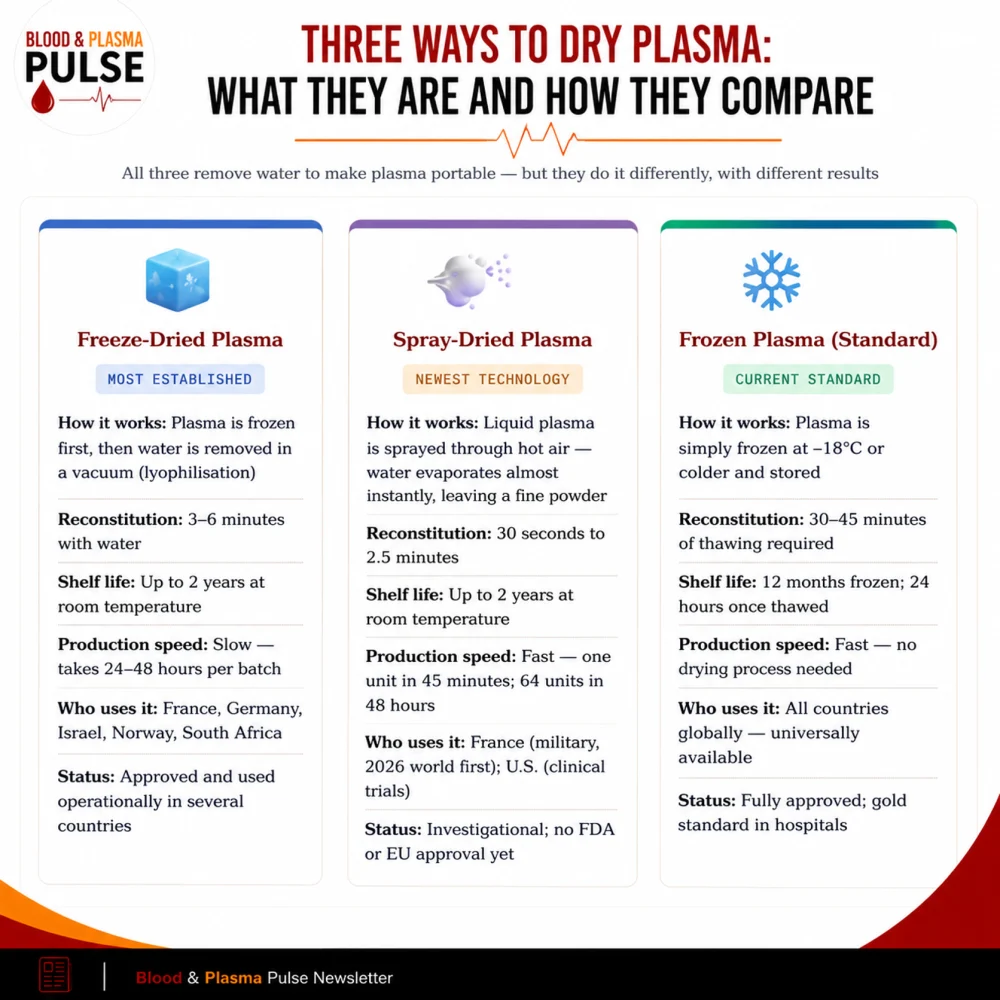
Figure 3. Comparing the three main forms of plasma used in trauma care. Dried plasma (both types) solves the cold chain problem but is not yet widely available. Sources: Buckley et al. (2019); Sailliol et al. (2013); Velico Medical (2026).
The key distinction between freeze-drying and spray-drying is speed and flexibility. Freeze-drying is a slow, centralized, factory-based process. It produces high-quality dried plasma, but it takes a long time and requires heavy, fixed equipment.
Spray-drying can be done in a modular container, essentially a mobile production unit, and produces a unit of plasma in just 45 minutes (Ndoudi, 2026).
Think of it this way: freeze-drying is a bakery that bakes bread the traditional way. Spray-drying is a food truck that can park anywhere and produce bread on demand. Both make excellent bread, but one can go where the hunger is.
‘Freeze-drying is a factory process. Spray-drying is a field process. That difference, between fixed infrastructure and deployable production, changes everything about what dried plasma can do.’
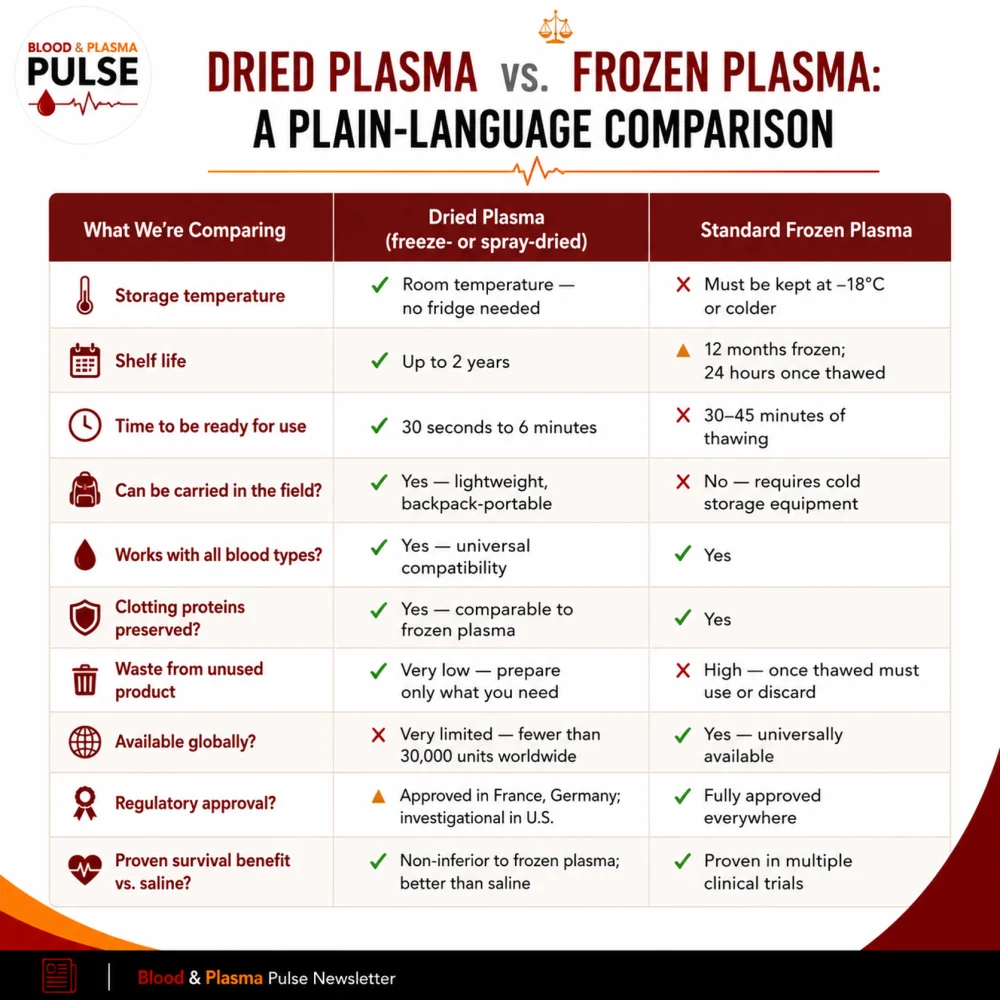
Figure 4. Dried plasma vs. standard frozen plasma across the dimensions that matter most in emergency care. Sources: Sailliol et al. (2013); Buckley et al. (2019); Mok et al. (2021); Velico Medical (2025, 2026); Ehn et al. (2025).
Does It Actually Work? What the Evidence Says
The honest answer is: yes, with important caveats. The evidence that dried plasma is safe and preserves the proteins that help blood clot is strong. The evidence that it definitively reduces death compared to other options is still developing, but what we have is promising.
A 2021 systematic review published in the Journal of Trauma and Acute Care Surgery, the most rigorous summary of evidence to that point, reviewed 12 human studies and 15 animal studies of freeze-dried plasma in trauma.
The conclusion: dried plasma is feasible and safe, with no difference in mortality compared to frozen plasma (Mok et al., 2021). That ‘no difference’ finding means dried plasma is at least as good as the frozen standard, not worse, while being far easier to deploy in the field.
A 2024 study published in the journal Transfusion followed 392 trauma patients and found no clear mortality disadvantage among those receiving dried plasma, and noted that its logistical advantages made it particularly valuable in remote or resource-limited settings (Mould-Millman et al., 2024).
A comprehensive review published in Transfusion Medicine Reviews in 2024 confirmed the same conclusion: dried plasma offers undeniable logistical advantages, a long shelf life, stability at room temperature, and rapid reconstitution without special equipment, and its clinical performance matches that of frozen plasma (Sheffield et al., 2024).
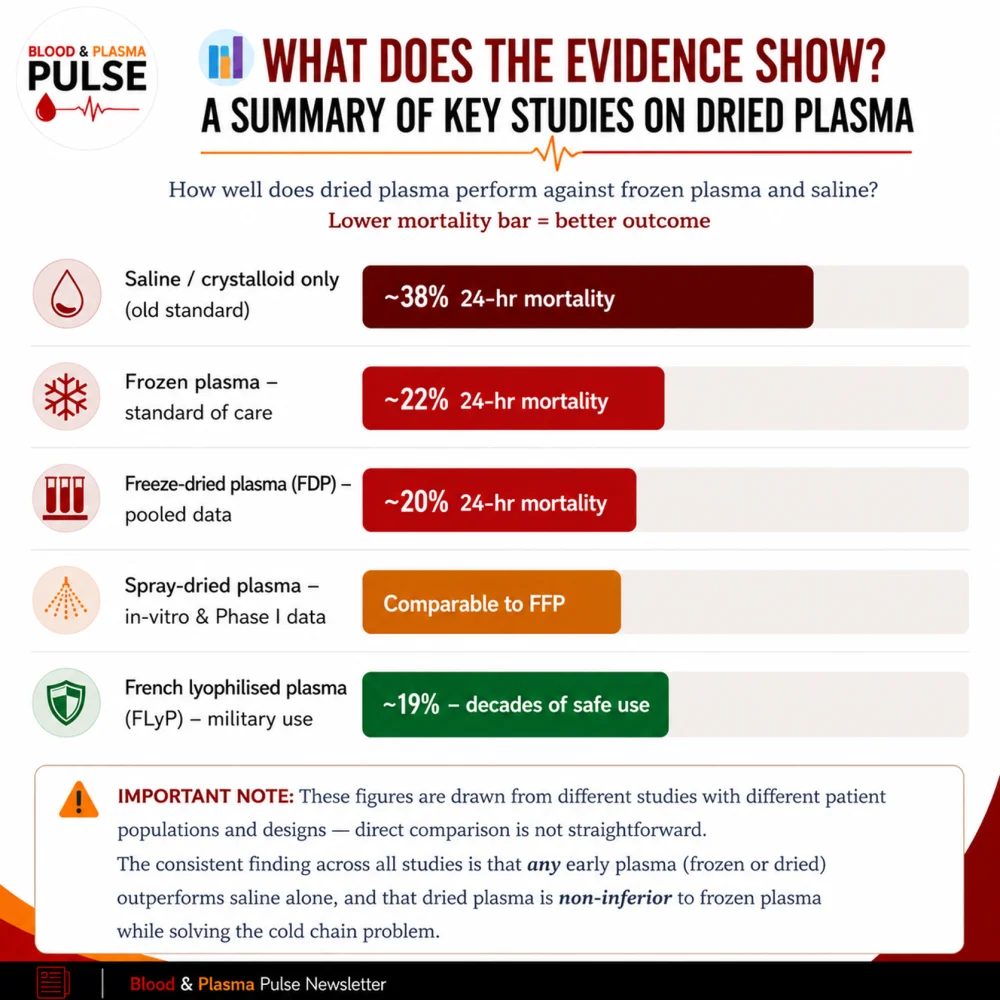
Figure 5. Summary of evidence on dried plasma in trauma care. The clinical case for dried plasma is not that it beats frozen plasma; it is that it performs equally well when frozen plasma is simply not an option. Sources: Mok et al. (2021).
There is, however, an important honest caveat. No randomized controlled trial, the gold standard of clinical evidence, has yet demonstrated a clear survival benefit for freeze-dried plasma over standard care in a civilian trauma setting (Sheffield et al., 2024).
The evidence is mostly observational, meaning it comes from watching what happens in the real world rather than a controlled experiment. That is not a reason to dismiss dried plasma; it is a reason to urgently design and fund those trials.
The logistical case is, in many ways, already closed. When frozen plasma genuinely cannot be provided, because there is no cold chain, no electricity, no thawing equipment, dried plasma is not just better than frozen plasma.
It is the only option. And something that works just as well, available when nothing else is, is exactly what emergency medicine needs.
The World First That Just Happened in Paris
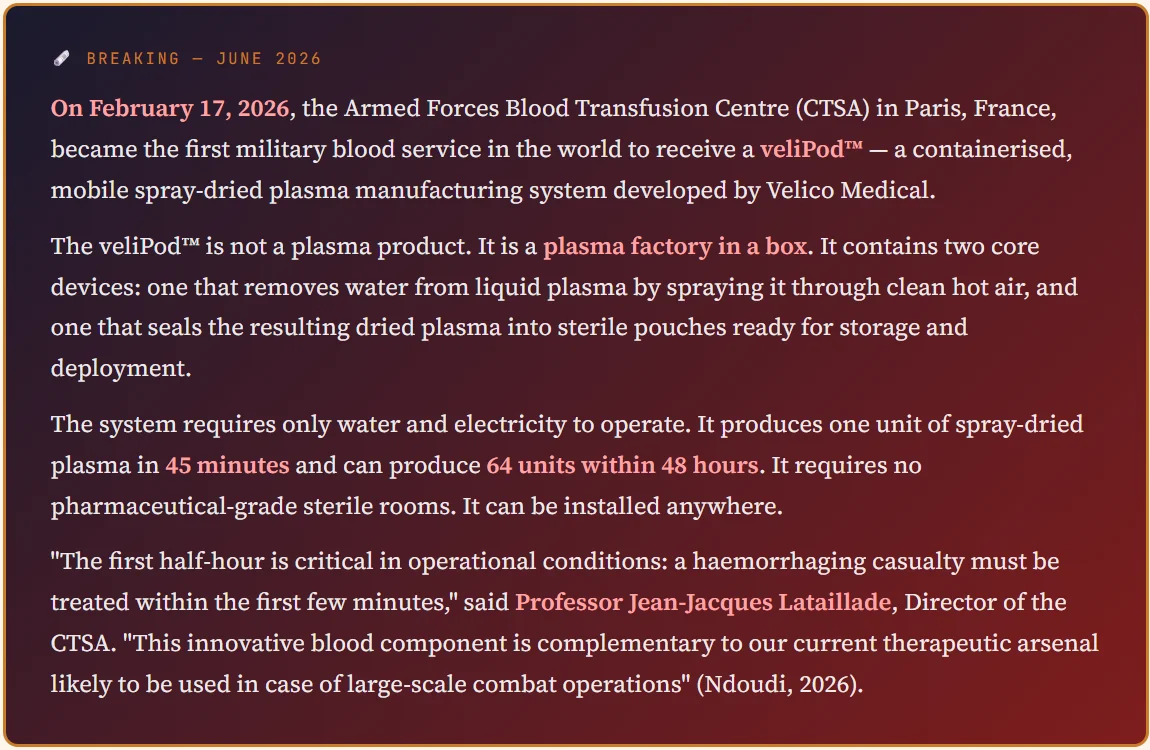
The veliPod will undergo a full year of evaluation at the CTSA before clinical expansion.
A regulatory dossier will be submitted to France’s National Agency for the Safety of Medicines and Health Products. If results are conclusive, the CTSA plans to acquire multiple units to scale up production (Ndoudi, 2026).
This is a significant moment, not because it solves every problem, but because it demonstrates something important: decentralized production of dried plasma is now technically feasible.
You do not need a large pharmaceutical factory to make plasma that can be carried anywhere and used immediately. The ‘plasma factory in a box’ concept has now been proven in the real world.
Velico Medical, the company behind the veliPod system, has received substantial funding from the U.S. government’s Biomedical Advanced Research and Development Authority (BARDA) and completed the first-in-human Phase I clinical trial of its spray-dried plasma product, with no serious adverse events reported (Velico Medical, 2025).
‘One of the advantages of spray-drying is its speed: producing one unit takes only 45 minutes. Unlike immobile and centralized production systems, the veliPod is a mobile container which requires only water and electricity for operation.’
Professor Jean-Jacques Lataillade, CTSA Paris (Ndoudi, 2026)
Who Is Using Dried Plasma Right Now and Who Isn’t?
The global picture of dried plasma adoption is sharply uneven. A small number of countries, primarily those with strong military medical traditions and a willingness to invest in logistics innovation, have been using it for decades. The rest of the world largely lacks access to it.
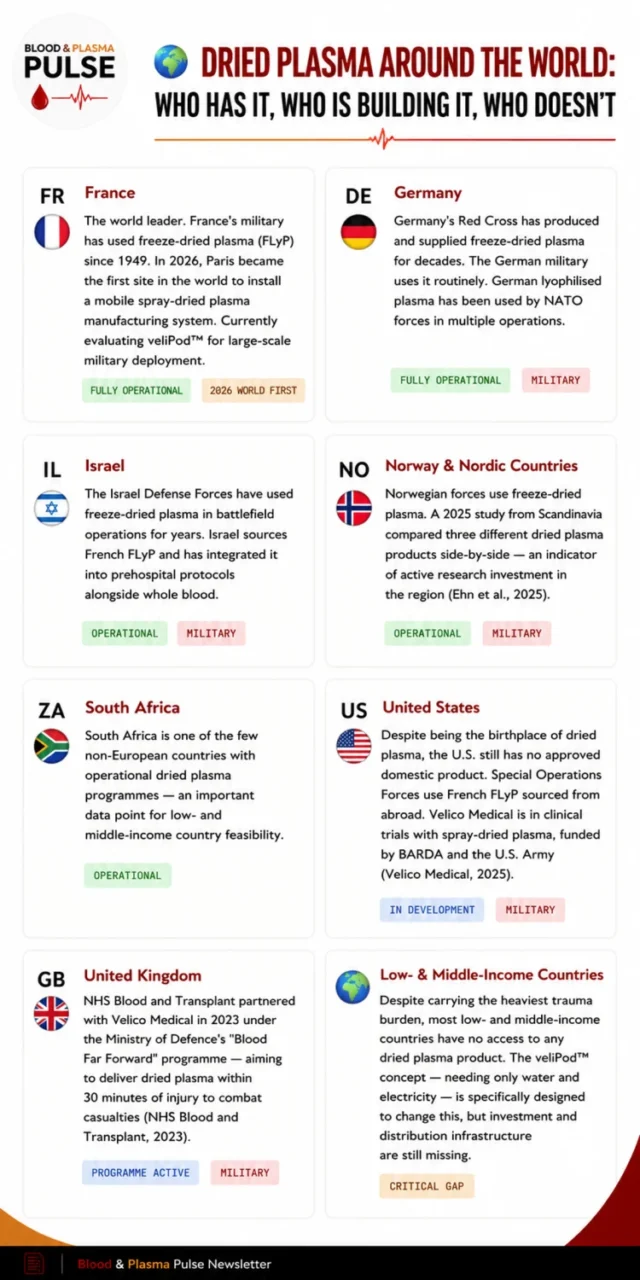
Figure 6. Global snapshot of dried plasma adoption, May 2026. The contrast between countries with operational programmes and the rest of the world is stark. Sources: Sailliol et al. (2013); Lier et al. (2023); NHS Blood and Transplant (2023).
What Does This Mean for the Blood and Plasma Sector?
For those of us working in blood collection, plasma processing, fractionation, and supply chain, the rise of dried plasma is not a distant research curiosity.
It is a story with direct, practical implications for how we think about plasma sourcing, inventory management, global supply strategy, and the future of plasma as a product category.
Dried plasma opens a new market for plasma collection organizations. Right now, almost all plasma collected globally enters either the fractionation pathway (to make immunoglobulin, albumin, and other medicines) or is processed as frozen plasma for hospital use.
A scaled dried plasma market would create a third pathway with potentially higher value for certain collections, particularly single-donor Group O plasma. Blood collection organizations that understand this early will be better positioned when demand grows.
Decentralized production changes the supply chain logic entirely. The veliPod model does not require plasma to travel from the collection centre to the large fractionation plant and back to the hospital.
It allows plasma to be collected, dried, and deployed locally. That is a fundamentally different model, and it has implications for how we think about transportation costs, wastage, and supply resilience in remote areas.
Fewer than 30,000 units exist globally, which is not enough. The current global supply of dried plasma is critically low (Velico Medical, 2025).
If large-scale military conflicts, mass-casualty events, or natural disasters occurred simultaneously across multiple regions, there would not be enough dried plasma to go around.
Scaling production, whether through centralized freeze-drying facilities or distributed spray-drying systems, is now a matter of national and global health security.
Regulatory frameworks need to catch up with the technology. France and Germany have operational programmes because they never stopped. The United States, despite funding the original WWII research and now funding its revival, still has no approved product on the market.
Every year of regulatory delay is a year of preventable deaths. Industry bodies and clinical advocates need to work alongside regulators to build the evidence base and accelerate approval pathways.
The biggest opportunity and the biggest moral responsibility are in low-income countries.
The countries that stand to benefit most from a room-temperature, backpack-portable plasma product are those in sub-Saharan Africa, South Asia, and Southeast Asia, where cold chain infrastructure is weakest, and trauma burden is highest.
Building equity into dried plasma scale-up from the beginning, rather than as an afterthought, is the right strategic and ethical choice.
The Bottom Line: Small Pouch, Big Idea
Eighty years ago, a pouch of dried plasma was packed into a tin can and shipped to soldiers bleeding on battlefields across the world. The technology worked. Then the technology was blamed for something it did not cause and disappeared for a generation.
Today, with modern pathogen screening, single-donor products, spray-drying innovation, and a mobile production system now deployed in Paris, dried plasma is back. And this time, it has the science, the safety profile, and the manufacturing capability to fulfil what that WWII tin can only promise.
The question is not whether dried plasma will play a bigger role in global trauma care. The question is how quickly we can build the production capacity, regulatory frameworks, and distribution networks to get it where it is needed most before the next crisis makes the answer for us.
A small pouch of powder. Ready in 90 seconds. No fridge required. It is one of the simplest ideas in medicine. And it is long overdue.
A product that can be carried in a backpack, stored for two years without refrigeration, and be ready to transfuse in under three minutes, and is as safe as the frozen standard. That is not a future product. It exists right now. The challenge is scale.”
Stay updated with Hemostasis Today.
-
Sep 20, 2026, 12:11Giacomo Buso: Silent Atherosclerosis Begins Earlier Than Expected
-
Sep 20, 2026, 12:0310 Posts Not to Miss This Week
-
Sep 20, 2026, 11:27Edward Lee Carter: Prasugrel Dosing Matters in P2Y12 Inhibitor Comparisons After PCI
-
Sep 20, 2026, 09:51Ceasovschih Alexandr: A Closer Look at Lipid Disorders in CKM Syndrome
-
Sep 20, 2026, 09:05World Stroke Academy: Can Adjunct IAT Improve Tissue Reperfusion?
-
Sep 20, 2026, 06:46Neeraj Songara: From Donated Blood to Engineered Therapeutics
-
Sep 20, 2026, 06:24Louise St. Germain Bannon: Improving Awareness and Care for Women Across the Lifespan
-
Sep 20, 2026, 05:17Maxime Dely: When ABO Compatibility Isn’t Enough for Safe Transfusion
-
Sep 20, 2026, 04:54William Aird: What Does a Complete History and Physical Really Mean?