


Simon Senanu: G6PD Deficiency Testing – What the Lab Must Get Right
Simon Senanu, Medical Laboratory Scientist at Perkins Medical Centre, shared a post on LinkedIn:
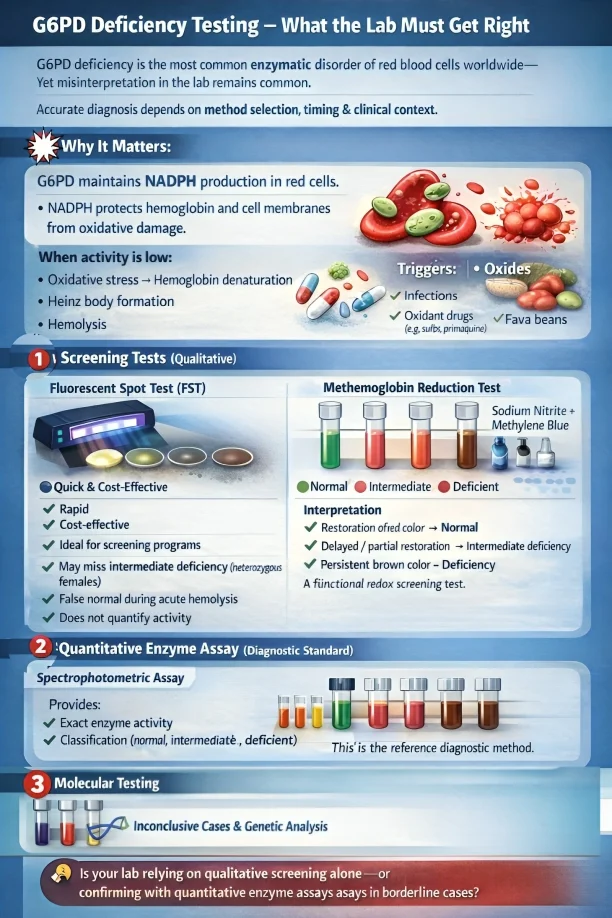
”G6PD Deficiency Testing – What the Lab Must Get Right
G6PD deficiency is the most common enzymatic disorder of red blood cells worldwide – yet misinterpretation in the lab remains common.
Accurate diagnosis depends on method selection, timing, and clinical context.
Why It Matters
G6PD maintains NADPH production in red cells.
NADPH protects hemoglobin and cell membranes from oxidative damage.
When activity is low:
- Oxidative stress → Hemoglobin denaturation
- Heinz body formation
- Hemolysis
Common triggers:
- Infections
- Oxidant drugs (e.g., sulfa drugs, primaquine)
- Fava beans
Screening Tests (Qualitative)
Fluorescent Spot Test (FST)
G6PD generates NADPH, which fluoresces under UV light.
Reduced fluorescence → deficiency suspected.
- Rapid
- Cost-effective
- Ideal for screening programs
Limitations:
- May miss intermediate deficiency (heterozygous females)
- False normal during acute hemolysis
- Does not quantify activity
Methemoglobin Reduction Test (Sodium Nitrite + Methylene Blue Method)
This is a functional oxidative challenge test performed in a single reaction system.
- Sodium nitrite oxidizes hemoglobin → methemoglobin (brown color).
- Methylene blue acts as an artificial electron carrier.
- G6PD generates NADPH, which reduces methylene blue.
- Reduced methylene blue facilitates conversion of methemoglobin back to hemoglobin.
Interpretation
- Restoration of red color indicates Normal
- Partial restoration(light brown) indicates Partial/intermediate deficiency
- Persistent brown color indicates Deficiency
A functional redox screening test.
Limitations:
- Semi-quantitative, subjective, and affected by hemolysis or incubation conditions.
- Primarily used in low-resource or teaching settings.
Quantitative Enzyme Assay (Diagnostic Standard)
Spectrophotometric Assay
Measures NADPH production rate per gram of hemoglobin.
Provides:
- Exact enzyme activity
- Classification (normal, intermediate, deficient)
- Clinical risk stratification
This is the reference diagnostic method.
Critical Laboratory Pitfalls
- Acute hemolysis
Older deficient RBCs are destroyed first. Reticulocytes have higher activity → False normal results.
Repeat testing 2-3 months post-episode.
- Recent transfusion
Donor RBCs can mask deficiency. Always review history.
- Female heterozygotes
Due to X-linked lyonization, enzyme levels may fall in the intermediate range.
Qualitative tests may miss these cases.
Molecular Testing
Used when:
- Results are inconclusive
- Neonatal diagnosis is required
- Borderline activity with severe hemolysis
- Genotyping is needed
Laboratory Takeaway
- Screening ≠ Quantification
- Timing is critical
- Always assess hemolysis and transfusion status
- Quantitative assay remains the diagnostic reference
Accurate G6PD diagnosis prevents drug-induced hemolysis and improves patient safety.”
Other posts featuring Simon Senanu on Hemostasis Today.
-
Sep 30, 2026, 01:52Javed Anees: DADA2 – When a Young Stroke Is More Than a Stroke
-
Sep 30, 2026, 01:51How a Venous Thrombus Becomes Revascularized – ISTH
-
Sep 29, 2026, 22:45Victor Agunyego: Paracetamol – The Most Common Drug We Underestimate
-
Sep 29, 2026, 22:42Nova Sinclair: Advancing the Future of Hematology – Meet Our 2027 Organizing Committee
-
Sep 29, 2026, 22:41Lorenz Räber: Intracoronary Imaging in PCI – Why, When, How, and Which Modality?
-
Sep 29, 2026, 22:31Selma Turkovic: Pleased to Deliver the Opening Presentation at Kingston Hospital
-
Sep 29, 2026, 22:31Miguel Teran: Ultrasound and Simulation in Arterial Blood Sampling
-
Sep 29, 2026, 22:28Mohammad Refaei: Navigating Your Career in Hematology From Training to Practice
-
Sep 29, 2026, 22:27Matteo Foschi: 10 Clinical Pearls for Antithrombotic Therapy in Secondary Stroke Prevention