


Simon Senanu: Diagnostic Significance of Target Cells in Peripheral Blood Smear
Simon Senanu, Medical Laboratory Scientist at Perkins Medical Centre, shared a post on LinkedIn:
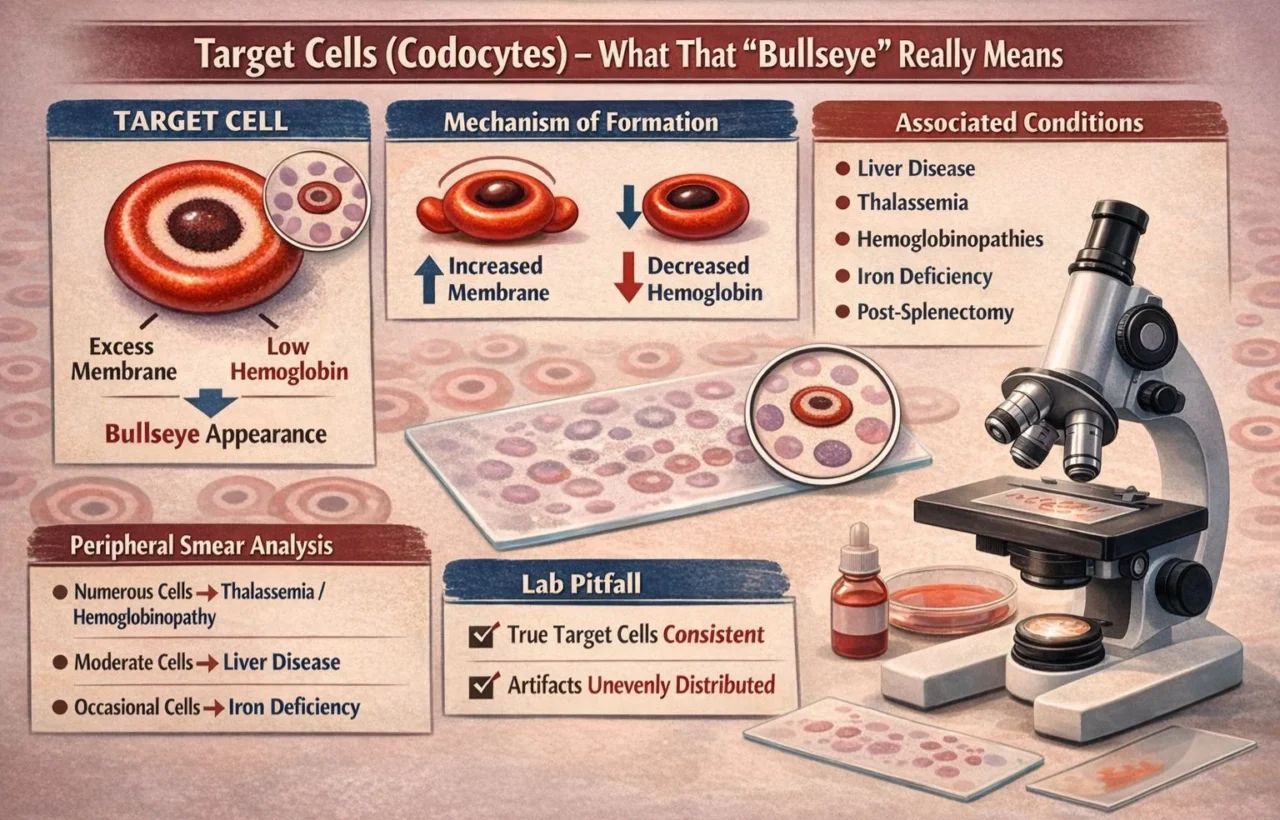
“Target cells (codocytes) – what that ‘bullseye’ really means
On a peripheral blood smear, some red blood cells display a distinctive central area of hemoglobin surrounded by a clear zone and a peripheral ring – giving a ‘bullseye’ appearance.
These are known as target cells (codocytes).
While visually striking, they are more than just morphology – they provide important diagnostic clues.
What Are Target Cells?
Target cells are red blood cells with excess membrane relative to cell volume.
This altered surface area-to-volume ratio causes hemoglobin to redistribute, forming the characteristic central staining pattern.
Mechanism of formation
Target cells form due to:
- Increased red cell membrane
or
- Reduced intracellular hemoglobin
This imbalance leads to folding of the membrane, producing the ‘target’ appearance.
Conditions associated with target cells
Target cells are seen in several clinical conditions, including:
- Liver disease – excess cholesterol incorporation into RBC membrane
- Thalassemia – reduced globin chain synthesis
- Hemoglobinopathies (e.g., HbS, HbC)
- Iron deficiency anemia (less prominent than in thalassemia)
- Post-splenectomy states
Peripheral smear clues
The pattern and abundance of target cells can guide diagnosis:
- Numerous target cells – think thalassemia or hemoglobinopathy
- Moderate numbers – consider liver disease
- Occasional cells – may be seen in iron deficiency
Always interpret alongside:
- RBC indices
- Clinical history
- Other smear findings
Laboratory pitfall
Target cells can sometimes be artifactual, especially in poorly prepared smears.
Key clue:
- True target cells are consistent across the smear
- Artifacts are irregular and unevenly distributed
Clinical significance
Target cells are not a diagnosis, they are a morphological signal.
Their presence should prompt evaluation for:
- Hemoglobin disorders
- Liver dysfunction
- Disorders of red cell production
Laboratory takeaway
When you see target cells, think in terms of membrane vs hemoglobin imbalance.
Morphology, when combined with laboratory data, becomes a powerful diagnostic tool.
When you see numerous target cells on a smear, do you first think thalassemia or liver disease?”
Other posts featuring Simon Senanu on Hemostasis Today.
-
Sep 19, 2026, 14:17Abdul Mannan: What Exactly Is a Platelet?
-
Sep 19, 2026, 13:39Keisuke Goda: Decoding Platelet Phenotypes in COVID-19 With Optofluidic Imaging
-
Sep 19, 2026, 13:30Targeted Thrombolysis Beyond tPA
-
Sep 19, 2026, 13:21Paul Armstrong: From Summer Studentship to Young Researcher
-
Sep 19, 2026, 13:06Rabiya Masood: Breaking the Cycle of Thalassemia Through Screening
-
Sep 19, 2026, 10:52Consuela A. Albright: The Critical Role of Black Blood Donors in Sickle Cell Treatment
-
Sep 19, 2026, 10:47Amber Yates: Inside Agios’ Partnership with the Sickle Cell Community
-
Sep 19, 2026, 10:46Anton Farkas: Mechanical Thrombectomy for Acute PE in Early Pregnancy
-
Sep 19, 2026, 10:40Marjolein Smidt: ASH Raises Ferritin Thresholds for Iron Deficiency