

Wolfgang Miesbach: Breakthrough in Haemophilia B Treatment
Wolfgang Miesbach, Professor of Medicine at Frankfurt University Hospital, shared a proud post on LinkedIn:
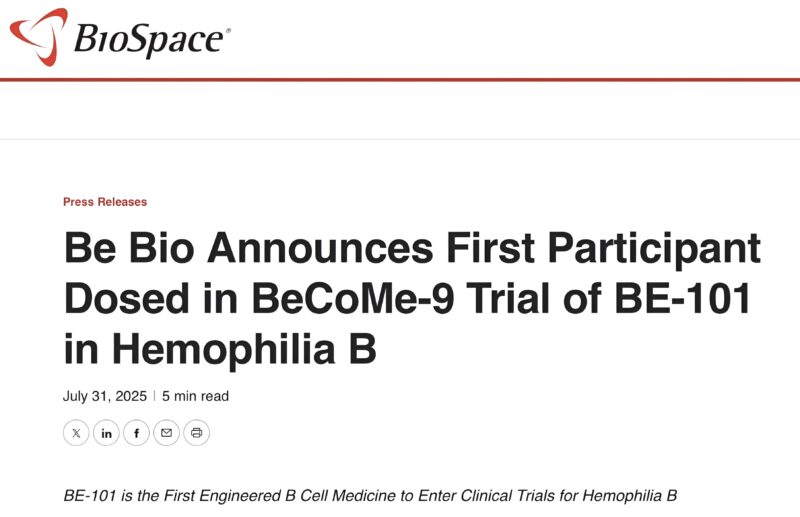
”Breakthrough in Haemophilia B Treatment: First-Ever Engineered B Cell Medicine Enters Clinical Trial. Be Biopharma has reached a historic milestone by dosing the first participant in their BeCoMe-9 Phase 1/2 trial of BE-101 – the world’s first Engineered B Cell Medicine (BCM) for haemophilia B.
This revolutionary approach may represent a paradigm shift from traditional gene therapy, offering unique advantages that could transform treatment for the 40,000 people living with this bleeding disorder globally.
What Makes BE-101 Different?
Unlike AAV-based gene therapies that deliver genes directly to the liver, BE-101 uses precision CRISPR/Cas9 gene editing to engineer the patient’s own B cells ex vivo to produce Factor IX.
These modified cells then function as living “protein factories” that can potentially:
- Produce therapeutic proteins for decades (B cells naturally live 10+ years)
- Be re-dosed and titrated as needed
- Engraft without toxic preconditioning unlike other cellular therapies
Current AAV-based haemophilia B gene therapies, while successful, face several challenges:
Known AAV Limitations:
– One-time only treatment due to neutralizing antibodies
– Pre-existing immunity excludes 40-60% of patients from treatment
– Declining efficacy over time – Factor IX levels can drop significantly
– Liver toxicity requiring immunosuppression in 17-89% of patients
– Limited cargo capacity restricting therapeutic options
– Only investigated and approved for the adult population
Potential BCM Advantages:
– Re-dosable and titratable – can adjust treatment as needed
– No preconditioning required – reduces treatment burden
– Sustained production – B cells can produce proteins for decades
– Potentially broader patient eligibility – not limited by AAV immunity or the age of the patients
Challenges Ahead:
While revolutionary, BCM therapy faces its own hurdles:
- Complex manufacturing requiring sophisticated cell culture and gene editing
- Unknown long-term durability compared to 13+ year AAV data
- Potential immune responses to engineered cells
- Manufacturing scalability for broader patient access.”
Wolfgang Miesbach gives a detailed review on BeCoMe-9 ,be sure to read the full article here.
Stay updated with the latest scientific advancements in the field of hemophilia with Hemostasis Today.
-
Oct 20, 2026, 05:46Jan T. Kielstein: DNP Poisoning and Hemoadsorption The Limits of Rescue Therapy
-
Oct 20, 2026, 05:33Giulia Di Paolo: Connecting Plasma Donation to the Patients Who Depend on It
-
Oct 20, 2026, 05:20James Knowles: Exploring Plasma Manufacturing and Strengthening Industry Collaboration
-
Oct 20, 2026, 05:11Giuseppe Lippi։ Understanding Liver Test Abnormalities After AAV Gene Therapy
-
Oct 20, 2026, 05:02Sanam Loghavi: Test Your Hematology Knowledge at ASH 2026!
-
Oct 20, 2026, 04:13Ifeanyichukwu Ifechidere: DOACs Are Not the Answer to Every Anticoagulation Question
-
Oct 20, 2026, 04:04Sadia Kamal: Honored to Receive the Outstanding Abstract Award at the 20th Midwest Platelet Conference
-
Oct 20, 2026, 04:03Yu-Hsuan Chen: One Antibody, Two Diseases from FcRn Biology to Clinical Translation
-
Oct 20, 2026, 03:49Domenico Simone Castiello: Rethinking Prolonged DAPT in Multivessel PCI – Insights from the DAPT-MVD Trial