


Ney Carter Borges: Syphilis and Cardiovascular Risk – A Silent and Progressive Vascular Burden
Ney Carter Borges, Member Cardiologist of Global Physician Association at Cleveland Clinic Florida, shared a post on LinkedIn about a recent article by Eli Tsakiris et al., published in JAMA Network Open:
“Syphilis and Cardiovascular Risk: A Silent and Progressive Vascular Burden
A large cohort study published in JAMA Network Open invites a shift in how we think about syphilis.
Rather than a disease limited to its infectious phase, it appears to behave – over time – as a silent and progressive vascular condition.
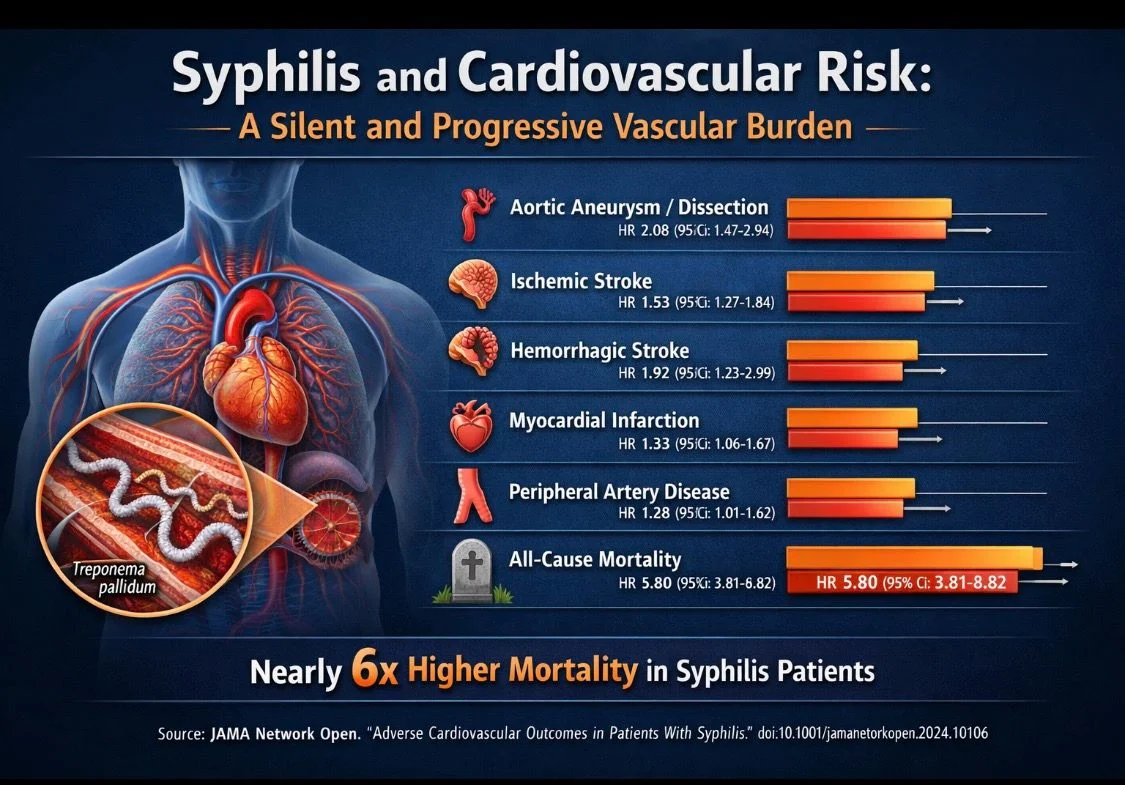
Following 8,814 individuals for nearly 15 years (including 1,469 with syphilis), the study shows a clear and clinically meaningful pattern: patients with syphilis face a higher burden of cardiovascular events.
The risk of aortic aneurysm or dissection was more than doubled (HR 2.08; 95% CI, 1.47–2.94).
Stroke risk was also significantly elevated, both ischemic (HR 1.53; 95% CI, 1.27–1.84) and hemorrhagic (HR 1.92; 95% CI, 1.23–2.99).
Myocardial infarction increased by about one-third (HR 1.33; 95% CI, 1.06–1.67), and peripheral artery disease followed a similar pattern (HR 1.28; 95% CI, 1.01–1.62).
What stands out most is the broader impact: overall mortality was nearly six times higher in individuals with syphilis (HR 5.80; 95% CI, 3.81–8.82).
This is not a subtle signal – it reflects a systemic process unfolding over years.
Yet, the story is not uniform.
In early stages, syphilis did not significantly increase cardiovascular risk.
The burden emerges later, suggesting a slow, cumulative vascular injury.
The underlying mechanism is biologically coherent: Treponema pallidum induces chronic inflammation, particularly targeting the small vessels that nourish arterial walls (vasa vasorum), leading to weakening, remodeling, and eventually serious complications like aneurysm or stroke.
From a clinical perspective, the message is straightforward but powerful: timing changes outcomes.
Detecting and treating syphilis early may not only control infection but also prevent long-term vascular damage.
Even acknowledging the observational nature of the data, the consistency and magnitude of these findings support a more vigilant cardiovascular approach in patients with a history of syphilis.”
Title: Adverse Cardiovascular Outcomes in Patients With Syphilis
Authors: Eli Tsakiris, Han Feng, Ghassan Bidaoui, Christian Massad, Janice Zha, Zhihao Wu, Yishi Jia, Yingshuo Liu, Hadi Younes, Yara Menassa, Michel Abou Khalil, Mayana Bsoul, Mohammad Montaser Atasi, Samer Zakhour, David Mushatt, Omar Kreidieh, Nassir F Marrouche, Amitabh C Pandey

Other posts featuring Ney Carter Borges on Hemostasis Today.
-
Oct 25, 2026, 13:0910 Posts Not to Miss This Week
-
Oct 25, 2026, 13:02Thomas Dayspring: Advancing Cardiovascular Risk Assessment Through Multidisciplinary Lipid Care
-
Oct 25, 2026, 12:46Ahmar U. Zaidi: RISE UP Study on Sickle Cell Disease
-
Oct 25, 2026, 10:32Jan Sloves: Advanced Venous Ultrasound Training in Poland
-
Oct 25, 2026, 10:20Jeff Sternlicht: Rethinking Cardiovascular Prevention Through Atherosclerosis Imaging
-
Oct 25, 2026, 10:12Dino Mehic: PhD Opportunity in Platelet Biology and Bleeding Disorders
-
Oct 25, 2026, 10:00Advancing Hemophilia Care Through Collaboration – WFH
-
Oct 25, 2026, 09:25Blood-Induced Joint Damage in Hemophilia: Beyond Recurrent Hemarthrosis
-
Oct 25, 2026, 05:30Denis Oduor: Whole Blood and Component Therapy in Clinical Practice