


Paul Bolaji: ACTIVATE Study in Ghana Demonstrates Over 400% Increase in Stroke Thrombolysis
Paul Bolaji, Education Lead (Stroke Services) at Dorset County Hospital NHS Foundation Trust, shared on LinkedIn about a recent article by Priscilla Abrafi Opare-Addo et al, published in Journal of Stroke and Cerebrovascular Diseases, adding:
”Intentional. Innovative. Introspective.
A phenomenal piece of implementation research by Dr Priscilla Abrafi Opare-Addo and team from Ghana demonstrating that acute stroke reperfusion therapies can indeed be improved in Low- and Middle-Income Countries when context-specific barriers are intentionally addressed.
Their ACTIVATE study achieved more than a 400% increase in thrombolysis rates in a tertiary hospital through a multipronged implementation strategy focused on:
- Stroke awareness campaigns
- Protocolised stroke interventions
- Multidisciplinary stroke teamwork
- Financial mitigation strategies
- Streamlined acute stroke pathways
Importantly, this was not merely a clinical intervention study it was implementation science in action: identifying contextual bottlenecks, understanding local realities, and designing pragmatic solutions tailored to the environment.
What stands out is the powerful message that improving acute reperfusion therapy in LMICs is not impossible.
- The barriers are real
- Delayed presentation,
- Limited imaging access,
- Workforce constraints,
- Financial toxicity,
- Fragmented pathways
but they are not insurmountable when tackled systematically.
Kudos to Dr Priscilla Abrafi Opare-Addo and the entire multidisciplinary team.
The hard work, systems thinking, and persistence behind this achievement truly show that this the kind of context-fit innovation and implementation research that Africa and indeed the wider LMIC community needs more of.”
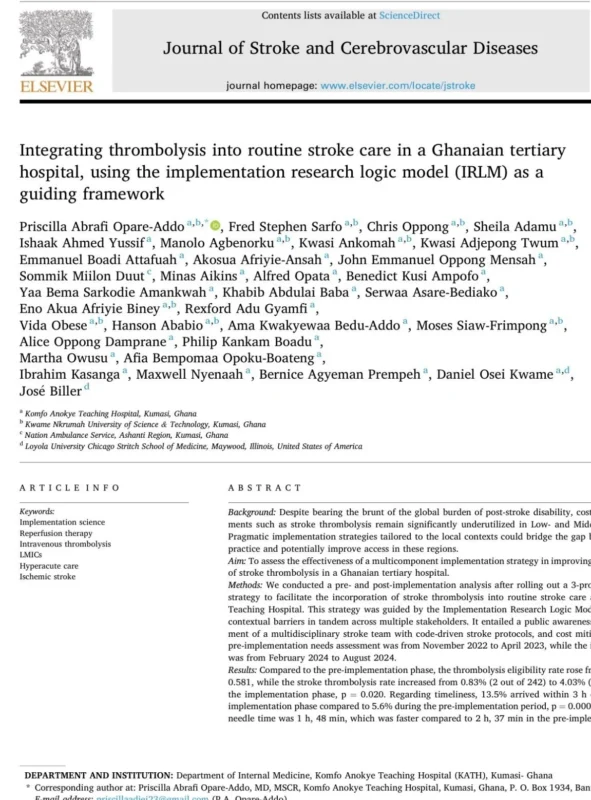
Title: Integrating thrombolysis into routine stroke care in a Ghanaian tertiary hospital, using the implementation research logic model (IRLM) as a guiding framework
Authors: Priscilla Abrafi Opare-Addo, Fred Stephen Sarfo, Chris Oppong, Sheila Adamu, Ishaak Ahmed Yussif, Manolo Agbenorku, Kwasi Ankomah, Kwasi Adjepong Twum, Emmanuel Boadi Attafuah, Akosua Afriyie-Ansah, John Emmanuel Oppong Mensah, Sommik Miilon Duut, Minas Aikins, Alfred Opata, Benedict Kusi Ampofo, Yaa Bema Sarkodie Amankwah, Khabib Abdulai Baba, Serwaa Asare-Bediako, Eno Akua Afriyie Biney, Rexford Adu Gyamfi, José Biller
Stay updated on all scientific advances with Hemostasis Today.
-
Oct 9, 2026, 16:23David Boone: Distinguishing Stroke Prevention from Rhythm Control in Atrial Fibrillation
-
Oct 9, 2026, 15:27Mohamed Hegazi: Geostatistical Modelling Maps Global β-Thalassaemia Carrier Prevalence
-
Oct 9, 2026, 15:15Maha Othman: Uncovering the Consensus on TXA in TBI – Call for Collaboration on a Landmark Umbrella Review
-
Oct 9, 2026, 15:07Daniel D. Han: How Inhalation Product Exposure Impairs Cardiac and Platelet Recovery After MI
-
Oct 9, 2026, 14:58William Toole: How Ultrasound-Guided PRP Therapy Relieves Joint and Tendon Pain
-
Oct 9, 2026, 14:50Shayan Mohammadmoradi: In Corpus Christi for the 20th Midwest Platelet Conference
-
Oct 9, 2026, 14:37Tariq Tramboo: High Platelet Concentrate for Osteoarthritis Knee – Recent Meta-Analyses
-
Oct 9, 2026, 14:26Yousma Khan: Hematology Series – Beyond RBCs, WBCs and Platelets
-
Oct 9, 2026, 14:13Jesus Ardila Novoa: Why the WHO’s Historic Essential Medicines List Decision Is Just the Beginning