


Simon Kraler and Colleagues’ New Work on JCAD: Targeting Impaired Fibrinolysis to Address Post-ACS Residual Risk
Simon Kraler, ESC Young Cardiovascular Professionals Committee Member at European Society of Cardiology, posted on LinkedIn:
“Residual risk: is it time to move beyond LDL-c and inflammation?
Despite guideline-directed lipid lowering and anti-inflammatory therapy, patients with a recent ACS remain at 𝐯𝐞𝐫𝐲 𝐡𝐢𝐠𝐡 𝐢𝐬𝐜𝐡𝐚𝐞𝐦𝐢𝐜 𝐫𝐢𝐬𝐤.
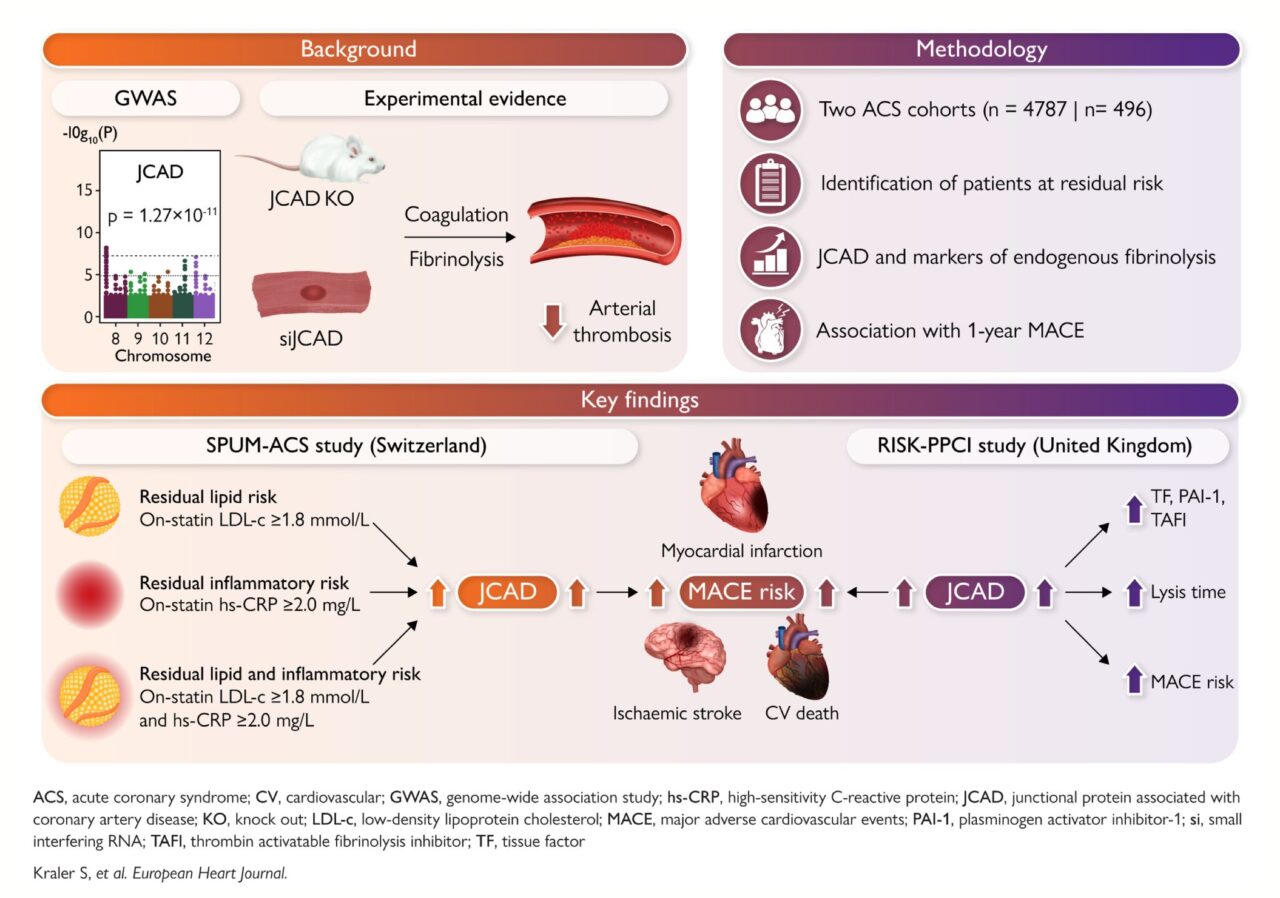
Based on GWAS and mechanistic data, we hypothesized that JCAD (‘Junctional Protein Associated with Coronary Artery Disease’) on chromosome 10 might represent the missing link.
In our newly published European Heart Journal study, JCAD independently predicted 1-year MACE in patients with residual lipid risk, inflammatory risk, or both – notably independent of LDL-c and hs-CRP
JCAD = impaired endogenous fibrinolysis and high MACE risk, with similar results obtained during external validation.
JCAD may represent a novel therapeutic target to address residual risk after a recent ACS.
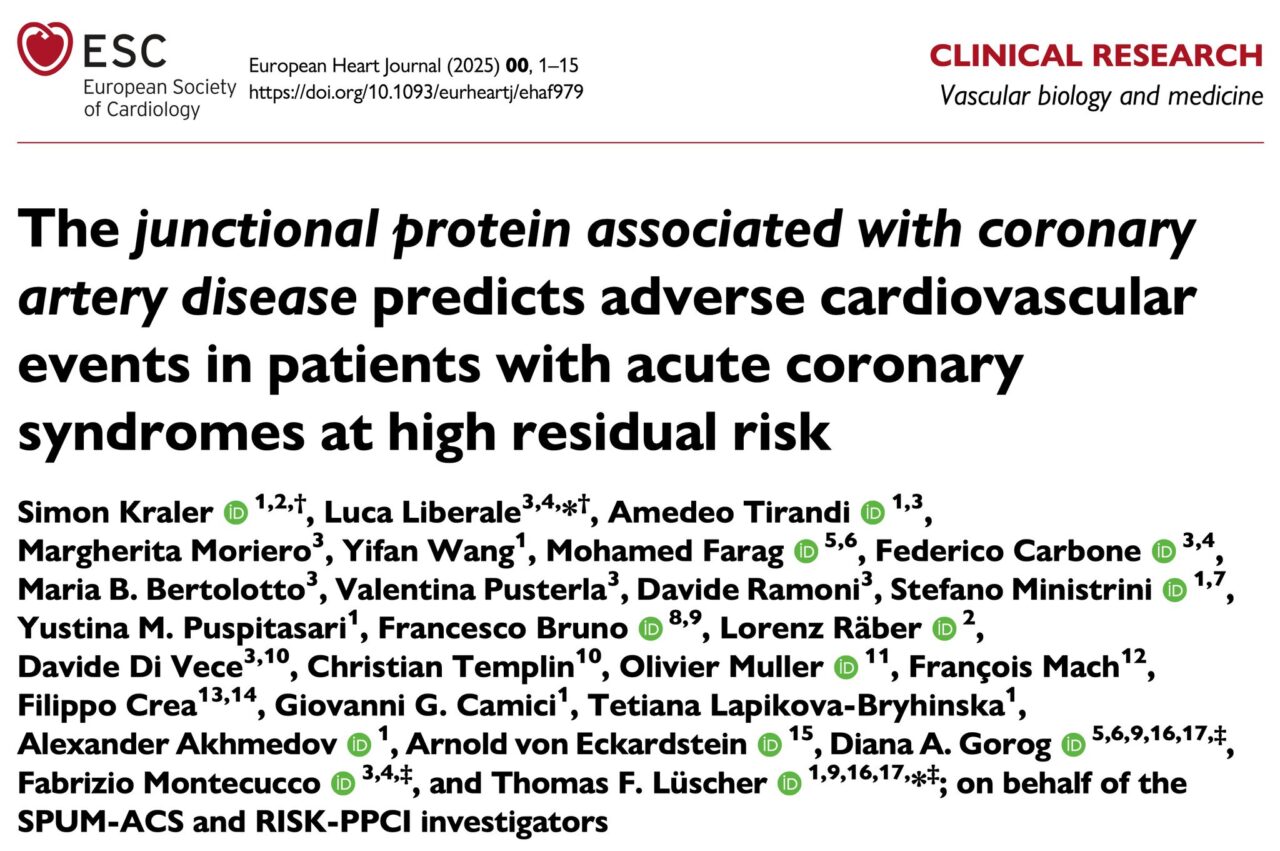
Title: The junctional protein associated with coronary artery disease predicts adverse cardiovascular events in patients with acute coronary syndromes at high residual risk
Authors: Simon Kraler, Luca Liberale, Amedeo Tirandi, Margherita Moriero, Yifan Wang, Mohamed Farag, Federico Carbone, Maria B Bertolotto, Valentina Pusterla, Davide Ramoni, Stefano Ministrini, Yustina M Puspitasari, Francesco Bruno, Lorenz Räber, Davide Di Vece, Christian Templin, Olivier Muller, François Mach, Filippo Crea, Giovanni G Camici, Tetiana Lapikova-Bryhinska, Alexander Akhmedov, Arnold von Eckardstein, Diana A Gorog, Fabrizio Montecucco, Thomas F Lüscher
Special thanks to the colleagues and friends at University of Genoa, King’s College London, University of Zurich, CHUV | Lausanne university hospital, Universitätsspital Zürich, HUG – Hopitaux Universitaires de Genève and Insel Gruppe.
Thank you Thomas F. Lüscher, Luca Liberale, Giovanni G Camici, Diana Gorog, Lorenz Räber, Davide Di Vece, Yifan Wang, Francesco Bruno and all!”
Discover the latest in Hemostasis Today.
-
Oct 7, 2026, 16:44Amor Salah: 2026 NCS/SCCM Guidelines for Managing Antithrombotic-Associated ICH
-
Oct 7, 2026, 16:04NETs in Thrombosis: From Mechanism to Therapeutic Target
-
Oct 7, 2026, 15:28Amir Samimi: Prognostic Value of Platelet Count in Resected HNSCC
-
Oct 7, 2026, 15:21Eloïse Laouenan: Bridging Immunity and Thrombosis in MVTE
-
Oct 7, 2026, 15:10Uthra Sundaram: Honouring Donors During International Plasma Awareness Week
-
Oct 7, 2026, 15:04Daniel Victor Ortigoza: Should Frail Older Patients With AF Switch From VKA to DOACs?
-
Oct 7, 2026, 14:53Susan Noone: Donor Turned Recipient Shares Lifesaving Transfusion Story
-
Oct 7, 2026, 14:49Aimee Burtenshaw: The Impact of the Infected Blood Inquiry on Hospital Transfusion Laboratories
-
Oct 7, 2026, 14:41Vikash Jaiswal: Does Timing Matter for Calcium in Pre-Eclampsia Prevention?