


Pooja Choradia/Instagram
Apr 7, 2026, 16:40
Pooja Choradia: Understanding Consumption Coagulopathy in Acute Pulmonary Embolism
Pooja Choradia, Critical care associate at P.D. Hinduja Hospital Khar, shared a post on LinkedIn:
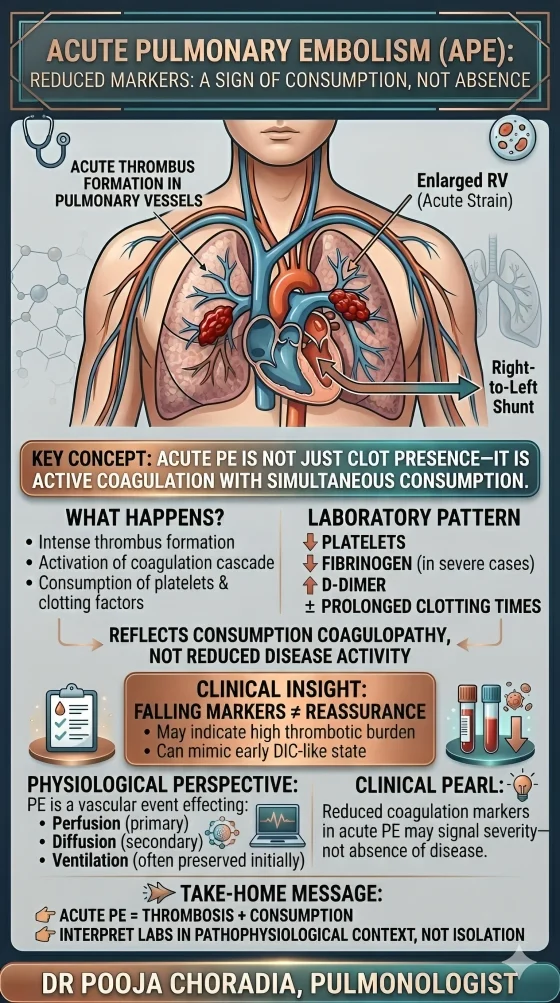
”Acute Pulmonary Embolism: Reduced Markers — A Sign of Consumption, Not Absence
Key Concept: Acute pulmonary embolism (PE) is not just clot presence — it is active coagulation with simultaneous consumption.
What Happens:
- Intense thrombus formation in pulmonary vessels
- Activation of the coagulation cascade
- Consumption of platelets and clotting factors
Laboratory Pattern:
- Low platelets
- Low fibrinogen (in severe cases)
- High D-dimer
- Possibly prolonged clotting times
Reflects consumption coagulopathy, not reduced disease activity
Clinical Insight:
- Falling markers do not reassurance
- May indicate high thrombotic burden
- Can mimic early DIC-like state
Physiological Perspective:
PE is a vascular event affecting:
- Perfusion (primary)
- Diffusion (secondary)
- Ventilation (often preserved initially)
Clinical Pearl:
Reduced coagulation markers in acute PE may signal severity, not absence of disease
Take-Home Message:
- Acute pulmonary embolism involves both thrombosis and consumption
- Interpret labs in pathophysiological context, not in isolation”
Stay updated with Hemostasis Today.
-
Oct 13, 2026, 02:01Nour Al-Mozain: Is It Really Anti-D? – Unraveling Auto-Anti-LW in the Transfusion Laboratory
-
Oct 13, 2026, 01:51Berenice Villegas: The Role of Morphologic Evaluation in Body Fluid Differential Analysis
-
Oct 13, 2026, 01:44Debadrita Ray: Evaluating vWF and VITRO Score for Detecting CSPH in cACLD Patients
-
Oct 13, 2026, 01:34Nagesh Ramesh: Donating Blood for International Plasma Awareness Week
-
Oct 12, 2026, 21:51Sam Botchey: Orthobiologics Are Advancing but the Evidence Must Keep Pace
-
Oct 12, 2026, 21:50Serum Vitamin D, Platelet Function, and Bleeding in Primary ITP – Platelets Journal
-
Oct 12, 2026, 21:30Nika Samadzadeh Tabrizi: Looking Forward to the PACeS Trial on Anticoagulation for POAF
-
Oct 12, 2026, 21:28Michael Megaly: Does Coronary Ectasia Affect Outcomes in Acute Coronary Syndromes?
-
Oct 12, 2026, 21:25Vitor Borin P. de Souza: Think Twice Before Anticoagulating an Isolated Subsegmental PE