

Mosa Safi/LinkedIn
May 21, 2026, 13:08
Mosa Safi: Updated TXA Recommendations in Tactical Combat Casualty Care
Mosa Safi, Senior Medical Instructor at Prometheus Medical International, shared a post on LinkedIn:
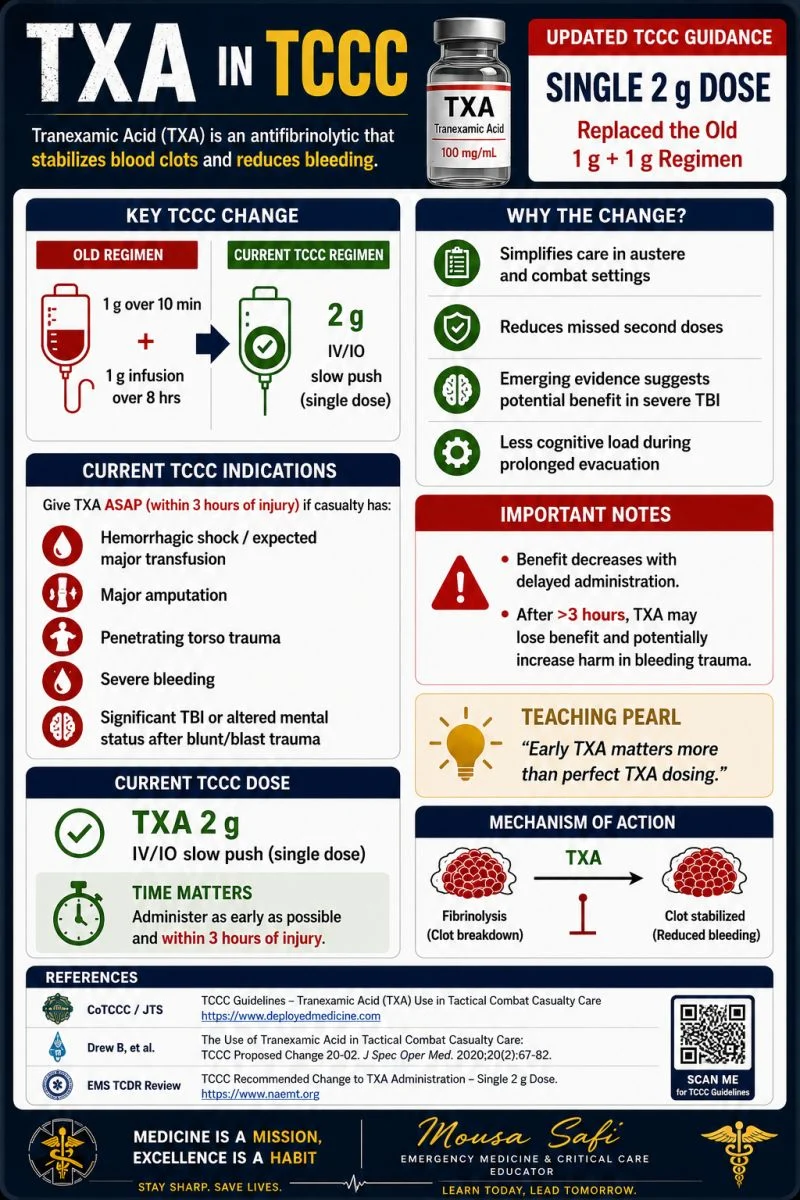
“Tranexamic Acid (TXA) is now given as a single 2 g slow IV/IO push, replacing the older protocol of 1 g over 10 min and 1 g infusion over 8 hrs.
Current TCCC indications
Give TXA ASAP (within 3 hours of injury) if casualty has:
- Hemorrhagic shock / expected major transfusion
- Major amputation
- Penetrating torso trauma
- Severe bleeding
- Significant TBI or altered mental status after blunt/blast trauma.
Current TCCC Dose
TXA 2 g IV/IO slow push (single dose)
Why the change?
- Simplifies care in austere/combat settings
- Reduces missed second doses
- Emerging evidence suggests potential benefit in severe TBI
- Less cognitive load during prolonged evacuation
Important
Benefit decreases with delayed administration.
After more than 3 hours, TXA may lose benefit and potentially increase harm in bleeding trauma.
Teaching pearl
‘Early TXA matters more than perfect TXA dosing.’
Bottom line
- TCCC moved from 1 g and 1 g infusion – single 2 g TXA dose
- Include severe TBI among TXA indications
- Administer as early as possible and within 3 hours of injury.”
Stay updated with Hemostasis Today.
-
Oct 8, 2026, 17:00Sally Mandour: Platelet Size And Shape Can Reveal The Diagnosis
-
Oct 8, 2026, 16:49Neil Morgan: Advancing Understanding Of Bleeding Disorders Of Unknown Cause
-
Oct 8, 2026, 16:38Beverley Hunt: Advancing Pulmonary Embolism Care Through Collaboration And Learning
-
Oct 8, 2026, 16:19Cedric Hermans: Six Webinars Advancing Haemophilia Care And Beyond
-
Oct 8, 2026, 16:09Luana Banu: Every Donation Connects A Human Chain
-
Oct 8, 2026, 15:51Khaled Musallam: A New Era In Thalassemia Care
-
Oct 8, 2026, 15:40Juan J. Ortiz։ Catheter Directed Therapy In Pulmonary Embolism
-
Oct 8, 2026, 15:34Petros Kountouris: Geostatistical Modelling Maps Global β-Thalassaemia Carrier Prevalence
-
Oct 8, 2026, 15:14Renzo Mancuso: Human Stem Cell Model Reveals Progenitor Fate in Tissue Macrophages