


Hemanth Kumar Manikyam: The Complex Immunology Behind Platelet Destruction in ITP
Hemanth Kumar Manikyam, Vice President of Research And Development at Botanic Healthcare, Visiting Professor at Chalapathi Institute of Pharmaceutical Sciences, Lam, shared a post on LinkedIn:
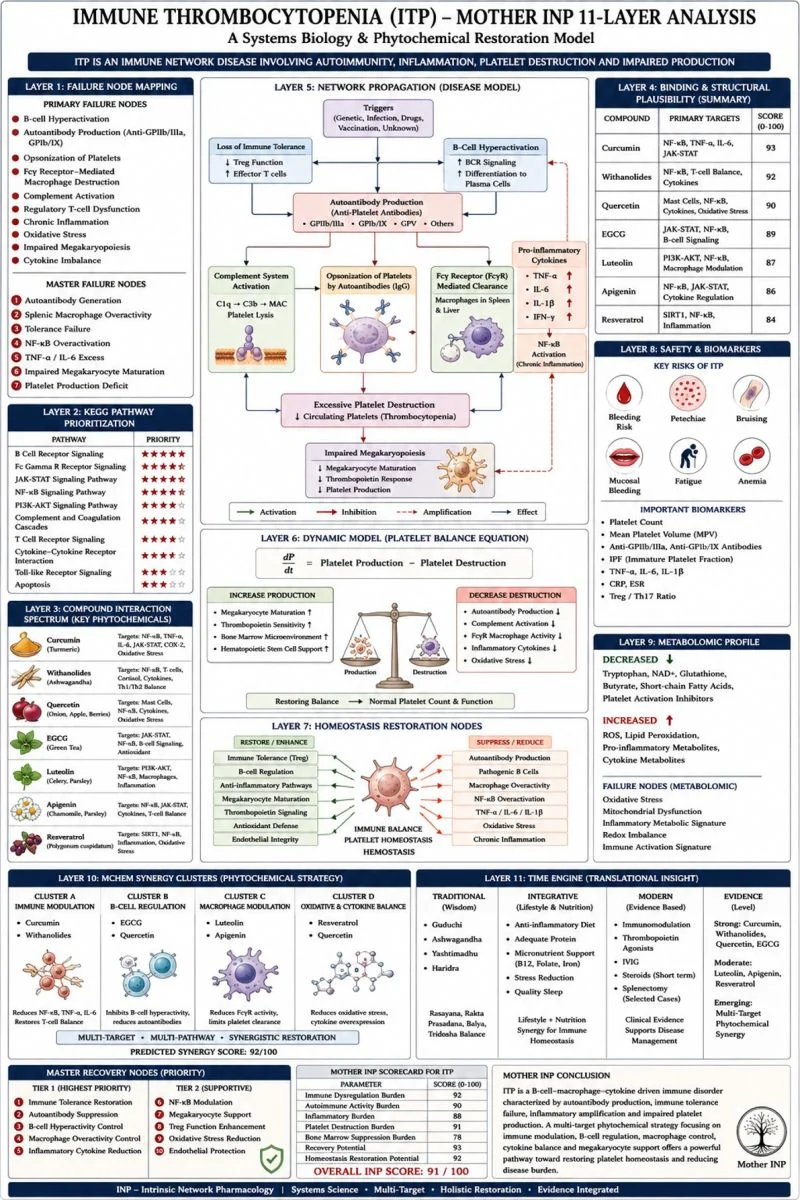
“Immune thrombocytopenia (ITP): A B-cell-macrophage immune network disorder?
Insights from Mother INP 11-Layer Analysis.
Immune Thrombocytopenia (ITP) is commonly described as a low platelet disorder.
However, our Mother INP 11-Layer analysis suggests that ITP is fundamentally an immune network disease involving autoantibody production, immune tolerance failure, chronic inflammation, excessive macrophage activity, and impaired platelet regeneration.
The primary failure nodes identified include:
- B-cell hyperactivation
- Autoantibody production against platelet glycoproteins
- Regulatory T-cell dysfunction
- Splenic macrophage overactivity
- NF-κB activation
- TNF-α and IL-6 elevation
- Megakaryocyte dysfunction
KEGG pathway prioritization highlighted B-cell receptor signaling, Fcγ receptor signaling, JAK-STAT, NF-κB, PI3K-AKT, complement activation, and cytokine-mediated immune pathways as key drivers of disease progression.
Using the Mother INP Engine, several phytochemicals emerged as high-priority restoration molecules.
Curcumin demonstrated broad immune-modulating effects through NF-κB, TNF-α, and IL-6 regulation.
Withanolides from Ashwagandha showed potential to support immune homeostasis and reduce inflammatory burden.
Quercetin demonstrated activity across cytokine signaling, oxidative stress reduction, and immune regulation pathways.
EGCG exhibited interactions with JAK-STAT and inflammatory signaling networks while supporting antioxidant defense systems.
The highest-priority recovery nodes identified were:
- Immune tolerance restoration
- Reduction of autoantibody formation
- Regulation of B-cell activity
- Suppression of excessive macrophage-mediated platelet destruction
- NF-κB modulation
- Cytokine balance restoration
- Support of megakaryocyte maturation
Network propagation analysis suggests that platelet destruction is not an isolated event but a downstream consequence of a larger immune signaling imbalance involving B cells, T cells, macrophages, cytokines, and inflammatory mediators.
The most promising phytochemical restoration cluster identified through the Mother INP framework was:
Epicatechin plus Curcumin plus Withanolides plus Quercetin plus EGCG working across multiple immune and inflammatory nodes simultaneously.
Mother INP Conclusion:
ITP is not simply a platelet deficiency disorder.
It is a systems-level immune dysregulation syndrome driven by immune tolerance failure, autoantibody production, inflammatory signaling, and hematological imbalance.”
Stay updated with Hemostasis Today.
-
Oct 20, 2026, 06:45Grant Garcia: Why Does a Blood Clot Diagnosis Immediately End an Athlete’s Season?
-
Oct 20, 2026, 06:35Parag Tamhankar: Landmark Study Reveals Genetic Spectrum and Targeted Therapies for ALPS in the Indian Population
-
Oct 20, 2026, 06:26Nina Houben: Neonatal Blood Transfusion Symposium and PhD Defense
-
Oct 20, 2026, 05:46Jan T. Kielstein: DNP Poisoning and Hemoadsorption The Limits of Rescue Therapy
-
Oct 20, 2026, 05:33Giulia Di Paolo: Connecting Plasma Donation to the Patients Who Depend on It
-
Oct 20, 2026, 05:20James Knowles: Exploring Plasma Manufacturing and Strengthening Industry Collaboration
-
Oct 20, 2026, 05:11Giuseppe Lippi։ Understanding Liver Test Abnormalities After AAV Gene Therapy
-
Oct 20, 2026, 05:02Sanam Loghavi: Test Your Hematology Knowledge at ASH 2026!
-
Oct 20, 2026, 04:13Ifeanyichukwu Ifechidere: DOACs Are Not the Answer to Every Anticoagulation Question