

Shadi Tabibian։ Women and Girls with Hemophilia Should Not Be Invisible in Hemophilia Care
Shadi Tabibian, Deputy of research at Blood Diseases Research Centers in Iran University of Medical Sciences, shared a post on LinkedIn about a recent article by Lakshmi Srivaths et al., published in Journal of Thrombosis and Haemostasis, adding:
”Women and girls with hemophilia should not be invisible in hemophilia care.
For many years, the diagnosis of females with F8 or F9 variants has often stopped at the word ‘carrier’. But this label alone does not adequately reflect bleeding risk, factor level, clinical phenotype, or the need for structured care.
The new ISTH SSC guidance emphasizes a more precise and equitable approach:
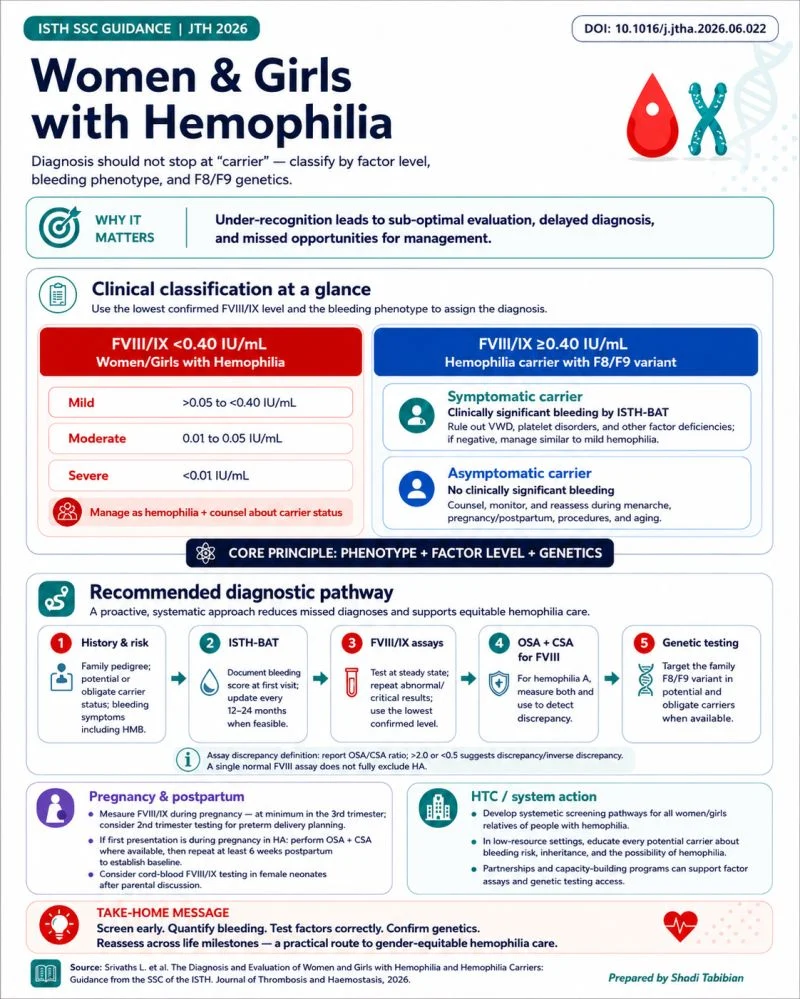
Diagnosis and classification should be based on the combination of:
bleeding phenotype plus lowest confirmed FVIII/FIX level plus F8/F9 genetics
This is an important shift in how we recognize, evaluate, and manage women and girls affected by hemophilia.
Key points highlighted in the guidance include:
- Women and girls with FVIII/FIX levels below 0.40 IU/mL should be classified according to hemophilia severity.
- Symptomatic carriers with normal or near-normal factor levels still require careful bleeding assessment and appropriate management.
- ISTH-BAT can help document bleeding phenotype systematically.
- FVIII testing may require both one-stage assay and chromogenic substrate assay when discrepancy is suspected.
- Genetic testing is essential when available, especially for family variant confirmation, counseling, and reproductive planning.
- Evaluation should not be limited to one life stage; reassessment is important around menarche, pregnancy, postpartum, procedures, and aging.
Under-recognition of women and girls with hemophilia leads to delayed diagnosis, suboptimal evaluation, and missed opportunities for prevention and management.
This guidance is a reminder that hemophilia care must be gender-equitable, phenotype-driven, and genetically informed.
Screen early. Quantify bleeding. Test correctly. Confirm genetics.
Women and girls deserve the same precision in hemophilia diagnosis and care.”
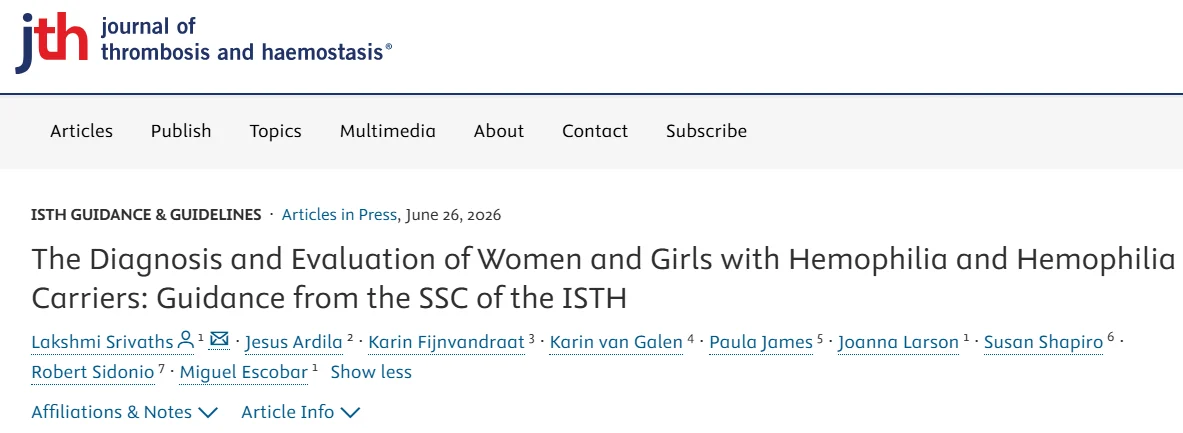
Title: The Diagnosis and Evaluation of Women and Girls with Hemophilia and Hemophilia Carriers: Guidance from the SSC of the ISTH
Authors: Lakshmi Srivaths, Jesus Ardila, Karin Fijnvandraat, Karin van Galen, Paula James, Joanna Larson, Susan Shapiro, Robert Sidonio, Miguel Escobar
Other posts featuring Shadi Tabibian on Hemostasis Today.
-
Oct 10, 2026, 17:58Archo Farzana Batool: Exploring Medical Writing Through an Article on Iron Deficiency Anemia
-
Oct 10, 2026, 17:53Assessing Frailty in Adults With Hemophilia – JTH
-
Oct 10, 2026, 17:52Fatma Sadeghi: Reducing Maternal Health Inequalities Through Nursing Advocacy
-
Oct 10, 2026, 17:50Grzegorz Hensler: How Apheresis Transformed Blood Cell Separation and Collection
-
Oct 10, 2026, 17:47Hemant K Sharma: Japan’s Universal Artificial Blood Research – A Potential Breakthrough in Transfusion Medicine
-
Oct 10, 2026, 17:40John Strouse: Learning About Bleeding Disorders and Sickle Cell Disease at FWGBD
-
Oct 10, 2026, 17:34Mae Caime: Speaking at the Annual Women’s Retreat for the Hemophilia Community in Florida
-
Oct 10, 2026, 17:30Chokri Ben Lamine: PNH beyond the Textbook Triad
-
Oct 10, 2026, 17:29Ruah Alyamany: Thrombosis and Anticoagulation in Hematological Malignancies at SOHO KSA 2026